Key figures: James Watt, Matthew Boulton, Oliver Evans, Dutch millwrights, Richard Arkwright
Summary
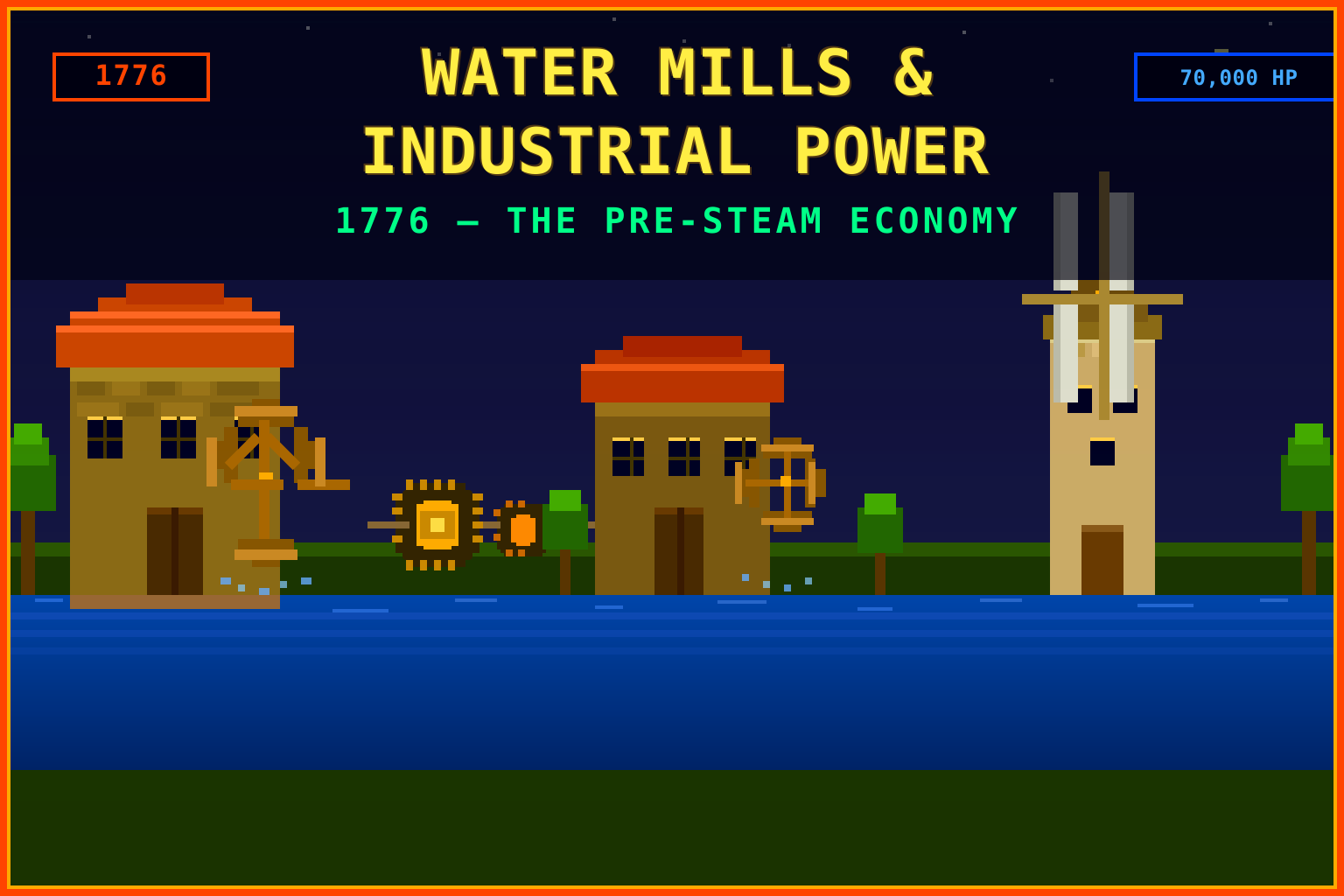
As James Watt’s steam engine began commercial operation in 1776, the world’s productive capacity still rested overwhelmingly on water power. Across Europe and America, water-powered mills defined the geography of industry: towns and manufactories clustered on riverbanks and streams where falling water could turn wheels and drive machinery. Textile mills, grain mills, sawmills, forges, and paper mills all depended on hydraulic force transmitted through complex systems of gears, shafts, and levers.
In colonial America, mill construction and ownership represented significant capital investment and marked the difference between subsistence and commercial agriculture. A farmer or merchant who controlled mill access controlled local economic power. The Netherlands maintained roughly 10,000 wind and water mills by the mid-18th century — a density unmatched in the world — while Britain’s mill-rich regions (Lancashire, Yorkshire, the Midlands) were beginning their concentration of textile production. Estimates suggest that by 1776, water wheels in England alone generated the equivalent of roughly 70,000 horsepower of continuous mechanical energy, dwarfing early steam output.
Water power’s limits, however, were already apparent in 1776. Mills could not be relocated to labor-abundant cities or coal fields; production was constrained by seasonal water availability and geography; and the British cotton industry’s explosive growth threatened to outpace water-power capacity. Oliver Evans in America and other engineers were experimenting with mechanical innovations — automated grain mills, more efficient gearing — that squeezed more productivity from water wheels.
How Water Mills Operated
The overshot wheel, dominant in hilly British regions, captured falling water at the wheel’s top, using gravity as the primary motive force and achieving efficiencies of 60–75 percent. The undershot wheel, suited to low-gradient streams, relied on current velocity, typically achieving only 20–30 percent efficiency. By the 1770s, millwrights such as John Smeaton had applied systematic experiments to wheel design, demonstrating that overshot wheels outperformed undershot models by a factor of three or more — a finding published in the Philosophical Transactions of the Royal Society (1759) that slowly propagated into millwright practice.
Inside the mill, water-wheel rotation was converted through wooden or iron gearing into the motion needed to drive millstones, hammer forge presses, or spinning frames. Richard Arkwright’s water-powered spinning mill at Cromford, Derbyshire — opened in 1771 — represented the state of the art in 1776: a multi-story factory employing hundreds of workers and driven by the River Derwent, producing cotton yarn at volumes impossible to hand-spin. Arkwright’s mill directly inspired Adam Smith’s observations on the division of labor and the factory system in The Wealth of Nations, published in 1776.
Colonial American Mill Economy
By 1776, the thirteen colonies contained an estimated 2,000 to 2,500 water-powered grist mills and hundreds of sawmills, fulling mills, and forge hammers. New England’s fast-running streams — particularly in Connecticut, Rhode Island, and Massachusetts — supplied abundant hydraulic power. Pennsylvania’s numerous mill sites on the Schuylkill, Delaware, and their tributaries made the colony a leader in flour production for Atlantic trade; Philadelphia merchants exported millions of barrels annually to the Caribbean and southern Europe, with milling profits underpinning some of the colony’s most significant commercial fortunes.
The Continental Congress’s management of wartime finance depended partly on this productive capacity: grain ground at colonial mills fed Continental Army troops, and Philadelphia’s commercial mills supplied flour for export that generated hard currency the Congress desperately needed. Disruptions to mill operations — whether from British occupation, drought, or ice — had immediate military as well as economic consequences.
The Steam Engine’s Challenge
Watt’s partnership with Birmingham manufacturer Matthew Boulton produced the first commercially leased Boulton & Watt engine in 1776, installed at a Staffordshire mine. The engine generated approximately 30 horsepower — modest by industrial standards — but crucially it could be placed anywhere coal was available rather than where rivers ran. Watt’s separate condenser design, patented in 1769 and refined throughout the early 1770s, reduced coal consumption by roughly 75 percent compared with earlier Newcomen engines, making steam economically viable for sustained industrial use.
The displacement of water by steam unfolded gradually: Britain’s water-powered cotton mills actually continued to multiply through the 1790s even as steam engines proliferated. But the geographical logic shifted. Steam allowed factories to concentrate in cities like Manchester and Birmingham, close to coal, markets, and workers, rather than dispersing along riverbanks. By 1800, Boulton & Watt alone had supplied more than 450 engines to British industry; the water-mill economy that had dominated 1776 was already giving way.
Significance
Water power’s dominance in 1776 reveals an economic system at a civilizational turning point. The mill-based economy had sustained medieval and early-modern growth, but it imposed geographic fragmentation and seasonal constraints incompatible with the expanding colonial trade networks and factory systems emerging in the 1770s. Watt’s steam engine’s entry into commercial use in 1776 was not an overnight revolution — water power remained significant well into the 19th century — but it established the technological possibility of breaking water power’s geographic monopoly.
The mills of 1776 were simultaneously the peak of water-power civilization and harbingers of an order being superseded. Understanding 1776 requires grasping this dual character: the economy of water mills and the economy of steam power coexisted, with Watt’s engine tipping the balance toward industrial modernity. Adam Smith’s Wealth of Nations, published the same year, analyzed the factory and the division of labor just as those forms were becoming technologically unconstrained by geography — a convergence that made 1776 a unique threshold in economic history.
Related Topics
Sources
- James Watt and the Steam Engine — Encyclopedia Britannica
- Richard Arkwright and the Water Frame — Encyclopedia Britannica
- John Smeaton, “An Experimental Enquiry Concerning the Natural Powers of Water and Wind” — Philosophical Transactions of the Royal Society, 1759 (via JSTOR)
- Oliver Evans and American Milling Innovation — JSTOR Archive
- Industrial Revolution and Water Power — Library of Congress History Collections