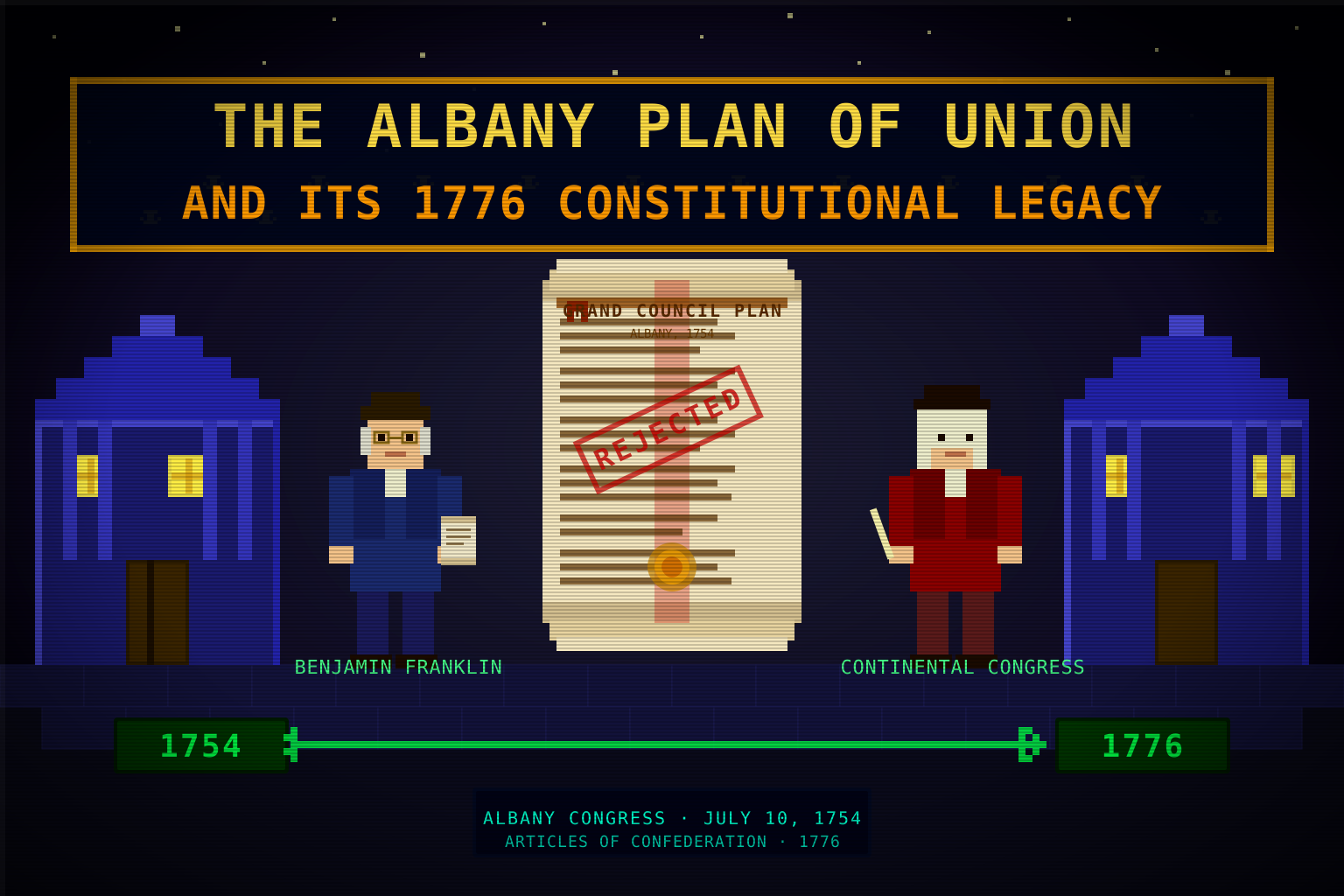
Key figures: Benjamin Franklin, John Dickinson, Thomas Hutchinson, Continental Congress delegates
Summary
The Albany Plan of Union (1754) was a visionary but failed proposal to unite the British North American colonies under a federal structure with a common “Grand Council” (an inter-colonial assembly) and a royally appointed “President-General” serving as executive. Benjamin Franklin championed the plan at the Albany Congress (June 19–July 11, 1754), convened to coordinate colonial defense against French expansion in the Ohio Valley during the opening phase of the Seven Years’ War (known in North America as the French and Indian War). The plan was accepted by the Albany Congress on July 10, 1754, but was subsequently rejected by every colonial legislature—which feared centralized colonial authority as a threat to their individual autonomy—and by the British Crown, which viewed any inter-colonial political body as a dangerous precedent for self-governance.
The Albany Plan’s failure left the colonies without a federal coordination mechanism for over two decades. When that coordination became urgently necessary during the Revolutionary crisis, colonial leaders had to improvise from scratch—and the institutional solutions they reached in 1775–1776 closely echoed the structure Franklin had proposed in 1754. John Dickinson’s draft of the Articles of Confederation, presented to the Continental Congress on July 12, 1776, proposed a “Congress of the United States” composed of state delegates with powers over foreign affairs, defense, and inter-state disputes but no direct taxation authority—a structure that paralleled the Albany Plan’s Grand Council model in key respects, with its own executive gap (no President-General equivalent) and its own limits on central power.
Franklin himself, serving in the Continental Congress through much of 1776, would have recognized the family resemblance between his 1754 proposal and the confederation framework being debated. He was among the members appointed to the committee that revised Dickinson’s draft Articles beginning in August 1776.
The Albany Congress of 1754: Structure and Failure
The Albany Congress assembled twenty-four delegates from seven colonies (Massachusetts, New York, Pennsylvania, Maryland, Connecticut, Rhode Island, and New Hampshire) between June 19 and July 11, 1754. The immediate occasion was to negotiate a treaty with the Iroquois Confederacy (Haudenosaunee), whose military cooperation was needed against France. But the deeper agenda—unity for defense—produced Franklin’s plan.
Key provisions of the 1754 Albany Plan:
- A Grand Council of 48 representatives, apportioned among colonies by their tax contributions to the common treasury
- A President-General appointed by the Crown to serve as chief executive and hold veto power over the Grand Council
- Authority over Indian affairs, frontier defense, and taxation for common defense purposes
- No authority over internal colonial affairs, preserving most colonial self-government
The plan was explicitly not a step toward independence—it preserved royal appointment of the executive and Crown oversight. Its failure illustrated the paradox of colonial politics: colonies that would not cooperate voluntarily could not be forced to do so by the Crown without risking the very centralization colonists most feared.
Thomas Hutchinson, then Lieutenant Governor of Massachusetts (later a Loyalist governor), participated in the Albany Congress and later wrote that both the colonial rejection and the royal rejection stemmed from the same anxiety: each side worried the plan gave too much to the other.
Franklin’s 1775–1776 Return to Federalism
Benjamin Franklin returned to Philadelphia from his decade-long mission in London in May 1775, just weeks after the Battles of Lexington and Concord. Within days he was elected to the Second Continental Congress. By July 21, 1775—still a year before independence—Franklin submitted to Congress his own “Articles of Confederation and Perpetual Union,” the first formal confederation proposal of the Revolution. This draft, known as the Franklin Articles, proposed:
- A perpetual union of colonies, each retaining internal sovereignty
- A Congress empowered to declare war, make treaties, manage Indian affairs, and establish a postal service
- Voting by proportional representation (weighted by population), not equal state votes
- Revenues raised by a common treasury, apportioned by population
Congress tabled the Franklin Articles as premature (independence had not yet been declared), but they directly influenced the committee charged with drafting the Articles of Confederation after independence, which began work in June 1776. See also: Benjamin Franklin in 1776.
Dickinson’s 1776 Draft: The Albany Parallels
John Dickinson chaired the committee tasked with producing a confederation document and submitted a draft on July 12, 1776—eight days after the Declaration of Independence. His draft Articles of Confederation shared structural features with the 1754 Albany Plan:
| Feature | Albany Plan (1754) | Dickinson Articles (1776) |
|---|---|---|
| Legislature | Grand Council, 48 seats, apportioned by taxation | Congress, equal state votes (1 per state) |
| Executive | President-General (Crown-appointed) | None (committee of Congress) |
| Defense authority | Yes — common defense fund | Yes — power to declare war |
| Indian affairs | Yes — inter-colonial treaty authority | Yes — exclusive federal authority |
| Internal taxation | No — states taxed internally | No — requisitions on states only |
| Trade regulation | Limited | None (major omission) |
The key structural difference: Dickinson’s Congress used equal state voting rather than proportional representation, reflecting the political reality that small states (Delaware, Rhode Island) would not accept subordination to large ones. This compromise—which Franklin opposed in 1776 as he had in 1754—would haunt the Confederation’s effectiveness until the Constitutional Convention in 1787. See also: John Dickinson and the Articles of Confederation.
Why the Albany Plan Mattered in 1776
The delegates debating the Articles of Confederation in the summer and fall of 1776 were not starting from a blank slate. Several had been present at earlier stages of colonial constitutional thinking: Franklin had proposed the 1754 and 1775 plans; John Adams had written the Thoughts on Government (April 1776), which shaped several state constitutions; Roger Sherman of Connecticut, who had served in colonial politics since the 1750s, brought institutional memory of prior federal attempts.
Three Albany Plan legacies were especially visible in 1776 debates:
-
The representation problem: Albany’s Grand Council used proportional representation; Dickinson’s Congress used equal state votes. The same argument—large vs. small states—played out in both 1754 and 1776, and was not resolved until the Great Compromise of 1787.
-
The executive gap: Albany had a President-General; the Articles had nothing equivalent. Both framers recognized the need for unified executive direction (a lesson also learned from the French and Indian War’s chaotic multi-colony military coordination), but colonial distrust of centralized power prevented it in both 1754 and 1776.
-
Indian affairs as a federal function: Both the Albany Plan and the Articles placed Indian treaties and frontier relations under inter-colonial/federal authority rather than individual state control. This was one of the areas where 1754 thinking translated directly into 1776 institutional design. See also: The Lee Resolution, July 2, 1776.
September 1776: Where the Articles Stood
The Articles of Confederation were debated in August–September 1776 but not finalized. By September 17 (the date of this file), Congress had not resolved several core disputes:
- Western land claims: States like Virginia and Massachusetts held enormous trans-Appalachian charters; states like Maryland and Delaware (with fixed western borders) demanded these be surrendered to federal control. This dispute would delay ratification of the Articles until 1781.
- Taxation method: How to apportion requisitions among states—by population (including enslaved people?) or by land value—was unresolved.
- State sovereignty clause: The draft’s Article II declared “Each state retains its sovereignty, freedom, and independence”—a formulation that, once ratified, would be used to argue that Congress had no compulsory authority over states.
These unresolved questions meant that the Confederation that finally took effect in 1781 was weaker than either Franklin’s 1754 plan or his 1775 draft had envisioned. The weakness of the Articles was the precipitating cause of the Constitutional Convention of 1787—where the Albany Plan’s model was again consulted and, this time, substantially implemented.
Significance
The Albany Plan represented the first mature articulation of American federalism—the principle that otherwise sovereign colonies could unite for common defense and governance while preserving internal autonomy. Its 1776 echo through the Articles of Confederation (and its 1787 reincarnation in the Constitution) proves the continuity of federalist thought from the colonial era onward. The plan’s influence on 1776 constitutional drafting demonstrates that independence did not create the federalism question ex nihilo; rather, independence made it urgent. The fact that a 1754 proposal gained relevance at the exact moment of constitutional founding suggests that American revolutionary thought drew on two decades of thinking about colonial union—a lineage often overlooked when 1776 is treated as a year of pure rupture rather than synthesis of colonial experience.
The debates of summer 1776 also reveal the political constraints that shaped the final product: the same tensions (large vs. small states, central vs. local power, proportional vs. equal representation) that doomed the Albany Plan reappeared in the Articles debates and were only resolved—incompletely—at Philadelphia in 1787.
Cross-References
- Benjamin Franklin in 1776 — architect of both the 1754 and 1775 federal drafts, active in Congress during 1776 Articles debate
- John Dickinson and the Articles of Confederation — primary drafter of the 1776 Articles; direct descendant of Albany Plan thinking
- The Lee Resolution, July 2, 1776 — the independence vote that made confederation urgent
- Continental Congress Finance, 1776 — the fiscal pressures (no federal taxation power) that plagued both Albany Plan and Articles
- The Gaspée Aftermath and 1776 Tensions — parallel constitutional failure showing structural limits of colonial-imperial governance