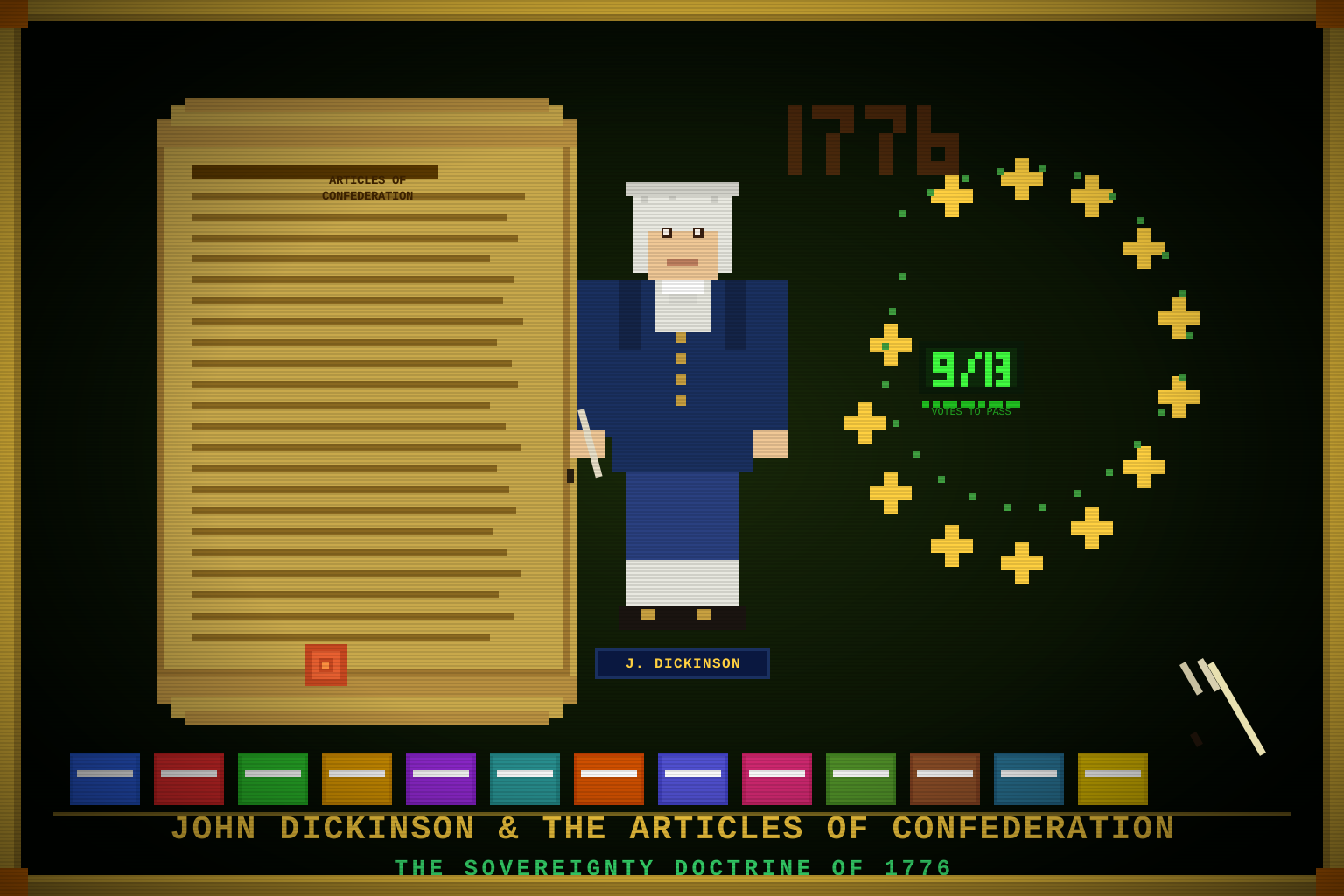
Key figures: John Dickinson, Benjamin Franklin, Samuel Chase, Thomas Burke, Roger Sherman, James Wilson
Summary
As the Declaration of Independence was being finalized in July 1776, Congress grappled with an equally urgent task: defining the structure of the new government. John Dickinson, the Delaware delegate who had opposed total independence just months earlier, undertook to draft what would become the nation’s first constitution—the Articles of Confederation. The drafting committee was appointed on June 12, 1776, and Dickinson’s draft was reported to Congress a month later, on July 12, 1776—reflecting the Revolutionary generation’s deepest fear: concentrated power. His framework created a weak central authority subordinate to the states, a deliberate choice rooted in 1776 ideology.
The Articles that emerged embodied Dickinson’s philosophy of state supremacy. Congress would have no power to tax, no executive, and no permanent judiciary. Each state held one vote regardless of population or wealth, and nine of thirteen states were required to pass any major legislation. The confederation could not regulate interstate or foreign commerce, could not enforce its own decisions, and could not borrow money on its own credit. Amendments required unanimous consent—a threshold that would prove paralytic. This was not weakness by accident, but by revolutionary design: the delegates had lived under a distant Parliament’s tyranny, and they built a government incapable of tyranny—incapable, too, of effective action.
Dickinson’s Draft and the Congressional Debates (June–November 1776)
Dickinson’s committee was appointed June 12, 1776—the day after Congress named the Committee of Five to draft the Declaration; its draft was reported on July 12, 1776, eight days after the Declaration of Independence was adopted. The original Dickinson draft was significantly more centralist than what Congress ultimately adopted. It proposed:
- Congress controlling western lands: the federal government, not individual states, would hold sovereignty over territories west of the Appalachians
- Proportional representation: larger states would have proportionally greater voting power in Congress
- Congressional power to set state tax quotas: based on total population, including enslaved people
- A permanent committee of states with executive authority between Congressional sessions
Each of these provisions was stripped out or fundamentally weakened by the time Congress completed debate in November 1776 and sent the revised Articles to the states (ratification was not completed until March 1781). The debates from July through November 1776 that produced the final Articles centered on the core tension between state autonomy and collective survival.
For the Declaration voted on July 2 and announced July 4, 1776, that preceded the Articles debate, see The Declaration of Independence and The Lee Resolution.
The Three Central Disputes
Western lands. Maryland, New Jersey, and Delaware—states without western land claims—refused to ratify the Articles unless states with charter claims to western territories (Virginia, Massachusetts, Connecticut, the Carolinas) ceded those lands to the confederation. Virginia’s charter granted it everything to the “western ocean.” The dispute delayed ratification for four years; Maryland finally ratified on March 1, 1781, only after Virginia agreed to cede its Northwest Territory claims. This dispute shaped the subsequent Northwest Ordinance of 1787, which established the constitutional framework for admitting new states.
Proportional versus equal voting. Large states (Virginia, Pennsylvania, Massachusetts) insisted that voting power should reflect population; small states (Delaware, New Jersey, Rhode Island) demanded one vote per state regardless of size. The final Articles gave each state one vote. Samuel Chase of Maryland argued that wealth, not population, should determine voting shares; James Wilson of Pennsylvania countered that population was the only legitimate measure of republican representation. The same dispute resurfaced—and reached a different compromise—at the Constitutional Convention of 1787 (the Senate/House bicameral solution).
Taxation and the three-fifths question. Dickinson’s draft proposed allocating financial contributions by total population, including enslaved people. Southern delegates objected vigorously: if enslaved people counted for taxation purposes, the South would bear a disproportionate financial burden, yet if Congress could not compel tax payments—which it could not under the Articles—the taxation formula was symbolic anyway. The final Articles allocated tax burdens based on surveyed land values rather than population, sidestepping the slavery question entirely. This deferral would prove catastrophic: no method of compelling state contributions existed, and the Confederation government lived perpetually on the edge of insolvency.
The Relationship to 1776 State Constitutions
The Articles of Confederation emerged in the same constitutional moment as the first wave of state constitutions—documents that set the ideological context for the national framework. New Hampshire adopted the first state constitution in January 1776 (see New Hampshire Constitution of 1776). Virginia adopted both its Declaration of Rights (June 12, 1776—the same day Congress appointed the Articles drafting committee) and its full constitution (June 29, 1776), see Virginia Declaration of Rights and Virginia Constitution of 1776. Pennsylvania adopted its famously radical constitution in September (see Pennsylvania Constitution of 1776).
These state constitutions, taken together, revealed the dominant ideology: power should flow from the people through representative assemblies, executives should be constrained, and written limits on government authority should be justiciable. Dickinson’s Articles applied these principles at the national level, but with a crucial difference: states, not the people, were the constituent members of the confederation. Where state constitutions placed individuals in a direct constitutional relationship with government, the Articles created a league of sovereign states in which individuals were subjects of their states first, not citizens of a nation.
Dickinson’s Personal Trajectory
Dickinson’s role in the Articles debate was shaped by his earlier political journey. He had been the principal drafter of the 1775 Olive Branch Petition, the last major attempt at reconciliation with Britain. When Richard Henry Lee’s resolution for independence came to a vote on July 2, 1776, Dickinson was among the delegates who abstained—not because he opposed independence in principle, but because he believed the confederation and foreign alliances should be secured first. His caution was logical: one does not declare independence before having the framework to sustain it. He was nonetheless one of the earliest delegates to volunteer for Continental Army service, absenting himself from Congress to serve in the New Jersey campaign of late 1776—a silent reconciliation with the cause he had helped launch.
Dickinson would later return to public service as President (Governor) of Delaware (1781–1782) and Pennsylvania (1782–1785), and played a key moderate role at the Constitutional Convention of 1787. His evolution from absolute state sovereignty in 1776 to bounded national authority in 1787 traced the arc of the Revolution itself.
Significance
The Articles of Confederation were the first codification of American political theory in 1776. They enshrined the principle that state governments, not a central authority, held the people’s ultimate loyalty and power. This doctrine would echo through the ratification debates of 1787–1788 and into the nineteenth century’s sectional conflicts.
Dickinson’s design reflected the genuine historical experience of the Revolution: thirteen separate colonies had mobilized separately, raised their own armies, and mobilized their own economic resources. Congress’s weakness during the war—its dependence on requisitions the states would not pay, its inability to supply the army or stabilize the currency—was not a flaw but a feature. The states’ sovereignty and parsimony kept them from becoming tools of a distant autocracy, the nightmare that had driven Independence.
Yet this same architecture would prove catastrophic in peace. Unable to regulate commerce, collect taxes, or enforce treaties, the Confederation stumbled through the 1780s. The failure drove the Constitutional Convention of 1787, where Dickinson again played a crucial role—this time in tempering the nationalists’ hand and preserving federalism as a principle. His move from absolute state sovereignty (1776) to bounded national authority (1787) traced the arc of the Revolution itself: from fear of centralized power to recognition that no power at all was paralysis.
The Articles’ core doctrine—that legitimate power flows from the states, and that the federal sphere should be vigilantly constrained—became embedded in American constitutional consciousness, particularly in the Tenth Amendment’s reservation of powers to the states and the people.
Related Topics
- Articles of Confederation (1776 debates) — the companion article covering the July–November debate timeline
- The Lee Resolution (July 2, 1776) — the independence vote that preceded Articles debate
- The Declaration of Independence — the philosophical complement to the political framework
- Virginia Declaration of Rights — adopted June 12, 1776, the same day Congress appointed the Articles drafting committee
- Virginia Constitution of 1776 — the model state constitution influencing the national framework
- Pennsylvania Constitution of 1776 — the most radical state constitution of 1776
- New Hampshire Constitution of 1776 — the first written state constitution
Sources
- Library of Congress, “The Articles of Confederation”
- Avalon Project, Yale Law School, “Articles of Confederation”
- John Dickinson Papers, Library of Congress
- Wikipedia, “Articles of Confederation”
- Wikipedia, “John Dickinson”
- Merrill Jensen, The Articles of Confederation (University of Wisconsin Press, 1940)