Summary
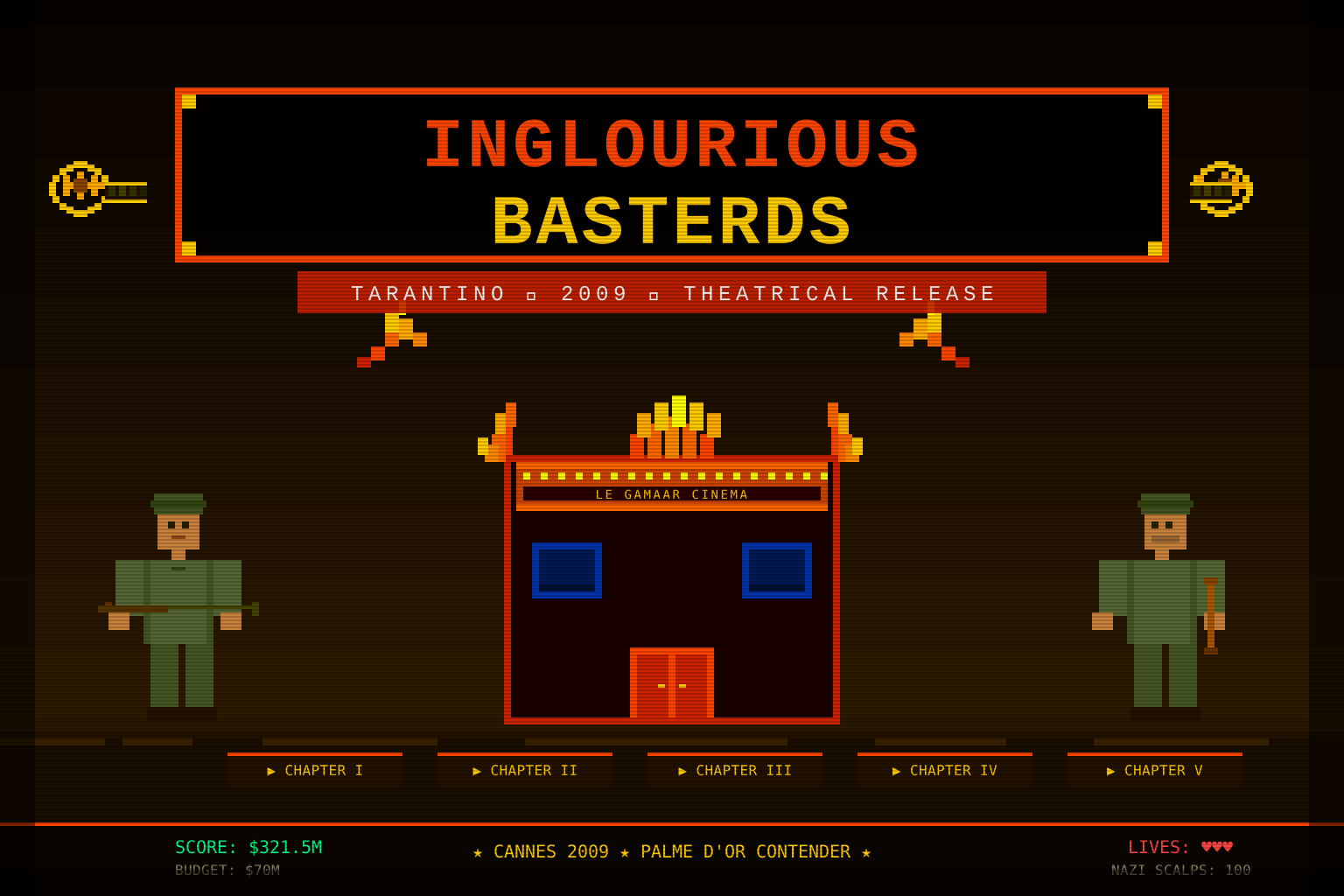
Inglourious Basterds, written and directed by Quentin Tarantino, premiered at the Cannes Film Festival on May 20, 2009 and released in the United States on August 21, 2009. The alternate-history war film interlaces two converging assassination plots against Nazi leadership during World War II. Brad Pitt leads a group of Jewish American soldiers known as “The Basterds,” tasked with hunting and killing Nazis, while French Jewish cinema owner Shosanna Dreyfus (Mélanie Laurent) independently plans an attack against Nazi leadership at her Paris cinema during a propaganda film premiere. Both schemes collide against SS Colonel Hans Landa (Christoph Waltz), an intelligence officer—called “The Jew Hunter”—who is pursuing the Basterds while also navigating his own survival. The ensemble cast included Michael Fassbender as Lt. Archie Hicox, Eli Roth as Sgt. Donny Donowitz, Diane Kruger as German actress and Allied spy Bridget von Hammersmark, Daniel Brühl as Frederick Zoller, and Til Schweiger as Sgt. Hugo Stiglitz. The film grossed $321.5 million worldwide against a $70 million production budget, yielding one of Tarantino’s highest profit margins.
Development
Tarantino spent roughly a decade developing the script, with early drafts dating to the late 1990s. An unfilmed war epic, the project went through multiple structural revisions before Tarantino reorganized it into its five-chapter format in 2008. The title is an intentional misspelling of the 1978 Italian war film Inglorious Bastards (dir. Enzo G. Castellari), from which Tarantino drew tonal but not narrative inspiration. The screenplay is notable for its trilingual dialogue—spoken across English, French, and German—requiring casting of native-speaker actors for each language’s sequences. Tarantino has cited The Good, the Bad and the Ugly (1966) and 1970s European war cinema as primary influences.
Cannes 2009
At the Cannes Film Festival, Inglourious Basterds competed for the Palme d’Or, which ultimately went to Michael Haneke’s The White Ribbon. However, Christoph Waltz received the Best Actor prize at Cannes for his performance as Hans Landa—the award that first brought him to international attention and set the stage for his subsequent Oscar campaign.
Significance
Inglourious Basterds achieved critical and commercial success, earning an 89% approval rating on Rotten Tomatoes and widespread acclaim. Roger Ebert awarded it four stars, calling it “a big, bold, audacious war movie.” Richard Corliss of Time named it one of the year’s best films.
Academy Award Performance
The film received eight Academy Award nominations at the 82nd Academy Awards (March 7, 2010):
| Category | Result |
|---|---|
| Best Picture | Nominated |
| Best Director (Tarantino) | Nominated |
| Best Supporting Actor (Waltz) | Won |
| Best Original Screenplay | Nominated |
| Best Film Editing | Nominated |
| Best Cinematography (Robert Richardson) | Nominated |
| Best Sound Editing | Nominated |
| Best Sound Mixing | Nominated |
Christoph Waltz’s win for Best Supporting Actor was the evening’s defining individual performance award. His portrayal of Hans Landa—a polyglot, psychologically complex villain who effortlessly switches between languages to gain psychological advantage—was widely cited as one of the greatest screen antagonist performances of the decade. The win launched Waltz’s international career; he went on to win a second Best Supporting Actor Oscar for Tarantino’s Django Unchained (2012), and remains the only actor to have won an Academy Award for a performance in a Tarantino-directed film.
Historical Revisionism and Cultural Impact
The narrative’s bold alternate-history ending—in which Hitler and Nazi leadership are assassinated inside a Paris cinema in August 1944, more than a year earlier than the historical date—ignited sustained critical discussion about the ethics and politics of historical revisionism in popular cinema. Academic publications, including pieces in Film Quarterly and The Journal of Popular Culture, debated whether the film offered Jewish audiences a cathartic fantasy, appropriated Jewish suffering for entertainment, or genuinely reconfigured who holds narrative agency in Holocaust-adjacent storytelling. Tarantino himself described the film as “a Jewish revenge fantasy.”
The film’s commercial performance—$321.5 million worldwide on a $70 million budget—made it Tarantino’s highest-grossing film until Django Unchained (2012, $425.4M) and confirmed his status as a commercially viable prestige auteur. Its influence on subsequent alternate-history and revenge cinema was substantial: Tarantino’s approach of transplanting genre tropes (the spaghetti Western, the men-on-a-mission picture) onto WWII’s moral landscape directly informed works like Overlord (2018) and The Man in the High Castle (2015–19) in their handling of counterfactual Nazi-defeat scenarios.
Summer 2009 Arts Context
Opening August 21, Inglourious Basterds arrived at the tail end of the summer season—after the cultural shock of Michael Jackson’s death on June 25 had dominated headlines, and after Transformers: Revenge of the Fallen and Up had defined the blockbuster season. The critical and commercial contrast between Inglourious Basterds and Transformers became a recurring reference point in discussions of the 2009 box office’s split between spectacle and substance. Avatar, which opened December 18 to shatter all box-office records, subsequently overshadowed all prior 2009 releases in aggregate year-end discourse.
Sources
- Wikipedia — Inglourious Basterds
- Box Office Mojo — Inglourious Basterds (2009)
- Roger Ebert — Review, Chicago Sun-Times, August 19, 2009
- Academy of Motion Picture Arts and Sciences — 82nd Academy Awards nominations