The Oprah Winfrey Show: Season 24 and Cultural Peak (2009)
Category: Arts & Culture
Key figures: Oprah Winfrey (host and executive producer), Gayle King (close friend and contributor), Harpo Productions staff, Nate Berkus and Dr. Oz (regular contributors), Stedman Graham (partner)
Summary
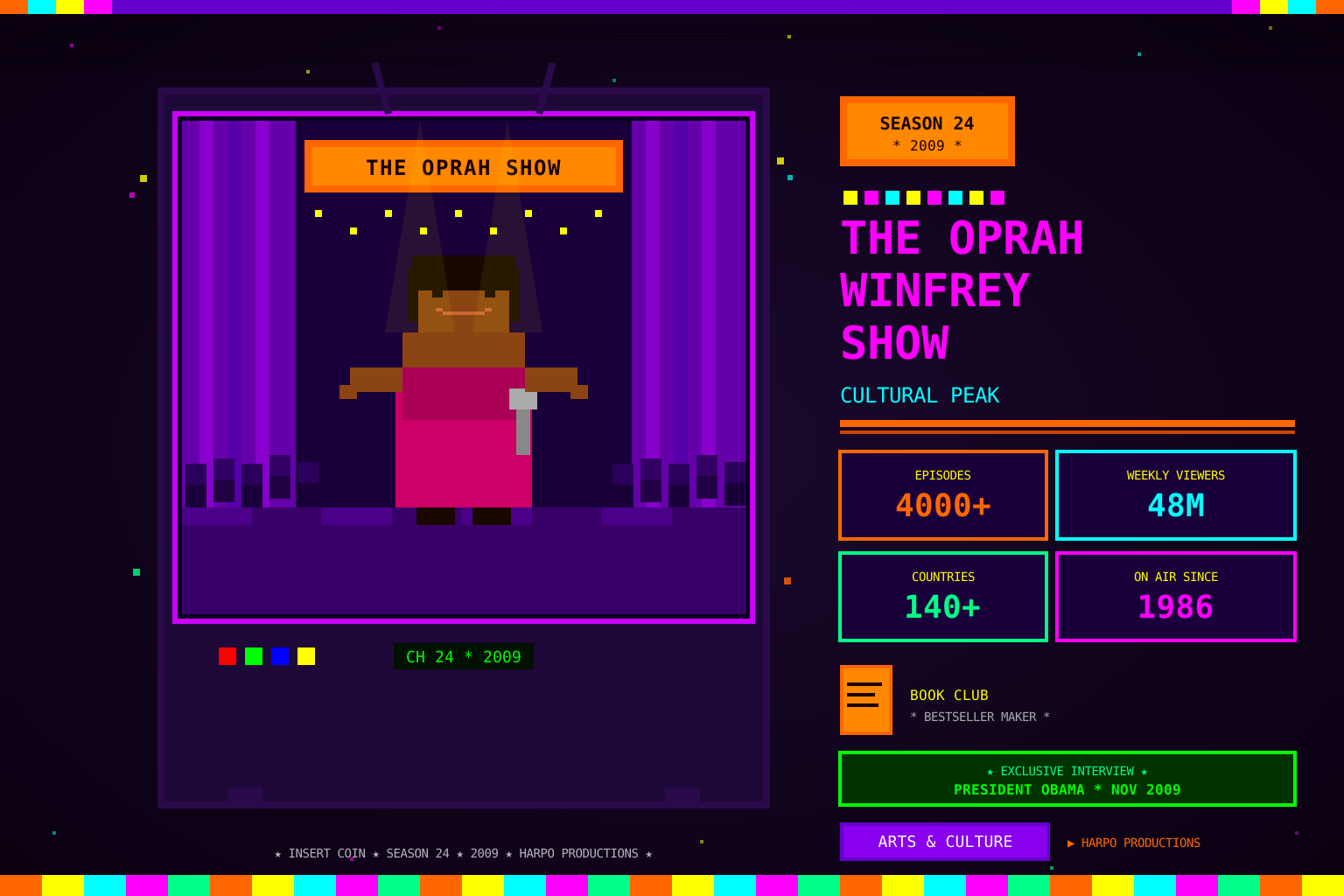
The Oprah Winfrey Show entered its 24th season on September 8, 2009, continuing its record run as the most-watched daytime talk program in American television history. Launched into national syndication on September 8, 1986 as an expansion of Oprah Winfrey’s local Chicago program AM Chicago (which she had hosted since 1984), the show had by 2009 broadcast more than 4,000 episodes across two dozen seasons. In the 2009 season, Winfrey secured significant newsmaker interviews — including a widely covered sit-down with President Barack Obama and First Lady Michelle Obama in November 2009 — and continued her “Oprah’s Book Club” selections that reliably drove chosen titles to bestseller status. The show aired in over 140 countries and was watched by an estimated 40–48 million viewers weekly worldwide. The series would ultimately conclude on May 25, 2011, with its 4,561st episode and 25th season, drawing approximately 16.4 million US viewers to the finale.
Season 24 (2009): Notable Episodes and Moments
The 2009 season opened against a backdrop of the worst economic recession since the Great Depression. Winfrey devoted substantial programming to financial guidance, housing crisis stories, and economic empowerment — topics that resonated with an audience facing unemployment, foreclosure, and retirement-savings losses.
Key 2009 episodes:
- Obama White House Visit (November 2009): Winfrey filmed segments at the White House for a prime-time ABC special, Christmas at the White House: An Oprah Primetime Special (December 13, 2009), the first time a sitting president had granted such extensive television access to a single host. The special drew approximately 14.3 million viewers.
- Michael Jackson tribute (July 2009): Following Michael Jackson’s death on June 25, 2009, Winfrey devoted several episodes to his legacy, broadcasting from Neverland Ranch and conducting interviews with childhood friends and collaborators. The episodes were among the highest-rated of the 2009 season. See also: Michael Jackson dies.
- “Favorite Things” episode (November 2009): The annual Favorite Things episode, in which Winfrey gifts the studio audience with an assortment of products, generated over US$5 million in broadcast publicity value for featured brands and typically caused immediate sell-outs of all featured items — a commercial phenomenon journalists had labeled the Oprah Effect.
- H1N1 vaccine awareness (October 2009): In the midst of the H1N1 swine flu pandemic, Winfrey dedicated episodes to pandemic preparedness and vaccine awareness. Her recommendation of flu vaccinations was credited by public health officials with meaningfully influencing uptake among her core demographic. See also: H1N1 swine flu pandemic.
The Oprah Effect in 2009
The “Oprah Effect” — the documented commercial and cultural impact of Winfrey’s endorsements — was at its zenith in the 2009 period. Economists and media analysts had quantified several dimensions of this influence:
- Books: A study by the Wharton School found that an Oprah’s Book Club selection increased average book sales by approximately 1.3 million copies. By 2009, the club had selected over 70 titles since its 1996 launch. Authors including Toni Morrison, Cormac McCarthy (The Road, selected September 2007), and Elie Wiesel (Night, selected January 2006) saw transformative sales spikes after selection.
- Food and diet: Winfrey’s dietary choices generated measurable industry shifts — her 21-day vegan “cleanse” in 2008 increased searches for vegan recipes by an estimated 30% and boosted specialty grocery sales. Conversely, her 1996 comments about beef during the BSE scare triggered a Texas cattlemen’s lawsuit under state “food disparagement” laws, ultimately dismissed.
- Products: Features on the Favorite Things episode reliably produced immediate sell-outs. The 2009 season featured a Kindle 2 as a Favorite Thing — a selection that simultaneously validated Amazon’s e-reader and drove week-over-week sales spikes. See also: Amazon Kindle e-reader expansion.
- Charities: Winfrey’s Angel Network, her charitable organization established in 1997, had by 2009 raised over US$80 million. Her support for specific charities during broadcast reliably generated donation surges.
Business and Media Empire (2009 Snapshot)
By 2009, Winfrey had assembled a media and entertainment conglomerate built on the show’s foundation:
| Entity | Description | Status in 2009 |
|---|---|---|
| Harpo Productions | Film and television production company | Active; produced show + film projects |
| Harpo Studios | 88,000 sq ft Chicago production facility | Operating since 1990 |
| O, The Oprah Magazine | Monthly lifestyle magazine (Hearst joint venture) | ~2.4M circulation |
| Harpo Films | Feature film development arm | Active |
| Oprah.com | Website with interactive viewer community | ~70M page views/month |
| XM Satellite Radio (Oprah & Friends) | 24-hour satellite radio channel | Active 2006–2014 |
| OWN (Oprah Winfrey Network) | Cable television network | In development; launched January 2011 |
The planned launch of OWN — announced in January 2008 as a rebranding of Discovery Health Channel — was the open secret behind speculation that The Oprah Winfrey Show would eventually end. Discovery Communications had agreed to a joint venture, with Winfrey holding 50% ownership. The network launched on January 1, 2011, and the daytime show ended May 25, 2011.
Format, Production, and Influence on Daytime Television
The Oprah Winfrey Show pioneered the “confessional talk-show” format that distinguished it from earlier daytime programs. Where predecessors such as The Phil Donahue Show (Donahue’s show had dominated daytime television from 1967–1996 before being displaced by Oprah) had prioritized topical debate, Winfrey centered the emotional arc of each episode on personal transformation and therapeutic disclosure.
Production model:
- Filmed primarily at Harpo Studios in Chicago’s Near West Side, with periodic location shoots
- Roughly 180–200 new episodes per season; across its 25 seasons the show produced 4,561 episodes in total
- Staff of approximately 400 people at its Chicago production base
- Syndicated to over 100 US markets by King World Productions (later CBS Television Distribution)
The show’s influence on daytime television was extensive: it was directly responsible for launching the television careers of Dr. Phil McGraw (his own daytime show debuted September 2002) and Dr. Mehmet Oz (The Dr. Oz Show, debuted September 2009 — the same season as the 24th Oprah season, with Winfrey as co-executive producer).
Oprah and the 2008–2009 Barack Obama Campaign
One dimension of the 2009 season that drew particular media attention was the aftermath of Winfrey’s highly public 2007–2008 endorsement of Barack Obama — the first time she had endorsed a presidential candidate. The endorsement, including campaign-trail appearances in Iowa, New Hampshire, and South Carolina in December 2007, drew large crowds — among them an estimated 29,000 at a rally in Columbia, South Carolina, one of the largest of the primary campaign — and generated intense analysis of celebrity political influence.
An economic study by professors at the University of Maryland and the London School of Economics estimated that Winfrey’s endorsement generated approximately 1 million additional votes for Obama in the Democratic primaries — enough to have been the decisive margin in several state contests. While the study’s methodology was contested, it underscored the unique political weight of her platform.
Her November 2009 White House special, filmed after Obama’s first year in office, drew 14.3 million viewers and stood as one of the major television events of the year.
Sources
- Wikipedia — The Oprah Winfrey Show (episode count, season dates, viewership data)
- Nielsen Media Research — 2009 daytime ratings
- Wharton School study on Oprah’s Book Club sales impact (2005, updated 2008)
- ABC News — “Oprah’s White House Christmas Special” viewership (December 2009)
- Harvard Business Review — “The Oprah Effect” (2010)
- University of Maryland / LSE — “Estimating the Influence of Oprah Winfrey’s Presidential Endorsement” (2008, Graefe et al.)
- CNN — Oprah media empire profile (2009)