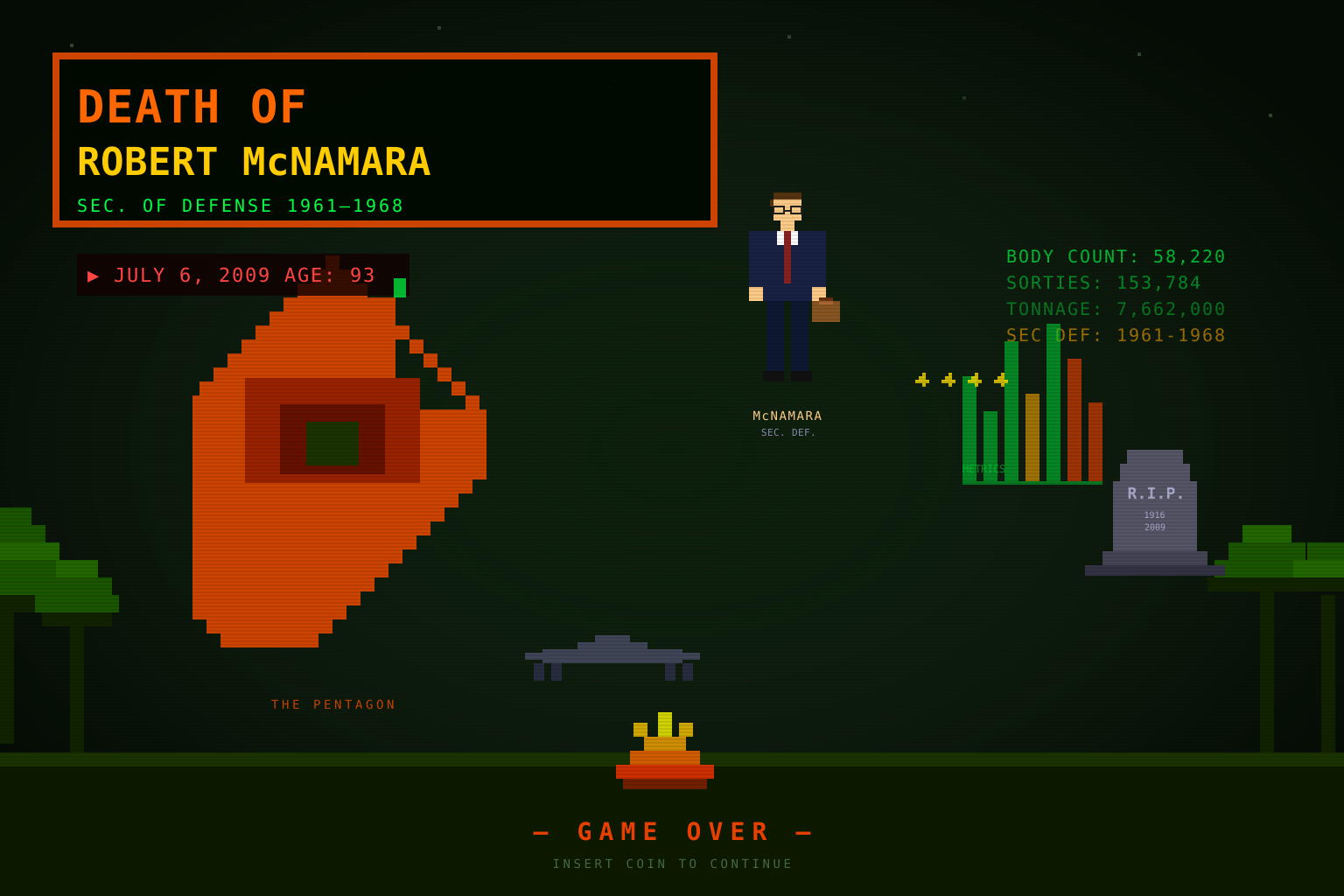
Key figures: Robert McNamara, President John F. Kennedy, President Lyndon B. Johnson, Errol Morris (filmmaker), General Curtis LeMay
Summary
Robert Strange McNamara, the U.S. Secretary of Defense during the Kennedy and Johnson administrations and a central architect of Cold War military strategy, died on July 6, 2009, at his home in Washington, D.C., at age 93. McNamara served as defense secretary from January 1961 to March 1968 — longer than any of his 27 predecessors — overseeing the Cuban Missile Crisis, the escalation of U.S. involvement in Vietnam, and the institutionalization of systems analysis and quantitative metrics in military decision-making. His tenure reshaped the Pentagon’s bureaucratic culture and remained subject to intense historical debate regarding the strategic logic, human costs, and ultimate futility of the Vietnam War.
McNamara was born on June 9, 1916, in San Francisco. He earned a degree in mathematics from the University of California, Berkeley, and an MBA from Harvard Business School. During World War II he served as a statistical control officer in the Army Air Forces under Curtis LeMay, where he pioneered the application of quantitative methods to military operations. After the war, he joined the Ford Motor Company, rising to president by 1960—an unusual executive trajectory in Detroit’s auto industry. President-elect Kennedy recruited him as defense secretary in December 1960, making him the youngest person to hold the post in the 20th century.
Cuban Missile Crisis
During the October 1962 Cuban Missile Crisis, McNamara was one of President Kennedy’s closest advisers. He advocated for a naval blockade (“quarantine”) of Cuba as an alternative to immediate air strikes and military invasion — a middle path that allowed diplomacy to precede military action. He worked closely with JFK, National Security Adviser McGeorge Bundy, and Soviet Premier Nikita Khrushchev’s representatives to negotiate the crisis’s peaceful resolution. The thirteen-day standoff resolved when the Soviet Union agreed to withdraw its missiles from Cuba in exchange for a U.S. pledge not to invade Cuba and a secret U.S. agreement to remove Jupiter missiles from Turkey within months.
Vietnam War and Escalation
McNamara’s role in the Vietnam War proved far more controversial. As defense secretary from 1961 onward, he oversaw a dramatic escalation of U.S. military involvement—from roughly 900 military advisers in South Vietnam at the start of 1961 to over 184,000 combat troops by the end of 1965, and to a peak of 543,400 by 1969. Following the August 1964 Gulf of Tonkin incident (in which an alleged second attack on the USS Maddox was almost certainly fictitious), McNamara recommended that Congress pass the Tonkin Gulf Resolution, which effectively granted the president a blank check for war without a formal declaration. The resolution passed overwhelmingly.
McNamara’s strategic approach relied heavily on quantitative metrics — “body counts,” bombing tonnage, and engagement statistics — metrics that later historians and analysts critiqued as fundamentally misreading the political and cultural dimensions of a guerrilla insurgency. By 1965–66, McNamara privately concluded the war was unwinnable, yet he did not share this assessment with the public or—more controversially—with President Johnson until late in his tenure. He remained in office until March 1968, when President Johnson appointed him President of the World Bank, a lateral move widely interpreted as removing him from a position of influence.
World Bank Presidency (1968–1981)
From 1968 to 1981, McNamara served as President of the World Bank — a tenure that outlasted his defense secretary role and constituted a second major chapter of his public career. He transformed the Bank’s mission from narrow infrastructure lending toward poverty alleviation, expanding annual lending from approximately $953 million in fiscal year 1968 to more than $12.4 billion by fiscal year 1981. He championed development lending for agriculture, education, and health in low-income countries, launching what became known as the “basic needs” approach to development economics. McNamara’s presidency nearly tripled the Bank’s staff and established a precedent for multilateral development institutions as agents of social policy, not merely capital project financing.
He also reorganized the Bank’s research capacity and helped elevate development economics as a rigorous academic discipline. His 1973 Nairobi speech to the Board of Governors — in which he called on member nations to address “absolute poverty” as a moral imperative — became a defining statement of 20th-century development policy. Critics, however, argued that some Bank-financed projects of his era (large-scale dams, resettlement schemes) caused significant environmental and human displacement, a tension that prefigured later debates about the social impact of international development institutions.
The McNamara Line
Among the lesser-remembered strategic initiatives of McNamara’s defense tenure was the so-called “McNamara Line” — formally the Strong Point Obstacle System (SPOS), later the Barrier Concept. Developed from 1967 onward under McNamara’s direct sponsorship, it was an electrified fence and sensor array designed to interrupt North Vietnamese infiltration routes along the Demilitarized Zone (DMZ) between North and South Vietnam. The project was championed by McNamara as a technological alternative to costly troop deployments but was never fully built; it was abandoned in 1968 amid skepticism from military commanders — including General Westmoreland — who doubted its feasibility against guerrilla infiltration. The concept demonstrated both McNamara’s faith in technological solutions and the limits of that faith in asymmetric warfare.
The Fog of War: Eleven Lessons
After leaving government, McNamara wrote a memoir (In Retrospect: The Tragedy and Lessons of Vietnam, 1995) and became the subject of filmmaker Errol Morris’s Academy Award–winning 2003 documentary The Fog of War: Eleven Lessons from the Life of Robert S. McNamara. The film, which won the Oscar for Best Documentary Feature, presented McNamara in a series of extended interviews in which he articulated eleven distilled “lessons” from his Cold War and Vietnam experience — including “empathize with your enemy,” “belief and seeing are both often wrong,” and “never answer the question that is asked of you; answer the question you wish had been asked.” The film’s candor, including McNamara’s acknowledgment that the Vietnam War was a “terrible mistake” and his admission that the Gulf of Tonkin second attack was probably fictitious, made it both acclaimed and controversial. At the time of his death, The Fog of War had been translated into dozens of languages and was widely used in university courses on ethics, military history, and decision-making.
McNamara was survived by his second wife Diana Masieri Byfield (his first wife Margaret Craig McNamara died in 1981), and their three children: Margaret, Kathleen, and Craig. He was buried with full military honors at Arlington National Cemetery on July 9, 2009.
Significance
McNamara’s death marked the passing of one of the last surviving decision-makers from the Cold War’s most pivotal crises and conflicts. His tenure as defense secretary symbolized both the promise and the peril of applying rational, quantitative analysis to matters of war and peace. The Pentagon’s adoption of systems analysis and cost-benefit frameworks during his tenure became the template for defense policy planning for decades, demonstrating his lasting institutional impact even as his strategic judgments on Vietnam came to be widely questioned. The 2009 debate over McNamara’s legacy — balancing his role in managing the Cuban Missile Crisis (generally regarded as a success requiring restraint) against his role in Vietnam (widely viewed as a strategic and moral failure) — reflected the enduring American struggle to comprehend the Cold War’s logic and costs. His death came just months before President Obama’s Nobel Peace Prize in October 2009, a moment that similarly rekindled debates over American military engagement in Iraq and Afghanistan. McNamara died roughly seven weeks before Senator Ted Kennedy, who had been one of the most prominent Senate opponents of Vietnam War escalation after breaking with the Johnson administration in the late 1960s — an ironic pairing that underscored how completely the Cold War political generation was passing from the scene in the summer of 2009.
Sources
- Robert McNamara — Wikipedia
- The Fog of War (2003) — Documentary Film by Errol Morris
- Cuban Missile Crisis — Wikipedia
- History of United States Military Operations in Vietnam — U.S. Army Center of Military History