Key figures: N/A
Summary
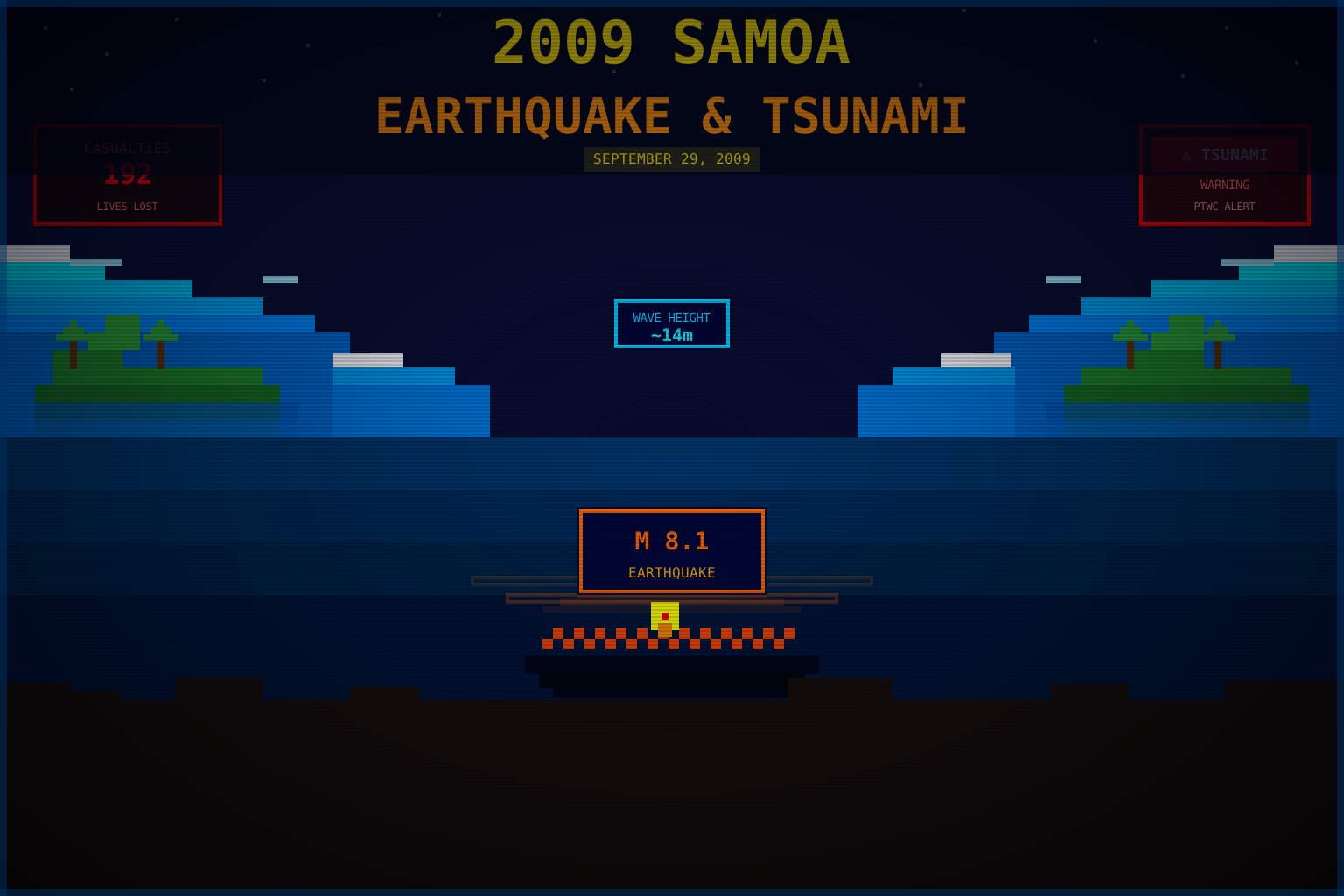
At about 6:48 a.m. local time on September 29, 2009, a magnitude-8.1 earthquake struck the seafloor midway between Samoa and American Samoa, near the northern end of the Tonga Trench — one of the most seismically active regions on Earth. The event was an unusual “doublet,” involving closely spaced ruptures on both a normal fault in the outer rise and the adjacent subduction thrust within a few minutes of one another. The seabed displacement generated a tsunami that reached the surrounding islands within minutes, leaving little time for evacuation.
Tsunami waves — locally reaching heights of roughly 14 metres and running far inland in low-lying areas — devastated coastal villages in the independent state of Samoa, the U.S. territory of American Samoa, and the northern Tongan island of Niuatoputapu. At least 192 people were killed: about 149 in Samoa, 34 in American Samoa, and 9 in Tonga. Thousands were displaced, and the United Nations reported that more than 3,000 Samoans were left homeless. The Pacific Tsunami Warning Center issued a warning shortly after the quake, and the disaster prompted a major international humanitarian and reconstruction response, including aid from the United States, Australia, and New Zealand.
Significance
The 2009 Samoa tsunami was one of the deadliest natural disasters of the year and the worst in modern Samoan history. It exposed the difficulty of warning near-source coastal populations, where destructive waves can arrive within 10–20 minutes, and spurred investment in community education, evacuation routes, and warning systems across the South Pacific. Post-disaster needs assessments led by the affected governments and international partners guided reconstruction and informed later regional disaster-preparedness planning. The event stands alongside the year’s other major seismic disasters, including the L’Aquila earthquake in Italy.
Sources
- 2009 Samoa earthquake and tsunami — Wikipedia
- On This Day: 2009 Samoa Islands Tsunami — NOAA National Centers for Environmental Information
- Over 3,000 Samoans left homeless by deadly Pacific tsunami — UN News