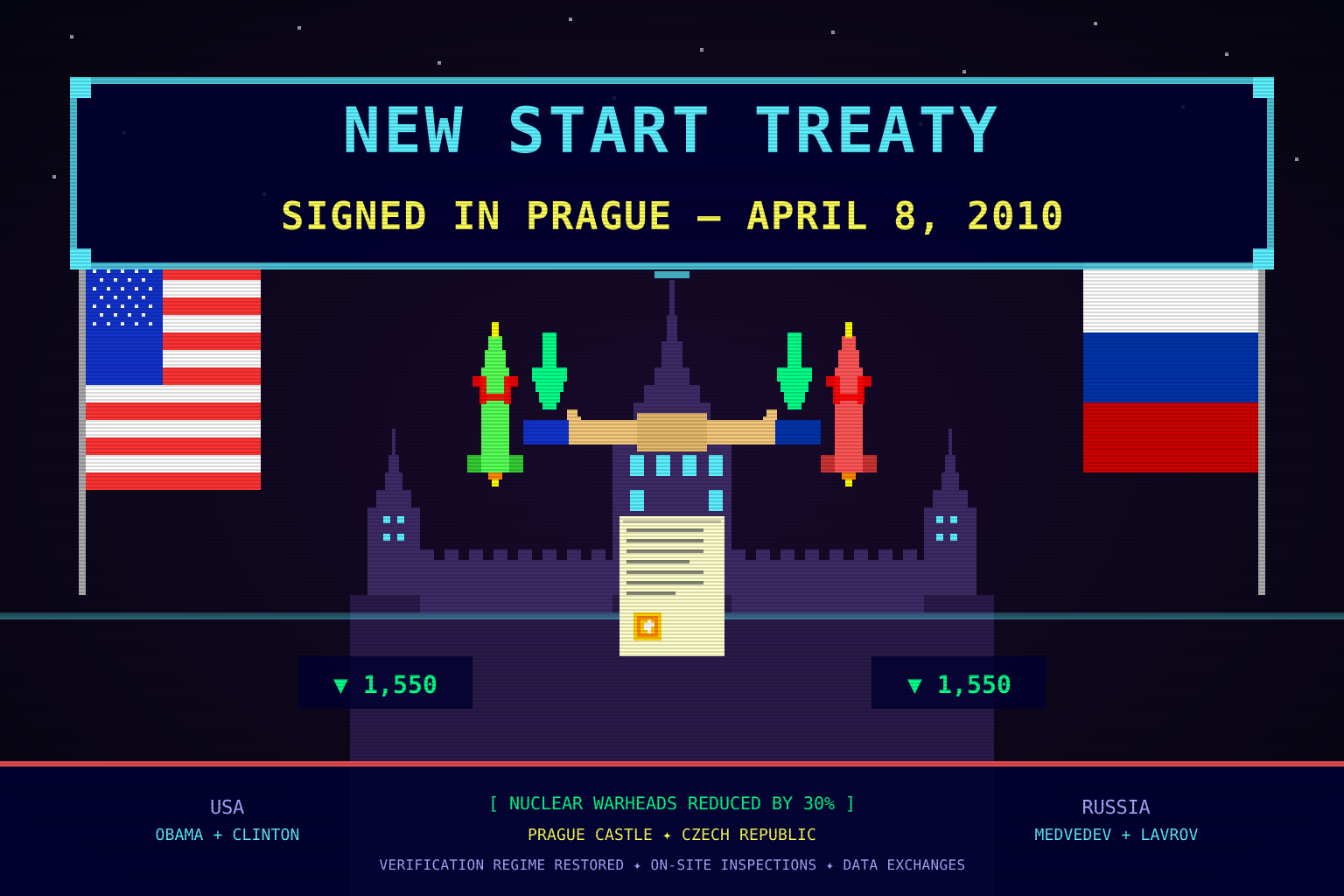
Key figures: Barack Obama (U.S. President), Dmitry Medvedev (Russian President), Hillary Clinton (U.S. Secretary of State), Sergei Lavrov (Russian Foreign Minister).
Summary
On April 8, 2010, U.S. President Barack Obama and Russian President Dmitry Medvedev signed the New Strategic Arms Reduction Treaty (New START) at Prague Castle in the Czech Republic. The treaty limited each country to 1,550 deployed strategic nuclear warheads, 700 deployed intercontinental ballistic missiles, submarine-launched ballistic missiles, and heavy bombers, and 800 deployed and non-deployed launchers and bombers. It replaced the 1991 START I treaty, which had expired on December 5, 2009, and superseded the 2002 Strategic Offensive Reductions Treaty (SORT).
The agreement restored a lapsed verification regime between the two states that together held roughly 90 percent of the world’s nuclear weapons, reinstating on-site inspections, data exchanges, and notifications of strategic-force movements. Its signing was a central element of the Obama administration’s “reset” of relations with Russia and of the president’s broader nonproliferation agenda, announced in Prague a year earlier.
Terms and Verification
New START set a seven-year timeline for the parties to reach its central limits after entry into force. Its principal caps were:
- 1,550 deployed strategic warheads each — about 30 percent below the SORT ceiling of 2,200.
- 700 deployed delivery vehicles (ICBMs, SLBMs, and nuclear-capable heavy bombers).
- 800 deployed and non-deployed ICBM launchers, SLBM launchers, and heavy bombers.
The treaty’s verification protocol permitted up to 18 short-notice on-site inspections per year and required regular exchanges of data on the number and location of strategic systems. Unlike START I, it counted each deployed heavy bomber as a single warhead, a change that shaped how each side structured its force.
Ratification
Ratification required a two-thirds majority in the U.S. Senate. After extended debate over the treaty’s relationship to missile defense and the administration’s commitments to modernize the remaining nuclear arsenal, the Senate gave its advice and consent on December 22, 2010, by a vote of 71–26. Russia’s Federal Assembly — the State Duma and the Federation Council — completed its approval in late January 2011. The treaty entered into force on February 5, 2011, when Secretary of State Hillary Clinton and Foreign Minister Sergei Lavrov exchanged instruments of ratification in Munich.
Significance
New START was the principal U.S.–Russian arms-control achievement of 2010 and the first binding strategic-arms treaty between the two powers to enter into force in nearly a decade. By re-establishing verified limits and mutual inspections after the expiry of START I, it preserved transparency between the world’s two largest nuclear arsenals at a moment when no verification mechanism was in place.
The treaty became the surviving pillar of bilateral strategic arms control in the following decade. It was extended in February 2021 for five years to 2026, and its provisions framed subsequent debates over the future of nuclear-arms limitation as relations between Washington and Moscow deteriorated.
Related
- WikiLeaks Diplomatic Cables Release — Another 2010 event that tested the diplomatic relationships the “reset” sought to stabilize.
- Smolensk Air Disaster — The April 10, 2010 crash that killed Poland’s president two days after the Prague signing, reshaping the region’s political climate.
- 2010 United States Midterm Elections — The November result that narrowed the Senate majority Obama relied on to ratify the treaty in December.