Category: People
Key figures: Steve Jobs (Apple CEO and co-founder), Jonathan Ive (SVP Industrial Design), Scott Forstall (SVP iOS Software)
Summary
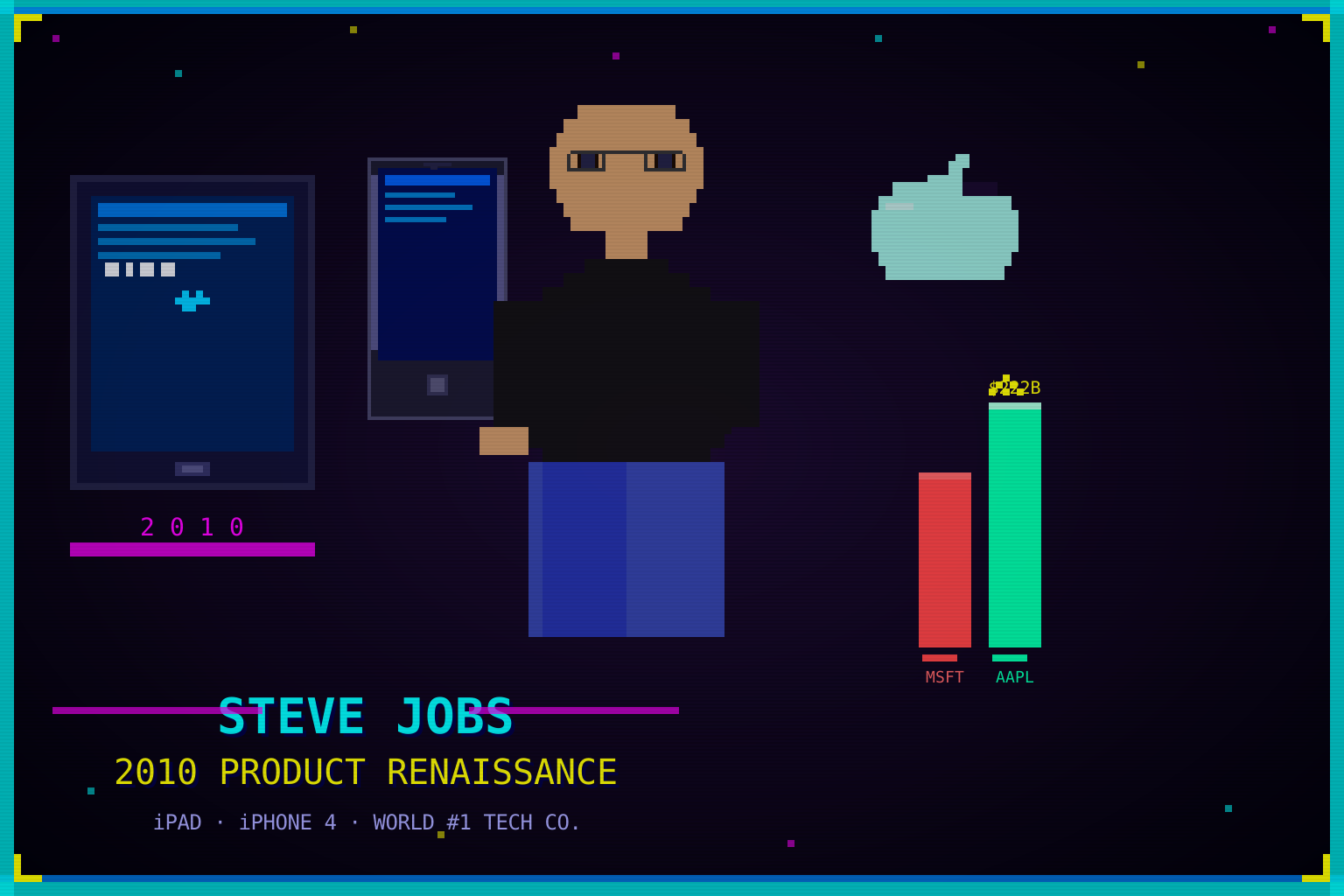
2010 was a landmark year for Steve Jobs and Apple, marked by the launch of two transformative products — the iPad and iPhone 4 — that redefined consumer electronics categories. On January 27, 2010, Jobs unveiled the iPad to the world at the Yerba Buena Center for the Arts in San Francisco, introducing the tablet computing category that would reshape personal computing for the next decade. By June 24, Jobs returned to present the iPhone 4, featuring the revolutionary Retina display and a redesigned industrial form factor. Despite ongoing health challenges following a liver transplant in 2009, Jobs maintained his role as Apple’s CEO and drove the company to a historic milestone: on May 26, 2010, Apple briefly surpassed Microsoft to become the world’s most valuable technology company by market capitalization, reaching approximately $222 billion. These launches represented the culmination of years of product development and Jobs’ unwavering vision for elegant, user-centric technology, and his keynote presentations showcased his unmatched ability to narrate technology’s potential to consumers and developers alike.
The iPad Unveiling: “A Third Category”
Jobs unveiled the iPad on January 27, 2010, to a packed audience of press, developers, and guests. Opening by posing the question of whether there was room for “a third category of device” between smartphones and laptops, he argued that existing netbooks “weren’t better at anything.” Jobs demonstrated the device from an armchair on stage — a deliberate staging decision intended to communicate domestic ease rather than technical formality — showing web browsing, email, video playback, and access to the existing App Store library of more than 140,000 applications.
The Wi-Fi model launched at retail on April 3, 2010 at a starting price of $499 — significantly below analyst predictions of $700–$1,000. Apple sold more than 300,000 units on the first day and reached 1 million sales within 28 days (half the time the original iPhone had required). By September 2010, iPad sales reached roughly 7.5 million units, establishing the tablet category with a force that no prior attempt, including Microsoft’s Tablet PC initiative, had managed. Time magazine named the iPad one of the 50 Best Inventions of 2010. See: iPad Launch.
iPhone 4 and Antennagate
On June 7, 2010, Jobs unveiled the iPhone 4 at Apple’s Worldwide Developers Conference (WWDC), declaring it “the biggest leap since the original iPhone.” The device’s defining feature was its Retina display: a 3.5-inch IPS panel running at 960×640 resolution and 326 pixels per inch — a density Jobs argued exceeded the threshold at which the human eye could resolve individual pixels at normal viewing distances. The iPhone 4’s flat-edged stainless steel and aluminosilicate glass design also marked a dramatic departure from the rounded plastic of the iPhone 3GS.
Pre-orders opened June 15 and generated 600,000 orders within 24 hours, crashing Apple’s servers and retail systems. The iPhone 4 went on sale June 24 and sold 1.7 million units in its first weekend across five initial markets (US, UK, France, Germany, Japan). However, the launch was quickly overshadowed by what became known as “Antennagate”: users discovered that bridging the device’s stainless-steel antenna band with a bare hand could cause a measurable signal-strength drop. Jobs initially responded dismissively (“just avoid holding it in that way”), drawing significant public criticism. Apple ultimately held a press conference on July 16 to address the issue, offering free bumper cases to all iPhone 4 customers — a rare product concession from Jobs — and commissioning independent testing that showed the issue was less severe than competitors’ phones in similar grip configurations. The controversy did not materially affect sales. See: iPhone 4 Launch and Retina Display.
iOS 4 and the App Store Ecosystem
Released on June 21, 2010, iOS 4 — the first version to drop the “iPhone OS” name — introduced multitasking for third-party apps, a folder system for application organization, and unified inbox for Mail. These features, long present on competing platforms, had been deliberate omissions by Jobs on grounds of battery life and user experience. Their arrival in 2010 closed the feature gap while maintaining iOS’s characteristic simplicity. By the end of 2010, the App Store contained roughly 300,000 applications and had recorded over 10 billion total downloads. Under Jobs’ direction, iOS 4 also introduced FaceTime video calling on the iPhone 4 and, in a later point release, Game Center — an online gaming network. See: iOS 4 and the App Store Ecosystem.
Apple’s Rise to Most Valuable Technology Company
On May 26, 2010, Apple’s market capitalization of approximately $222 billion surpassed Microsoft’s approximately $219 billion market cap, making Apple — for the first time in its history — the world’s most valuable technology company. The symbolic reversal was stark: Microsoft had been among the companies that kept Apple financially afloat with a $150 million investment in 1997, the same year Jobs returned to lead the company he co-founded. By 2010, Apple’s hardware and software integration strategy, driven by Jobs, had generated a sustained premium-margin business model that rewarded shareholders and redefined investor expectations of consumer technology companies.
Health Challenges and Leadership Continuity
Jobs had undergone a liver transplant in Tennessee in April 2009 — a procedure whose full context (Jobs had been diagnosed with a rare form of pancreatic neuroendocrine cancer in 2003) was not publicly confirmed until his authorized biographer Walter Isaacson published Steve Jobs in 2011. In 2010, Jobs was visibly thinner than in prior years, and his public appearances were carefully limited to major product launches and shareholder meetings. Despite mounting health concerns among investors and observers — Apple’s stock had dropped significantly when Jobs took medical leave in January 2009 — Jobs maintained full executive control throughout 2010 and continued to drive product decisions with characteristic intensity. He would formally step down as CEO on August 24, 2011, designating Tim Cook as his successor, and died on October 5, 2011.
Significance
Steve Jobs’ 2010 represents the apex of his product leadership before his health forced him to step down. The iPad and iPhone 4 launches demonstrated his enduring ability to identify market opportunities and create products that consumers didn’t yet know they wanted. The iPad’s introduction launched a new category that generated over $1 trillion in cumulative revenue for Apple over the subsequent decade. The iPhone 4’s Retina display technology set new standards for mobile device screens and became a competitive benchmark across the industry. Jobs’ leadership in 2010 cemented his legacy as one of history’s greatest product visionaries and established the foundation for Apple’s dominance throughout the 2010s. His insistence on simplicity, design excellence, and the integration of hardware and software became the template that other technology companies pursued for years to come.
Related
- iPad Launch — the January 27 unveiling and April 3 retail launch that created the tablet category
- iPhone 4 Launch and Retina Display — the WWDC unveiling, Antennagate, and Retina display technology
- iOS 4 and the App Store Ecosystem — multitasking, 300,000 apps, and 10 billion downloads