Key figures: Leonid Elenin (discoverer), International Scientific Optical Network (ISON), Minor Planet Center (MPC).
Summary
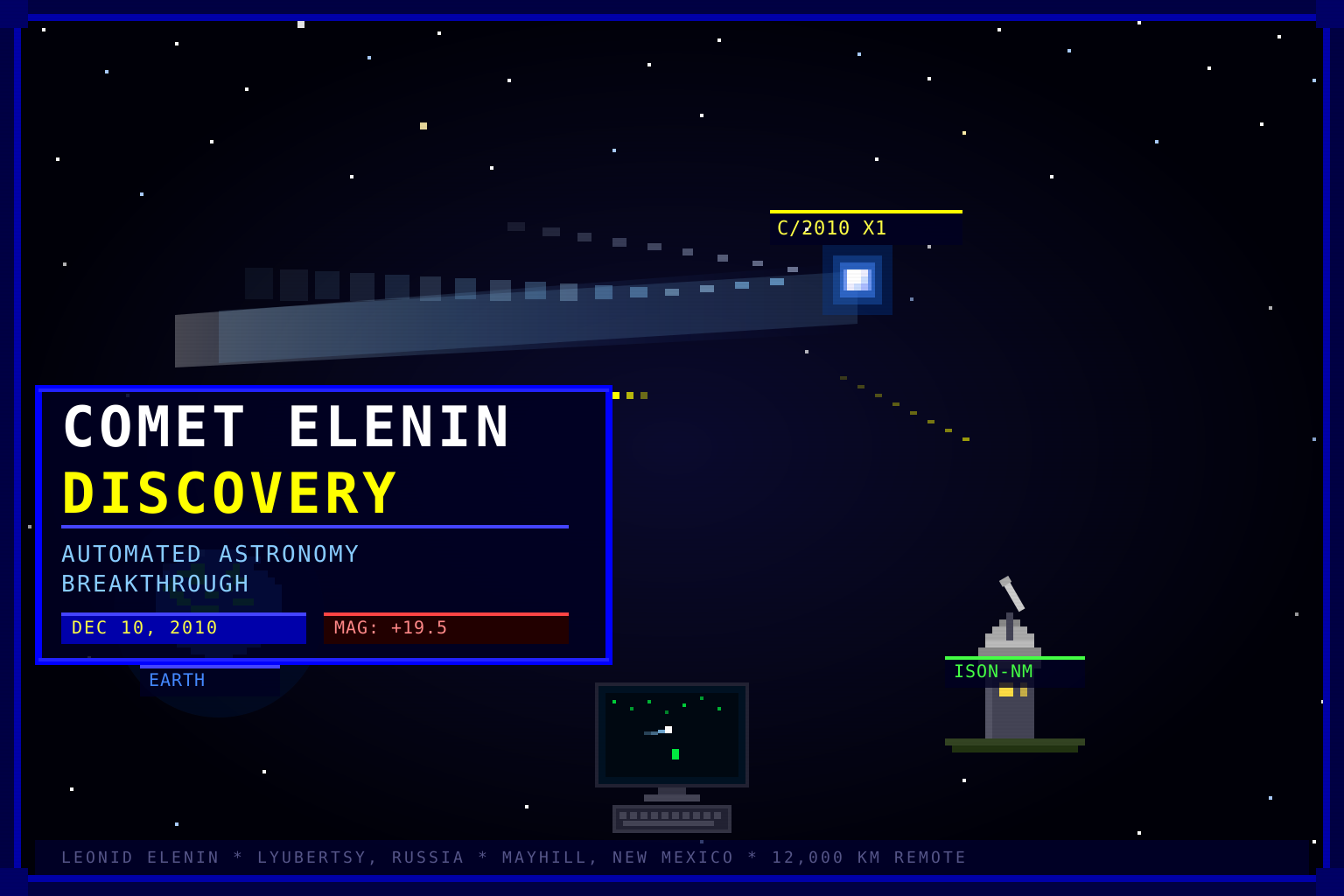
On December 10, 2010, Russian amateur-professional astronomer Leonid Elenin discovered a long-period comet (C/2010 X1) using automated robotic telescopes operated remotely through the International Scientific Optical Network’s (ISON) observatory near Mayhill, New Mexico—located approximately 12,000 kilometers from Elenin’s base in Lyubertsy, Russia. The comet, initially detected at approximately magnitude 19.5 (roughly 150,000 times fainter than unaided-eye visibility), was designated C/2010 X1 (Elenin) by the Minor Planet Center in accordance with IAU naming conventions. Initial orbital calculations predicted perihelion on September 10, 2011, followed by an Earth approach on October 16–17, 2011 at approximately 34.9 million kilometers, with preliminary brightness models suggesting it could become visible to the naked eye.
Discovery Circumstances
The International Scientific Optical Network
The International Scientific Optical Network (ISON) is a Russian-led consortium of robotic observatories established to monitor near-Earth space for asteroids, comets, and artificial satellites. The observatory Elenin used—Tzec Maun Observatory near Mayhill, New Mexico, also designated ISON-NM—operated under a remote observing agreement that allowed astronomers anywhere in the world to schedule and control exposures through a web interface. The facility operated a 0.45-meter (18-inch) astrograph designed specifically for wide-field survey imaging of faint solar system objects.
Elenin, a researcher at the Keldysh Institute of Applied Mathematics in Moscow, was conducting a systematic search for near-Earth objects when his automated image-processing pipeline flagged an elongated trail in three sequential 180-second exposures taken on the night of December 10–11 UT. He confirmed the object with follow-up images taken on December 11 and submitted astrometric measurements to the Minor Planet Center, which confirmed the cometary nature from the object’s diffuse appearance and curved trajectory.
Orbital Parameters at Discovery
- Designation: C/2010 X1 (Elenin)
- Discovery date: December 10, 2010 (UT)
- Discovery observatory: ISON-NM (Mayhill, New Mexico); IAU code H15
- Discovery magnitude: ~19.5 (visual equivalent)
- Heliocentric distance at discovery: 4.221 AU (approximately 631 million km from the Sun)
- Geocentric distance at discovery: approximately 647 million km (4.33 AU) from Earth
- Orbit type: Long-period, Oort cloud origin; eccentricity ~1.0 (near-parabolic)
- Predicted perihelion distance: 0.482 AU (approximately 72 million km from Sun), September 10, 2011
- Predicted Earth closest approach: ~0.233 AU (34.9 million km), October 16–17, 2011
At 4.221 AU heliocentric distance, Elenin was still well beyond the asteroid belt when discovered—a testament to the sensitivity of modern robotic survey equipment. Most short-period comets are only discovered within 3 AU of the Sun, when solar heating begins producing a visible coma. Elenin’s discovery at greater distance gave astronomers an unusually long lead time for orbital determination.
Initial Brightness Predictions and Public Interest
Early brightness extrapolations—applying standard power-law models of cometary brightening as a function of heliocentric distance—suggested that Elenin could reach magnitude 6 near perihelion, borderline naked-eye visibility, and potentially as bright as magnitude 4 during the Earth approach window in October 2011. These estimates prompted significant coverage in both specialist astronomical publications and mainstream science media beginning in early 2011.
The prospect of a naked-eye comet generated substantial public anticipation, recalling the major naked-eye comets of the preceding two decades: Comet Hyakutake (March 1996, peak magnitude −0.9) and Comet Hale-Bopp (April 1997, peak magnitude −1.4). Coverage in outlets including Sky & Telescope, NASA’s Jet Propulsion Laboratory website, and popular science blogs reached millions of readers. Separately, a fringe online community promoted unfounded claims that Elenin posed a collision risk or gravitational perturbation hazard to Earth—claims that NASA and the JPL Near-Earth Object Program explicitly refuted. At its predicted closest approach of 34.9 million km, the comet would come no closer than 0.233 AU—roughly 90 times the Earth-Moon distance.
Trajectory, Fragmentation, and Fate
Elenin’s actual evolution differed substantially from initial models. In late August 2011, roughly two weeks before predicted perihelion, observers detected a sharp decline in the comet’s brightness and a change in its morphology suggesting fragmentation of the nucleus. The nucleus—estimated at 3–4 km diameter from pre-perihelion photometry—likely began disintegrating under solar radiation pressure and tidal forces as it approached the Sun.
By early September 2011, the comet had faded to below magnitude 12 and was classified as a diffuse cloud rather than a discrete nucleus. Post-perihelion observations in October 2011 showed only a faint dispersed shell without a central condensation. Elenin was formally declared dissolved; it never became visible to the naked eye and was undetectable without large telescopes by late 2011.
The episode provided a cautionary data point for cometary brightness models: long-period Oort cloud comets experiencing their first approach to the inner solar system carry volatile-rich but structurally fragile nuclei that can fragment unpredictably, making pre-perihelion brightness forecasts highly uncertain.
Significance
Automated Comet Discovery at Scale
Comet Elenin’s discovery exemplified a major structural shift in 21st-century planetary astronomy: the rise of automated, remotely-operated observing networks capable of detecting faint solar-system objects without human observers physically present at the telescope. The ISON network and parallel systems—Pan-STARRS (Haleakalā, Hawai’i), the Catalina Sky Survey (Arizona), and LINEAR (New Mexico)—had collectively transformed the rate of near-Earth object discovery from tens per year in the 1990s to hundreds annually by 2010.
In 2010 alone, ground-based surveys discovered approximately 800 new near-Earth objects, the majority via automated pipelines of the type Elenin used. The Catalina Sky Survey and LINEAR together accounted for the bulk of discoveries; ISON contributed a smaller but growing share of outer solar system detections where its survey geometry was advantageous.
Cross-Disciplinary Astronomical Activity in 2010
Elenin’s discovery came in a year of exceptional astronomical productivity. In August 2010, the Kepler Space Telescope had announced the detection of Kepler-9b and Kepler-9c—the first multi-planet system confirmed by transit timing variations (see: Kepler-9 Exoplanet Discovery). In September 2010, astronomers announced the discovery of Gliese 581g, a potentially habitable exoplanet (see: Gliese 581g). The year’s astronomical discoveries collectively demonstrated the maturation of automated, data-intensive observational astronomy.
The ISON network also exemplified the international scientific collaboration that characterized 2010 astronomy: a Russian research institution controlling instruments in the American Southwest, submitting data to a Cambridge-based (UK) clearinghouse (the Minor Planet Center), with follow-up observations contributed by amateur astronomers in Europe, Australia, and North America.
Related
- Kepler-9 Exoplanet Discovery — The Kepler mission’s confirmation of the first multi-planet exoplanet system, a landmark in automated space telescope science in 2010.
- Gliese 581g Exoplanet — Another major astronomical discovery announced in 2010, a potentially Earth-like planet in the habitable zone.
- SpaceX Falcon 9 / Dragon COTS Demo-1 — A major milestone in commercial spaceflight, also in December 2010, illustrating the breadth of space-sector activity in the same month as Elenin’s discovery.
- Graphene and the 2010 Nobel Prize in Physics — The year’s physics Nobel, awarded for graphene, reflecting the parallel advances in materials science and astronomy that marked 2010’s scientific landscape.