Category: Society & Economics
Key figures: Akio Toyoda (Toyota President and CEO), Ray LaHood (U.S. Secretary of Transportation), David Strickland (NHTSA Administrator), Henry Waxman and Bart Stupak (Congressional committee chairs)
Summary
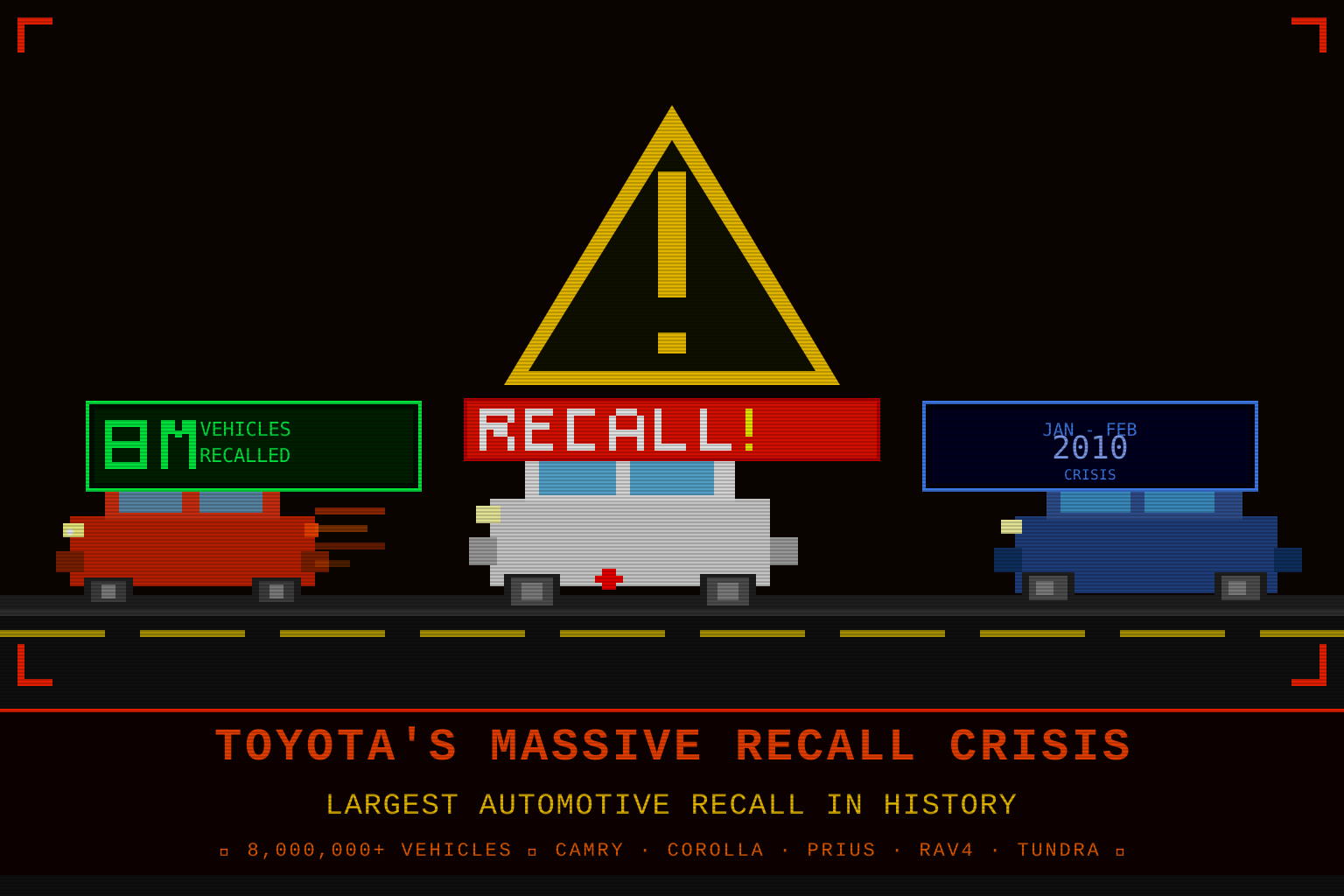
Beginning in late 2009 but escalating dramatically in January–February 2010, Toyota Motor Corporation faced an unprecedented crisis involving the largest automotive recall in U.S. and global history. The immediate trigger was a fatal August 28, 2009, crash near San Diego in which a loaner Lexus ES 350 accelerated uncontrollably to 120 mph, killing all four occupants; NHTSA records subsequently revealed that Toyota had received complaints about unintended acceleration dating back to 2002. On January 21, 2010, Toyota announced a recall of roughly 2.3 million vehicles to replace accelerator pedals prone to sticking; five days later, on January 26, it suspended U.S. sales and production of the eight affected models — the largest voluntary sales halt in the company’s history. Multiple overlapping recall waves ultimately covered over 8 million vehicles worldwide, including flagship models such as the Camry, Corolla, RAV4, Highlander, Prius, and Tundra. Toyota faced Congressional hearings in late February 2010 — most prominently the February 24 House Committee on Oversight and Government Reform hearing at which CEO Akio Toyoda testified directly — and endured regulatory investigations by NHTSA and international scrutiny. The crisis exposed deep tensions between rapid global expansion, cost containment, and safety assurance and became a defining reference point for corporate accountability and vehicle safety regulation.
Timeline of the Crisis
| Date | Event |
|---|---|
| August 28, 2009 | Fatal Lexus ES 350 crash near Santee, CA; 911 call from inside vehicle released publicly |
| September 29, 2009 | Toyota issues initial U.S. recall of 3.8 million vehicles for floor mat entrapment |
| January 21, 2010 | Toyota recalls ~2.3 million vehicles for sticky accelerator pedals (a defect separate from the floor mats) |
| January 26, 2010 | Toyota suspends U.S. sales and production of the eight affected models |
| January 27, 2010 | Floor-mat entrapment recall expanded by ~1.1 million vehicles at NHTSA’s urging |
| February 3, 2010 | Toyota announces fix for sticky pedal; 8 suspended models clear to resume sales |
| February 9, 2010 | NHTSA opens formal investigation into Prius brake issues |
| February 9, 2010 | Toyota recalls 437,000 Prius and Lexus HS 250h hybrids for brake software issue |
| February 24, 2010 | CEO Akio Toyoda testifies before the U.S. House Committee on Oversight and Government Reform |
| March 2010 | Separate recall for 2010 Tacoma all-wheel-drive front driveshaft propeller |
| April 2010 | NHTSA probe expands to evaluate whether Toyota withheld defect information |
| 2014 | Toyota reaches $1.2 billion criminal settlement with U.S. Department of Justice |
Significance
Scale and Precedent: The 2010 Toyota recall represented an unprecedented mobilization of the automotive safety apparatus. At its peak, over 8.5 million vehicles were subject to active recalls across multiple campaigns — far exceeding any prior single-manufacturer recall scope. For context: General Motors’ largest prior recall (1971, for potential engine compartment fires) covered approximately 6.7 million vehicles. Toyota’s recalls encompassed nine separate campaigns addressing overlapping issues. The scale demonstrated how interconnected global manufacturing had become, and how a defect cluster could simultaneously implicate models across multiple categories and price points.
Erosion of Brand Trust: Toyota’s reputation had been built on the Toyota Production System (TPS) — the manufacturing philosophy based on kaizen (continuous improvement) and jidoka (error-stopping) that made “Toyota quality” synonymous with reliability. For three decades, Toyota had used this quality positioning as a competitive differentiator in the U.S. market, where its vehicles commanded loyalty-premium pricing over domestic competitors. The recalls raised fundamental questions about whether Toyota’s aggressive global expansion — the company had surpassed GM as the world’s largest automaker in 2008 — had diluted the quality culture that underpinned its brand promise. Consumer-reputation surveys registered a steep drop in Toyota’s brand standing during the crisis, as buyers who had long associated the marque with reliability reassessed it.
Regulatory and Political Response: The crisis triggered the most aggressive U.S. government response to automotive safety since the 1970s seat-belt and airbag mandates. Secretary Ray LaHood’s Department of Transportation opened formal investigations and publicly called Toyota vehicles “unsafe to drive” — unusually direct language for a Cabinet official. The February 2010 Congressional hearings were among the most widely watched automotive industry testimonies in history; Akio Toyoda’s direct appearance before Congress was itself unprecedented for a sitting Toyota CEO. The hearings established precedent for rapid, adversarial Congressional intervention in automotive safety crises and influenced subsequent oversight of General Motors’ ignition switch recall (2014) and Takata airbag defect (2015–2016). Congress also used the hearings to argue for increasing NHTSA’s fine authority, which was capped at $16.4 million at the time — widely criticized as insufficient to deter non-disclosure by large automakers.
The Electronic Complexity Problem: As vehicles became increasingly computerized, the Toyota recall highlighted the diagnostic and accountability challenges posed by software-controlled systems. Unlike mechanical failures with clear cause-and-effect relationships, electronic throttle control (ETC) defects were harder to isolate, reproduce, and definitively attribute. NHTSA commissioned NASA engineers to independently review Toyota’s electronic throttle system — a remarkable step underscoring how inadequate the regulator’s in-house technical capacity was for evaluating modern automotive software. The February 2011 NASA/NHTSA report found no evidence of electronic defects causing unintended acceleration; most attributed incidents to floor mat entanglement or pedal misapplication. Yet the investigation took 15 months and its conclusions remained contested by plaintiffs’ attorneys. The episode exposed a gap between the pace of automotive technology adoption and the maturity of regulatory diagnostic capabilities — a gap that became more acute as autonomous-vehicle software grew increasingly complex through the following decade.
Financial Consequences: The direct recall repair costs exceeded $2 billion. Toyota’s U.S. sales fell 8.7% in February 2010 — the month of peak media coverage — compared with February 2009, while Ford and GM both posted gains as consumers shifted purchasing patterns. The company’s U.S. market share fell from 17.0% in 2009 to 15.2% in 2010. The long-term legal exposure proved substantial: in March 2014, Toyota agreed to a $1.2 billion criminal deferred-prosecution agreement with the U.S. Department of Justice — the largest criminal penalty ever imposed on an automotive manufacturer at that time — resolving charges that the company had concealed information about the unintended acceleration defects from regulators and the public. Civil settlements added several hundred million dollars more to the total.
Correlation with Broader 2010 Regulatory Environment: The Toyota crisis unfolded amid an already charged regulatory atmosphere. The Dodd-Frank Act, signed in July 2010, represented the most sweeping financial regulation expansion since the 1930s; the Affordable Care Act, signed in March 2010, represented the largest healthcare system overhaul since 1965. Together, these three major 2010 regulatory events — Toyota, Dodd-Frank, ACA — defined 2010 as a year when public trust in corporate and financial self-regulation collapsed, and government intervention was demanded across multiple sectors simultaneously. The Flash Crash of May 6, 2010, added financial markets to this list — another domain where rapid technology adoption had outpaced regulatory understanding.
Global Supply Chain Vulnerability: The crisis revealed vulnerabilities in Toyota’s globally dispersed manufacturing and quality assurance operations. The defect clusters implicated components sourced from multiple tier-1 and tier-2 suppliers across North America and Japan. The CTS Corporation (Indiana) manufactured the sticky pedal assembly at issue in the January 2010 recall; the floor mat entrapment issue implicated a supplier-installed mat sold by Toyota dealerships. Coordinating recalls and repairs across twelve countries with differing regulatory frameworks and consumer protection laws proved operationally complex, delaying resolution in some markets by months. The episode foreshadowed broader supply chain vulnerability concerns that would recur — most visibly in the 2011 Japan earthquake’s impact on Toyota production, and more broadly in the 2020–2021 semiconductor shortage that paralyzed global automotive manufacturing.
Industry-Wide Cultural Impact: The crisis prompted Toyota’s competitors to conduct internal audits of their own recall and defect-reporting processes. Ford, GM, and Chrysler each commissioned reviews of their NHTSA reporting workflows following the Toyota hearings. The automotive industry’s trade association (AIAM, Alliance of Automobile Manufacturers) began regular meetings with NHTSA to establish clearer communication protocols. These changes contributed to a measurable increase in voluntary recalls across the industry from 2010 onward — in part reflecting improved defect detection and reporting, and in part reflecting heightened concern about the reputational and legal consequences of delayed disclosure.
Sources
- Wikipedia: 2009–2010 Toyota vehicle recalls — comprehensive coverage of recall scope, models, and timeline
- NHTSA Official Investigation Records — federal safety investigation reports and recall notices
- NASA/NHTSA Technical Assessment of Toyota Electronic Throttle Control Systems, February 2011 — independent engineering review of electronic defect claims
- U.S. House Committee on Oversight and Government Reform Hearing, February 24, 2010 — Congressional testimony transcript including Akio Toyoda’s appearance
- U.S. Department of Justice Criminal Settlement with Toyota, March 2014 — $1.2 billion deferred prosecution agreement
- Reuters and Associated Press News Archives, 2010 — contemporaneous reporting on recall announcements and developments