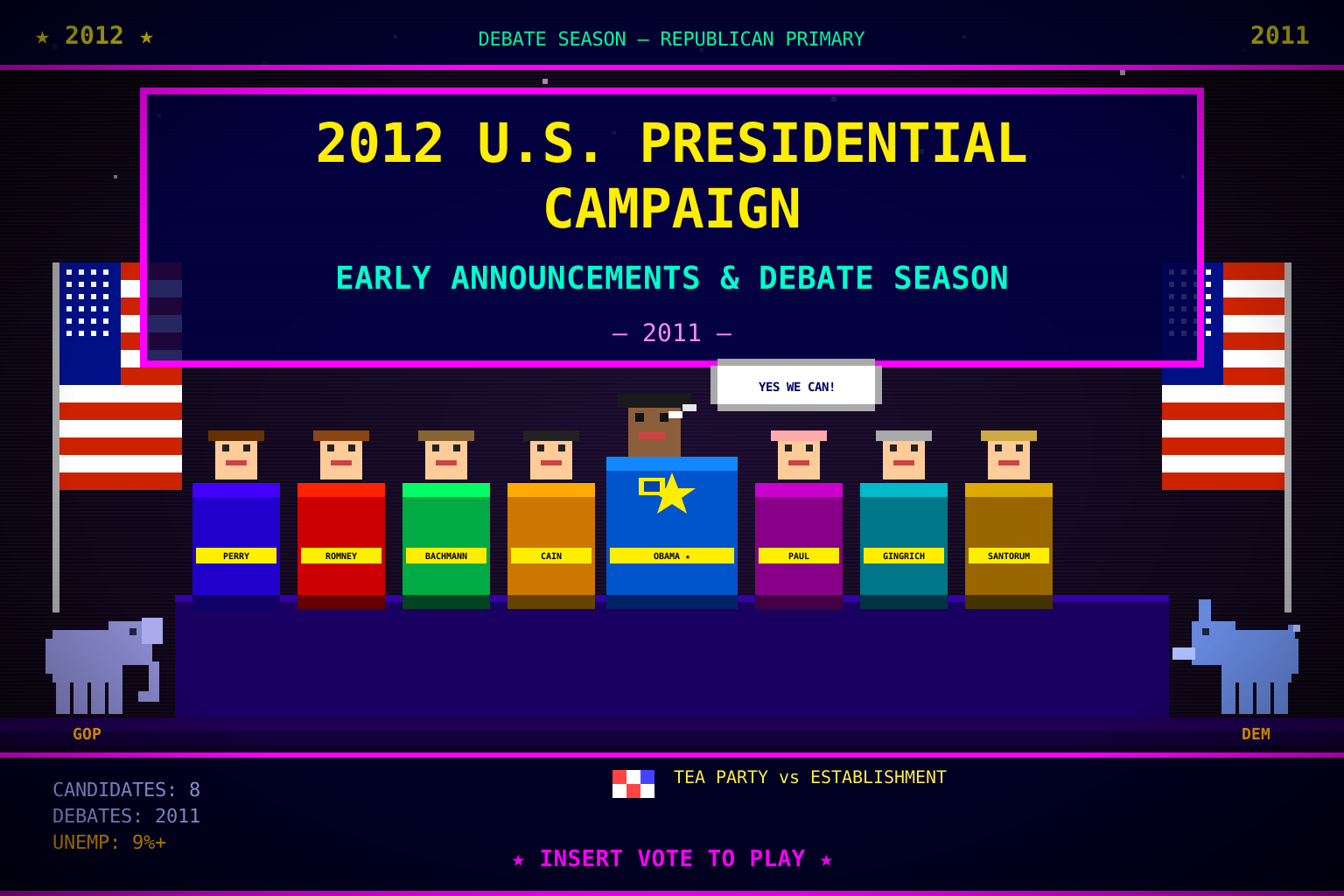
Key figures: Rick Perry, Mitt Romney, Michele Bachmann, Herman Cain, Ron Paul, Jon Huntsman, Newt Gingrich, Rick Santorum; incumbent President Barack Obama; Republican National Committee Chairman Reince Priebus
Summary
The 2012 presidential race began in earnest during 2011, with a historically large and fragmented Republican primary field emerging to challenge incumbent President Barack Obama. The campaign season was shaped by economic anxiety—unemployment remained above 9 percent through much of 2011—and by intense ideological contestation within the Republican Party between Tea Party insurgents, evangelical social conservatives, libertarian-leaning voters, and the established moderate wing that backed Mitt Romney.
The Republican Field Takes Shape
By spring 2011, the Republican field was extraordinarily fluid. Early speculation centered on figures who ultimately chose not to run: former Alaska Governor Sarah Palin, Indiana Governor Mitch Daniels, New Jersey Governor Chris Christie, and real estate developer Donald Trump (who publicly flirted with candidacy but declined in May 2011). Their absences set the stage for a contested field without a dominant establishment figure.
The announced candidates and their entry dates:
| Candidate | Announced | Background |
|---|---|---|
| Mitt Romney | June 2, 2011 | Former Gov. of Massachusetts; 2008 presidential candidate |
| Michele Bachmann | June 13, 2011 | Rep., Minnesota; Tea Party caucus founder |
| Tim Pawlenty | May 23, 2011 | Former Gov. of Minnesota (withdrew August 14, 2011) |
| Herman Cain | May 21, 2011 | Former CEO, Godfather’s Pizza |
| Ron Paul | May 13, 2011 | Rep., Texas; libertarian constitutionalist |
| Newt Gingrich | May 11, 2011 | Former House Speaker |
| Jon Huntsman | June 21, 2011 | Former Gov. of Utah; Obama’s Ambassador to China |
| Rick Santorum | June 6, 2011 | Former Senator, Pennsylvania |
| Rick Perry | August 13, 2011 | Gov. of Texas; entered at Ames Straw Poll |
Rick Perry’s Entry and Early Surge
Texas Governor Rick Perry’s August 13 entry—timed to coincide with the Ames, Iowa Straw Poll—immediately reshuffled the race. Perry combined evangelical credentials with a booming Texas jobs record (Texas had added 1 million jobs from 2007 to 2011, accounting for roughly 40 percent of all net U.S. job creation in that period) into a potent political message. Within days, national polls showed Perry rising to first place, often polling between 29 and 32 percent among Republican primary voters, surpassing Romney (who consistently polled in the mid-20s) and eclipsing the field.
Perry’s campaign was premised on contrasting Texas’s low-regulation, low-tax economic growth against what he framed as Obama’s “socialist” economic policies. He announced his candidacy on August 13 at the RedState Gathering in Charleston, South Carolina, and set an aggressively conservative tone in his early campaign, repeatedly characterizing Social Security as a “Ponzi scheme”—a framing (drawn from his 2010 book Fed Up! and pressed at the September 7 debate) that proved both energizing to some primary voters and a vulnerability in general-election matchups.
The Debate Season (May–December 2011)
The 2011 debate season was unprecedented in scope: eleven Republican primary debates were held before year’s end, compared to just six at a comparable point in the 2008 cycle. The debates—hosted by CNN, Fox News, NBC, Bloomberg, CBS, ABC, and others—exposed the field’s divisions and accelerated several candidates’ rises and falls.
Key moments:
- June 13, CNN New Hampshire Debate: The first major debate exposed Bachmann’s rhetorical sharpness; she announced her formal candidacy from the debate stage.
- September 7, NBC/POLITICO Debate (Simi Valley): Perry’s first debate, in which his Social Security attacks drew sharp Romney counterattacks. Romney performed defensively but held ground.
- September 22, Fox News/Google Debate: Perry was booed by some in the audience when defending Texas’s in-state tuition for children of undocumented immigrants—revealing the cultural fault lines within the primary electorate.
- November 9, CNBC Debate (Rochester, Michigan): Perry’s famous “oops” moment, in which he failed to remember the third of three federal agencies he pledged to eliminate (the Department of Energy), is widely considered the most consequential gaffe in modern primary debate history. Perry’s polling collapsed within weeks.
- November 12, CBS/National Journal Debate: Herman Cain, riding the wave of his “9-9-9” tax reform plan (a flat 9 percent income, corporate, and national sales tax), briefly led some national polls at 25–27 percent—before sexual harassment allegations emerged in late October and early November, fatally damaging his campaign.
Bachmann and Cain: The Dark-Horse Phenomenon
The 2011 primary illustrated the “non-Romney” dynamic that defined the race: as Republican voters cycled through alternatives to the perceived frontrunner, each new candidate surged and collapsed. Bachmann won the Ames Straw Poll on August 13, 2011, with 28.6 percent of votes—a signal of Tea Party strength—but was rapidly overshadowed by Perry’s entry the same day. Herman Cain’s “9-9-9” plan resonated with economically anxious primary voters seeking clear, dramatic alternatives to Obama’s approach; Cain briefly became the frontrunner in October before his campaign collapsed under the weight of multiple harassment accusations and revelations of an extramarital affair.
By December 2011, Newt Gingrich had become the latest “non-Romney” alternative, surging to lead in Iowa and nationally on the strength of debate performances in which his attacks on the media garnered applause. Gingrich polled at 33–37 percent in some national surveys in early December, with Romney steady in the mid-20s.
Obama’s Campaign Preparation
While Republicans contested their primary, President Obama’s reelection campaign, Obama for America, quietly built one of the most sophisticated political data and field operations in American history. The campaign set an early goal of raising $1 billion—ultimately raising $715 million through the election, the largest sum for any incumbent president to that point. Obama’s team focused heavily on grassroots organizing, particularly in swing states like Ohio, Florida, Virginia, and Colorado, using advanced voter targeting models developed from the 2008 campaign.
Obama’s approval ratings in 2011 ranged from approximately 41 to 49 percent (Gallup), depressed by elevated unemployment (which peaked at 9.1 percent in August 2011) and deep partisan polarization. The administration’s handling of the August 2011 debt ceiling crisis—which resulted in the first-ever U.S. credit rating downgrade, from AAA to AA+ by Standard & Poor’s on August 5—was perceived as politically damaging, contributing to approval ratings near their lowest of his presidency.
Significance
Realignment Dynamics
The 2011 campaign season represented an important stage in the realignment of American politics. The Tea Party’s influence—which had powered the 2010 Republican wave (netting 63 House seats and 6 Senate seats)—shaped the primary’s ideological floor. Candidates competed to be the most authentically anti-establishment, producing policy positions (abolishing the Federal Reserve, withdrawing from international organizations, eliminating multiple cabinet departments) that would have been considered fringe a decade earlier.
The primary’s length and intensity was self-defeating for the eventual nominee. Romney, who effectively clinched the nomination in April 2012 after a bruising primary extending through six months of national competition, emerged damaged by positions he had taken to win conservative voters—positions that limited his appeal in a general electorate where independents and suburban moderates were decisive.
Tea Party vs. Establishment
The 2011–12 primary season illustrated the tensions that would define the Republican Party through the 2016 election and beyond. The Tea Party’s insistence on ideological purity clashed with the pragmatic calculation that electability required moderation. Romney navigated this tension by projecting competence and inevitability rather than ideological fervor—a strategy that won him the nomination but generated insufficient enthusiasm among the base, contributing to lower Republican turnout in the 2012 general election.
Occupy Wall Street as Counter-Narrative
The simultaneous rise of Occupy Wall Street in September 2011 created a competing populist narrative. While Republicans argued over how far to slash government, Occupy protesters framed the central political question as inequality and corporate power—a framing that benefited Obama’s “Buffett Rule” and economic fairness messaging in the general election. The twin populisms of 2011—Tea Party anti-government and Occupy anti-corporatism—illustrated the depth of American public discontent with existing institutions.
Sources
- 2012 United States Presidential Election (Wikipedia) — comprehensive overview of primary and general election
- 2011–12 Republican Party Presidential Primaries (Wikipedia) — detailed primary chronology and candidate profiles
- Pew Research Center: 2012 Presidential Campaign Tracking — polling data and voter sentiment analysis
- Balz, D. (2013). Collision 2012: Obama vs. Romney and the Future of Elections in America. Viking — comprehensive account of both campaigns
Related
- United States Credit-Rating Downgrade — the August 5 S&P downgrade that shaped campaign messaging
- Occupy Wall Street — September 2011 counterpoint to Tea Party populism
- Death of Osama bin Laden — foreign-policy victory complicating Republican attack lines
- Eurozone Sovereign Debt Crisis — global economic context constraining campaign narratives
- Arab Spring — foreign-policy backdrop testing candidates’ international positions