Key figures: Rupert Murdoch (News Corporation chairman and CEO), James Murdoch (News International chairman), Rebekah Brooks (News International CEO), David Cameron (British Prime Minister), Jeremy Hunt (Culture Secretary), Lord Justice Brian Leveson (Inquiry chairman), Sir Paul Stephenson (Metropolitan Police Commissioner)
Summary
The 2011 phone-hacking scandal brought one of the most powerful media empires in the world into direct collision with democratic accountability. For five decades, Rupert Murdoch’s News International—the UK arm of News Corp—had wielded enormous political influence over British public life, backing governments from Margaret Thatcher through Tony Blair. The exposure of systematic, industrial-scale phone hacking at News of the World shattered that arrangement and triggered a regulatory crisis that reverberated through Westminster, Scotland Yard, and media boardrooms worldwide.
Chronology of the Crisis
The scandal’s roots stretched back to 2005–2006, when royal correspondent Clive Goodman and private investigator Glenn Mulcaire were arrested and convicted for hacking the voicemails of members of the Royal Household. News International claimed the practice was the work of “one rogue reporter,” an explanation that held—under pressure—until 2011.
The turning point came on July 4, 2011, when The Guardian reported that journalists at News of the World had hacked the voicemail of missing 13-year-old Milly Dowler in 2002, shortly after her disappearance—and had deleted messages, inadvertently giving her family false hope she was still alive. The story provoked a public uproar qualitatively different from earlier disclosures, personalizing the scandal’s victims and making the earlier “rogue reporter” defence untenable.
Within days, the crisis cascaded:
- July 7, 2011: News International confirmed the Dowler hacking and issued an apology.
- July 10, 2011: News of the World published its final edition after 168 years in print. The closure was framed as accountability, but critics noted it protected the more profitable The Sun and News Corp’s BSkyB acquisition bid.
- July 13, 2011: News Corp withdrew its £7.8 billion bid to acquire full ownership of BSkyB, the UK satellite television broadcaster, under regulatory and political pressure.
- July 15, 2011: Rebekah Brooks, CEO of News International, resigned. She was subsequently arrested and eventually tried in 2014.
- July 17, 2011: Sean Hoare, the first journalist publicly to allege phone hacking on a systematic basis, was found dead. A coroner later ruled his death non-suspicious.
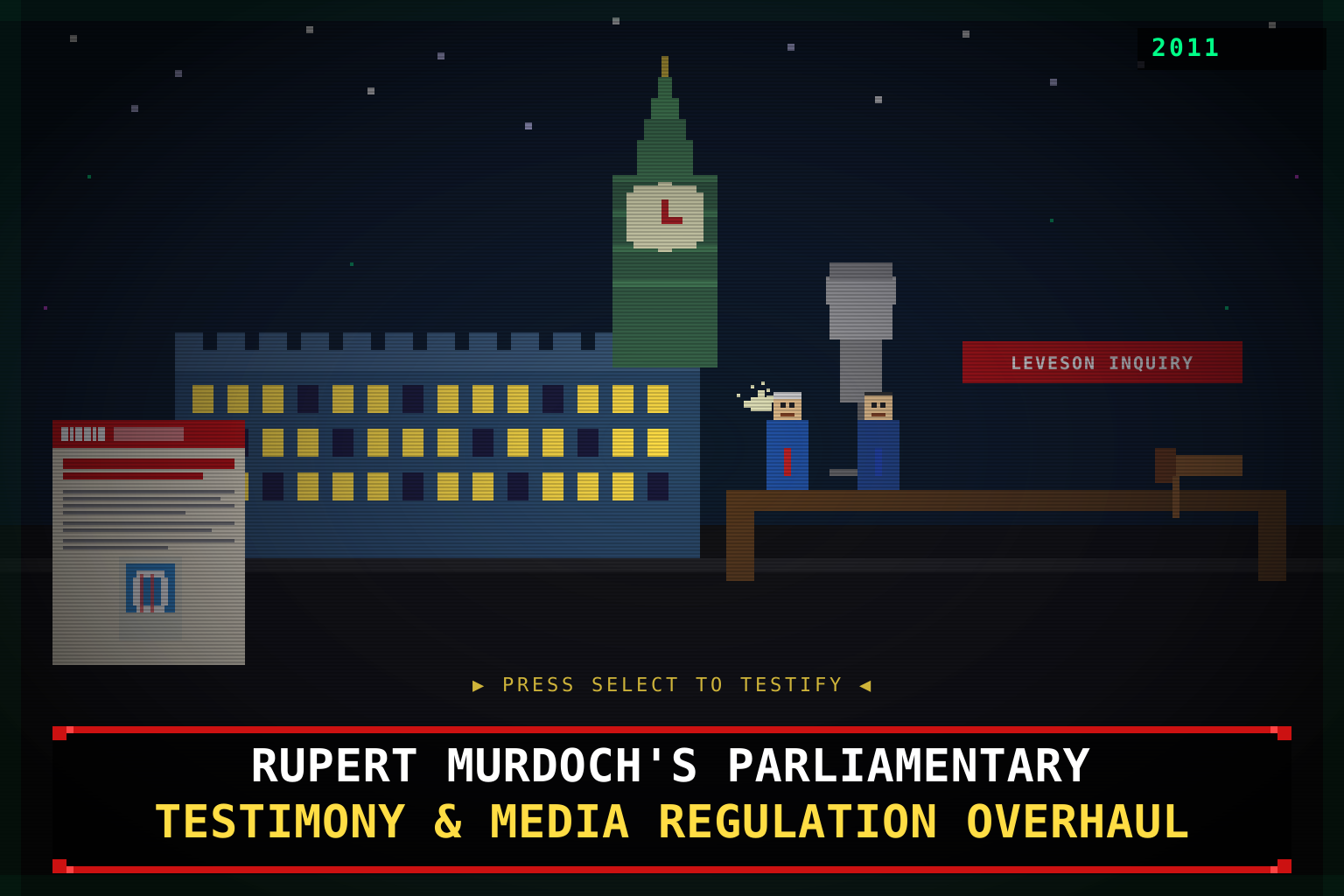
- July 19, 2011: Rupert Murdoch and his son James Murdoch appeared before the House of Commons Culture, Media and Sport Select Committee. During the hearing, Rupert Murdoch was struck in the face with a shaving cream-filled plate by comedian Jonnie Marbles; his wife Wendi Deng deflected the attacker.
The Parliamentary Testimony
Rupert Murdoch’s July 19 testimony was one of the most watched parliamentary hearings in British history. Appearing before MPs led by committee chairman John Whittingdale, Murdoch described the day as “the most humble day of my life.” He repeatedly claimed ignorance of the extent of hacking, stating that the relevant decisions were made by editors and journalists far below his direct oversight. James Murdoch similarly maintained he had not been fully briefed on the scale of the practice when authorizing a 2008 settlement payment of approximately £700,000 to Gordon Taylor, the Professional Footballers’ Association chief executive, whose phone had been hacked.
The committee’s subsequent 2012 report concluded that James Murdoch had “turned a blind eye” to mounting evidence of wrongdoing, and that Rupert Murdoch was “not a fit person to exercise the stewardship of a major international company”—an unprecedented parliamentary censure for a private citizen. News Corp rejected the findings.
The Leveson Inquiry
Prime Minister David Cameron announced the Leveson Inquiry on July 13, 2011. Chaired by Lord Justice Brian Leveson, the inquiry was formally titled An Inquiry into the Culture, Practices and Ethics of the Press. It ran in four modules:
- Module 1 (November 2011–February 2012): The culture and ethics of the press, including testimony from celebrities such as Hugh Grant, Sienna Miller, and Steve Coogan, who described systematic harassment and hacking.
- Module 2 (February–May 2012): The relationship between the press and police, including evidence of payments to officers and collusion in information exchange.
- Module 3 (May–June 2012): The relationship between the press and politicians, including testimony from David Cameron, Gordon Brown, Tony Blair, and other senior figures.
- Module 4 (July 2012): Regulatory models and proposals for reform.
The Inquiry heard testimony from more than 300 witnesses. Hacking victims who testified included actress Sienna Miller (whose £100,000 settlement with News International was among the first disclosed), rugby player Steve Clifford, and families of crime victims. By November 2011, News International had settled with more than 60 victims for amounts totaling over £2 million; by 2014 that total had risen to more than £500 million across thousands of claimants.
Leveson Report and Regulatory Aftermath
The Leveson Report, published in November 2012 in four volumes totaling approximately 2,000 pages, recommended establishing a new independent self-regulatory body for the British press, underpinned by statute to guarantee its independence—but not directly controlled by government. The key mechanism proposed was “recognition” by a “Recognition Panel” established by Royal Charter, which would verify the new regulator’s independence, effectiveness, and breadth of coverage.
The industry response was fractured:
- The majority of British newspapers, led by The Daily Mail and The Daily Telegraph, declined to join the Royal Charter-backed regulator (IMPRESS) and instead established IPSO (Independent Press Standards Organisation) in 2014.
- IMPRESS was certified as the independent regulator under the Royal Charter in 2016 but covered only a small number of publications.
This split means that, as of 2026, Britain effectively operates two parallel press regulation bodies, neither of which commands universal industry participation—an outcome widely seen as a partial implementation of Leveson’s vision.
Significance
Accountability and Power
Murdoch’s testimony crystallized a global reckoning with media power. For decades, Murdoch’s influence over British politics, culture, and governance had been near-absolute. The Sun’s political endorsements were considered determinative; “it’s The Sun wot won it” became a widely cited phrase after the 1992 general election. The 2011 scandal exposed the costs of that concentrated power and the informal arrangements between press barons and politicians that sustained it.
His appearance before Parliament symbolized the vulnerability of even the most entrenched corporate titans to democratic accountability, though his ability to retain ownership of News Corp (via a restructuring in 2013 that split the company into 21st Century Fox and the publishing-focused News Corp) also demonstrated the limits of that accountability.
Systemic Effects on Journalism and Police
The scandal revealed deep, structural relationships between tabloid journalists and the Metropolitan Police. Operation Elveden, a concurrent inquiry into corrupt payments to police and public officials, resulted in the prosecution of more than 60 journalists and officials; many of these charges ultimately did not result in convictions. The scandal led to the resignation of Metropolitan Police Commissioner Sir Paul Stephenson on July 17, 2011, and his deputy John Yates days later.
Scotland Yard’s Operation Weeting (the main phone hacking criminal investigation) and the parallel Operation Motorman (illegal use of private investigators) confirmed that hacking was not limited to News of the World; it was widespread across British tabloid journalism.
International Regulatory Impact
The scandal accelerated international movements for media regulation. In the United States, congressional hearings examined whether News Corp had hacked American citizens, including 9/11 victims’ families—allegations that were ultimately not conclusively proven. News Corp’s political influence in the United States (through Fox News) remained robust, but the British scandal added to domestic scrutiny of media conglomerate power.
Politically, the scandal damaged the Conservative Party’s credibility. Cameron’s prior employment of Andy Coulson—former News of the World editor who was eventually convicted of conspiracy to hack phones—as his communications director came under sustained scrutiny. Coulson was convicted in June 2014 and sentenced to 18 months in prison.
Sources
- Leveson Inquiry Official Report (2012) — comprehensive examination of press ethics and regulation
- News International Phone Hacking Scandal (Wikipedia) — detailed chronology and outcomes
- Davies, N. (2014). Hack Attack: The Inside Story of How the Truth Caught Up with Rupert Murdoch. Chatto & Windus — investigative account by the journalist who broke the story
- House of Commons Culture, Media and Sport Select Committee. (2012). News International and Phone-Hacking, HC 903 — parliamentary committee report
Related
- News of the World Phone Hacking Scandal — the tabloid closure and hacking revelations that precipitated the testimony
- WikiLeaks and Bradley Manning — parallel 2011 reckoning over institutional transparency and disclosure
- Occupy Wall Street — concurrent crisis of trust in powerful institutions
- Arab Spring — parallel debate over media power and democratic access