Key figures: Satoshi Nakamoto (Bitcoin creator, pseudonymous), Mark Karpelès (Mt. Gox operator), Erik Voorhees (Bitcoin entrepreneur), Gavin Andresen (Bitcoin Lead Maintainer), Charlie Shrem (BitInstant founder), Adrian Chen (Gawker journalist whose June 2011 article triggered the price spike)
Summary
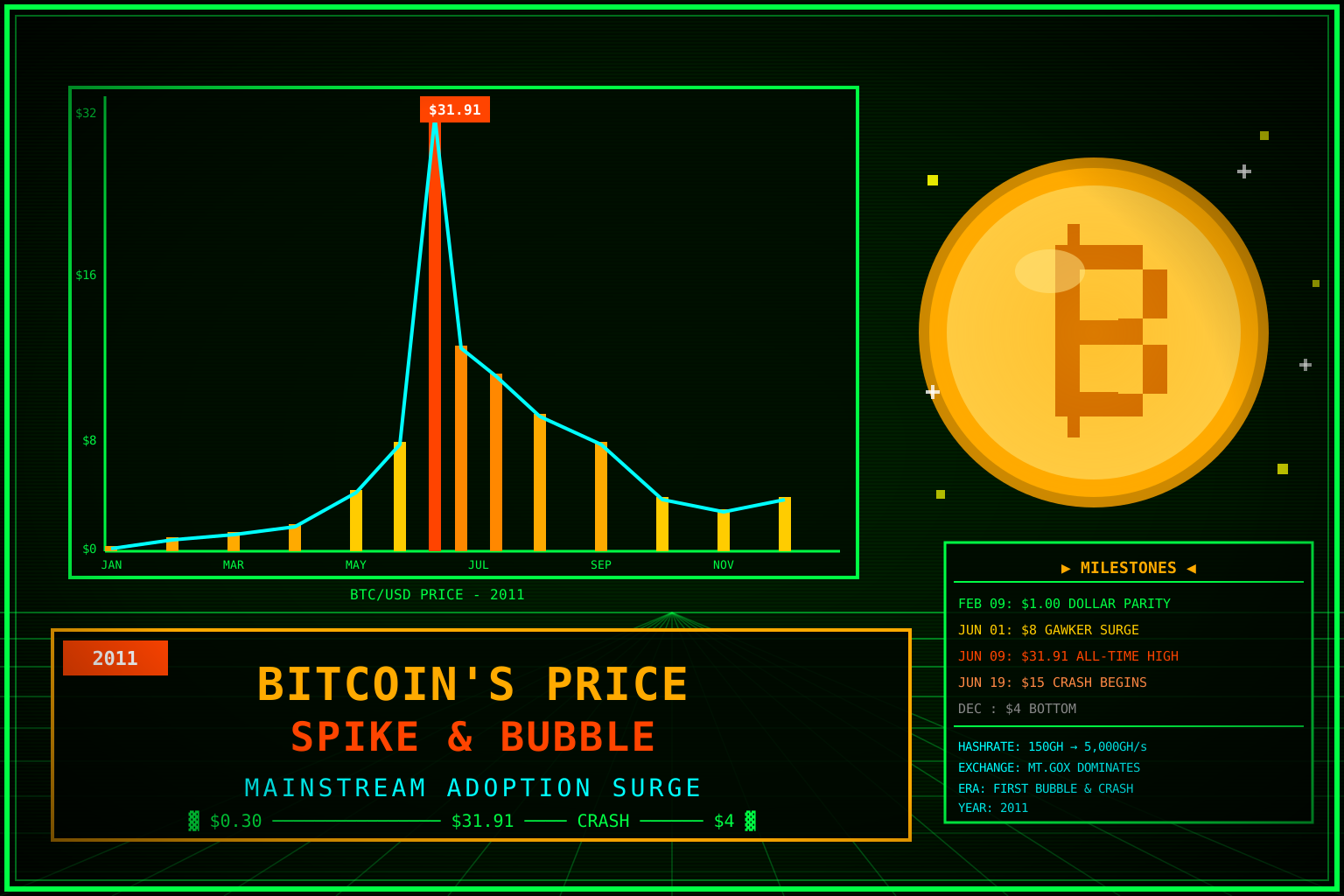
Throughout 2011, Bitcoin experienced its first major price bubble and subsequent crash, reaching an all-time high of approximately $30 per coin on June 8–9, 2011, before collapsing to single digits by December. Amid this volatility, the cryptocurrency ecosystem underwent rapid expansion: online exchanges proliferated, merchant adoption accelerated, and mainstream media coverage transformed Bitcoin from an obscure technical curiosity into a recognized (if controversial) financial phenomenon. The year also established the regulatory and security challenges that would define cryptocurrency’s subsequent decades.
Price and Network Milestones
| Date | Bitcoin Price (USD) | Network Hash Rate | Notable Event |
|---|---|---|---|
| January 1, 2011 | ~$0.30 | ~150 GH/s | Year opens; price near parity with USD first achieved |
| February 9, 2011 | $1.00 | ~300 GH/s | Bitcoin reaches dollar parity for the first time |
| April 18, 2011 | ~$2 | ~500 GH/s | Namecoin forks from Bitcoin codebase |
| June 1, 2011 | ~$8 | ~3,000 GH/s | Gawker Silk Road article published; price begins surging |
| June 8–9, 2011 | $31.91 | ~5,000 GH/s | All-time high at the time |
| June 19, 2011 | ~$15 | ~4,500 GH/s | Mt. Gox hack disclosed; price halves within hours |
| October 7, 2011 | ~$4 | ~8,000 GH/s | Litecoin launches as a Bitcoin alternative |
| December 31, 2011 | ~$4.25 | ~10,000 GH/s | Year closes; 87% below June peak |
Bitcoin’s network hash rate — a measure of total computational power dedicated to Bitcoin mining — grew roughly 65-fold over 2011, from approximately 150 GH/s to 10,000 GH/s (10 TH/s). This growth reflected the transition from CPU-based mining to GPU-based mining, a shift that dramatically increased both network security and the competitive pressure on individual miners.
The Road to $30
Bitcoin’s price began 2011 at approximately $0.30–$1 per coin. The rise was driven by several converging factors:
Dollar Parity: A Psychological Threshold
On February 9, 2011, Bitcoin reached $1.00 per coin, achieving parity with the U.S. dollar for the first time. This milestone, widely reported in the technical press, acted as a credibility signal: Bitcoin was no longer priced in fractions of a cent. The $1 threshold had a psychological effect on early adopters who had purchased Bitcoin when it was worth a few cents, and on newcomers evaluating whether to enter the market.
The Gawker Effect: Silk Road and the First Mainstream Spike
The decisive catalyst for the June surge was an article published by journalist Adrian Chen on Gawker.com on June 1, 2011, titled “The Underground Website Where You Can Buy Any Drug Imaginable.” Chen described Silk Road — an anonymous online marketplace running as a Tor hidden service and accepting only Bitcoin for payments — with sufficient technical detail to allow anyone to access it. The article reached millions of readers outside the existing cryptocurrency community.
The effects were immediate: Bitcoin’s price jumped from approximately $8 on June 1 to over $29 within a week, peaking at $31.91. Google searches for “Bitcoin” spiked to an all-time high. Mt. Gox, the dominant exchange, gained approximately 10,000 new user registrations per day in early June — compared to its previous pace of a few hundred. The Gawker article thus simultaneously introduced Bitcoin to a mass audience, exposed its use in illicit commerce, and created the speculative dynamics that drove prices to new highs.
Exchange Infrastructure: Mt. Gox Dominance
Mt. Gox (originally launched in 2007 as a trading card exchange site, repurposed for Bitcoin in July 2010 by Jed McCaleb and later acquired by Mark Karpelès in March 2011) became the dominant fiat-to-Bitcoin exchange. By June 2011, Mt. Gox handled over 70% of all Bitcoin-to-USD transactions and reported approximately 60,000 user accounts. Its dominance was a structural vulnerability — the concentration of exchange volume in a single, poorly secured platform meant that any failure at Mt. Gox would cascade through the entire Bitcoin market.
The rise of Mt. Gox coincided with the broader cloud computing infrastructure boom of 2011, which lowered barriers to running exchange and wallet services but also increased the attack surface available to sophisticated adversaries.
GPU Mining and the Technical Infrastructure Transition
Bitcoin’s first year (2009) saw mining performed on ordinary CPUs. By mid-2010, early adopters discovered that graphics processing units (GPUs) — designed for parallel computation for video games — could mine Bitcoin approximately 10–50× faster than CPUs. By 2011, GPU mining had become standard. Mining farms emerged: dedicated hardware setups with multiple high-end GPUs running 24 hours per day, consuming substantial electricity, and generating proportional Bitcoin rewards.
This transition had network-level consequences: the Bitcoin difficulty adjustment algorithm (which recalibrates mining difficulty every 2,016 blocks, approximately every two weeks) ratcheted upward continuously through 2011 as hash rate grew. Solo miners found it increasingly difficult to earn rewards; mining pools emerged as the dominant model, allowing miners to combine hash power and share rewards proportionally. By late 2011, large pools like Slush’s Pool (founded November 2010) commanded a significant fraction of total network hash rate.
The first commercial Application-Specific Integrated Circuit (ASIC) designs for Bitcoin mining were conceptualized in late 2011 — though the first commercial ASICs would not ship until mid-2013, their eventual arrival would make GPU mining economically obsolete.
The Mt. Gox Hack and Market Collapse
On June 19, 2011, Mt. Gox’s systems were compromised in a sophisticated attack. Hackers gained access to the exchange’s administrative database, exposing user account data and weakly-hashed passwords. More critically, they exploited administrative credentials to transfer approximately 2,609 BTC from an auditor account, triggering a cascading failure through the exchange’s internal systems.
In the immediate aftermath, the attacker used the compromised administrative access to place fraudulent sell orders at $0.01 per Bitcoin across approximately 478 accounts, briefly crashing the listed price to a penny before the exchange suspended trading. The actual market price — settled on external markets — fell from $17 to $15 within hours of the disclosure, continuing a decline over subsequent weeks.
The hack exposed structural weaknesses in Mt. Gox’s security:
- No Cold Storage — Mt. Gox kept the majority of customer Bitcoin in “hot” (internet-connected) wallets rather than “cold” (offline) storage, maximizing exposure to theft.
- Weak Password Storage — User passwords were stored with insufficient hashing (MD5 without adequate salting), enabling offline brute-force attacks against the database.
- Single Point of Failure — As the dominant exchange, Mt. Gox’s outage removed price discovery infrastructure for the majority of the market, amplifying uncertainty.
- No Regulatory Oversight — Unlike traditional financial exchanges, Mt. Gox faced no capital requirements, insurance mandates, or security audit requirements.
The June 2011 attack was a prelude: Mt. Gox suffered additional security incidents through 2013, culminating in the February 2014 disclosure that approximately 850,000 BTC (worth ~$450 million at then-current prices) had been stolen over years, the single largest cryptocurrency theft in history to that date.
Regulatory Scrutiny and Policy Responses
The 2011 price surge coincided with growing governmental attention to cryptocurrency:
Early U.S. Scrutiny and the Path to FinCEN Guidance
U.S. Senator Charles Schumer sent a letter to the DEA and the DOJ in June 2011 demanding that Silk Road and Bitcoin be shut down, citing the Gawker article. The letter was notable as the first formal action by a U.S. elected official targeting Bitcoin. While it produced no immediate enforcement action, it signaled that federal law enforcement was becoming aware of cryptocurrency and beginning to formulate responses.
The U.S. Treasury’s Financial Crimes Enforcement Network (FinCEN) began informal discussions about virtual currency classification in 2011, ultimately issuing formal guidance in March 2013 that classified virtual currency exchanges as “money services businesses” subject to the Bank Secrecy Act’s anti-money-laundering requirements.
International Responses
While U.S. regulatory response was delayed, other jurisdictions moved faster. In 2011, the European Central Bank published an analysis of virtual currency schemes — one of the first central bank assessments of Bitcoin — and concluded that Bitcoin’s decentralized nature made it difficult to regulate through existing monetary policy frameworks. Japan, which would later become a major cryptocurrency market (and where Mt. Gox was physically located), had no specific cryptocurrency regulations in 2011.
Alternative Currencies and Competitive Launches
Bitcoin’s 2011 volatility spurred alternative cryptocurrency projects, a pattern that would define the “altcoin” ecosystem:
- Namecoin (April 18, 2011) — The first Bitcoin fork, designed for decentralized domain name registration using the
.bitTLD. It introduced the concept of merge mining, allowing miners to simultaneously mine Bitcoin and Namecoin without dividing their hash rate. - Litecoin (October 7, 2011) — Created by former Google engineer Charlie Lee, Litecoin used the Scrypt hashing algorithm (favored over SHA-256 for its memory-intensiveness, which was intended to reduce ASIC advantage) and targeted 2.5-minute block times versus Bitcoin’s 10-minute target. Lee marketed Litecoin explicitly as “silver to Bitcoin’s gold.”
- Ripple — Conceptualized in 2011 by Jed McCaleb (who had previously sold Mt. Gox to Karpelès) as an alternative consensus mechanism using a trusted-validator network rather than Bitcoin’s proof-of-work. Ripple launched as a protocol in 2012 but its conceptual roots lie in 2011 discussions about Bitcoin’s limitations.
These alternatives reflected Bitcoin’s perceived limitations: slow transaction confirmation (~10 minutes per block), high energy consumption, and governance challenges arising from its decentralized structure.
Year-End State and Philosophical Implications
Bitcoin ended 2011 at approximately $4.25 per coin — an 87% decline from its June peak but still a roughly 14-fold gain from its January $0.30 start. The price crash was commonly described as “the bubble bursting,” yet several countervailing facts shaped subsequent analysis:
- The Bitcoin network remained operational throughout; no technical failure caused the collapse — only exchange failure and speculative retrenchment.
- The number of Bitcoin transactions processed by the network grew through the year even as price fell; usage and price diverged.
- Early Bitcoin businesses (including Coinbase, founded June 2012; and Kraken, founded July 2011) launched during or immediately after the crash, betting on long-term ecosystem growth despite short-term price collapse.
The 2011 volatility crystallized a philosophical divide among Bitcoin’s participants that would define the subsequent decade:
-
Monetary Utopians — Believers that Bitcoin represented a genuine alternative to government-issued fiat currency, immune to inflation and central bank manipulation. This camp drew heavily from Austrian School economics and libertarian political theory.
-
Technological Pragmatists — Engineers and computer scientists who viewed Bitcoin as an elegant proof-of-concept for decentralized consensus but questioned its volatility, scalability, and governance mechanisms.
-
Libertarian Ideologues — Advocates who saw Bitcoin as a tool for financial sovereignty, privacy, and resistance to state surveillance — as illustrated by Silk Road’s use of Bitcoin specifically because it evaded financial monitoring.
-
Skeptics — Economists and policymakers who viewed cryptocurrency as a speculative bubble detached from economic fundamentals, prone to manipulation, and unsuitable for mainstream commerce. This camp’s predictions of Bitcoin’s demise proved repeatedly premature.
Relationship to Concurrent Technology Trends
Bitcoin’s 2011 trajectory intersected with several broader technology developments. The rise of Android mobile platforms created a new distribution channel for Bitcoin wallets and exchange apps, expanding the accessible user base beyond desktop-computing early adopters. The launch of Google+ in June 2011 — concurrent with Bitcoin’s peak — illustrated Silicon Valley’s competing vision of the internet’s future: centralized, identity-verified social networking versus decentralized, pseudonymous financial infrastructure.
Significance
Bitcoin’s 2011 collapse was widely declared a death knell for cryptocurrency. Mainstream financial analysts and journalists predicted Bitcoin would fade into obscurity. Instead, 2011 marked the threshold between Bitcoin as an esoteric technical experiment and Bitcoin as a recognized (if controversial) financial asset class.
The year established several patterns that would define cryptocurrency’s subsequent evolution:
-
Extreme Volatility as a Feature — Bitcoin’s price cycles became a defining characteristic, attracting speculation and alarming traditional finance. Rather than deterring adoption, volatility became part of the asset’s mystique and a source of trading opportunity.
-
Regulatory Arbitrage — Cryptocurrency exchanges flourished in jurisdictions with light regulation while facing restriction in heavily regulated markets. This geographic fragmentation shaped global crypto adoption patterns — Mt. Gox in Japan, Bitstamp in Slovenia, later Binance in Malta and the Cayman Islands.
-
Security as a Critical Differentiator — The Mt. Gox hack made clear that exchange security was paramount. Subsequent infrastructure companies (Coinbase, founded 2012; Kraken, founded 2011) built their reputations partly on security practices: insurance, cold storage policies, and external audits.
-
Community-Driven Development — Bitcoin’s 2011 price collapse would have killed a centralized startup; the decentralized, community-governed Bitcoin network proved resilient. Lead maintainer Gavin Andresen continued releasing client updates (Bitcoin Core v0.3.24 was released in July 2011) throughout the market turbulence, demonstrating that the protocol itself was independent of any individual actor or institution.
By 2017, Bitcoin had again become a speculative phenomenon, reaching $20,000 per coin. By November 2021, it exceeded $68,000. The 2011 cycle — rapid rise, public hype, exchange disaster, crash, survivorship, regulatory adaptation — became the template for subsequent cryptocurrency booms and busts, repeated in 2013, 2017, and 2021.
Sources
- Bitcoin — Wikipedia
- Mt. Gox — Wikipedia
- Bitcoin Price History — CoinMarketCap
- Litecoin — Wikipedia
- Namecoin — Wikipedia
- The Underground Website Where You Can Buy Any Drug Imaginable — Gawker, June 1, 2011
- Bitcoin’s Price History — Investopedia
- The Mt. Gox Disaster: A Complete History — Wired, 2014
- FinCEN Application of FinCEN’s Regulations to Persons Administering, Exchanging, or Using Virtual Currencies — U.S. Treasury, March 2013
- Senator Schumer Letter on Silk Road — June 2011