Category: Science & Technology
Key figures: Kevin Systrom (CEO and co-founder), Mike Krieger (CTO and co-founder), Jack Dorsey (early investor), Mark Zuckerberg (Facebook, acquirer)
Summary
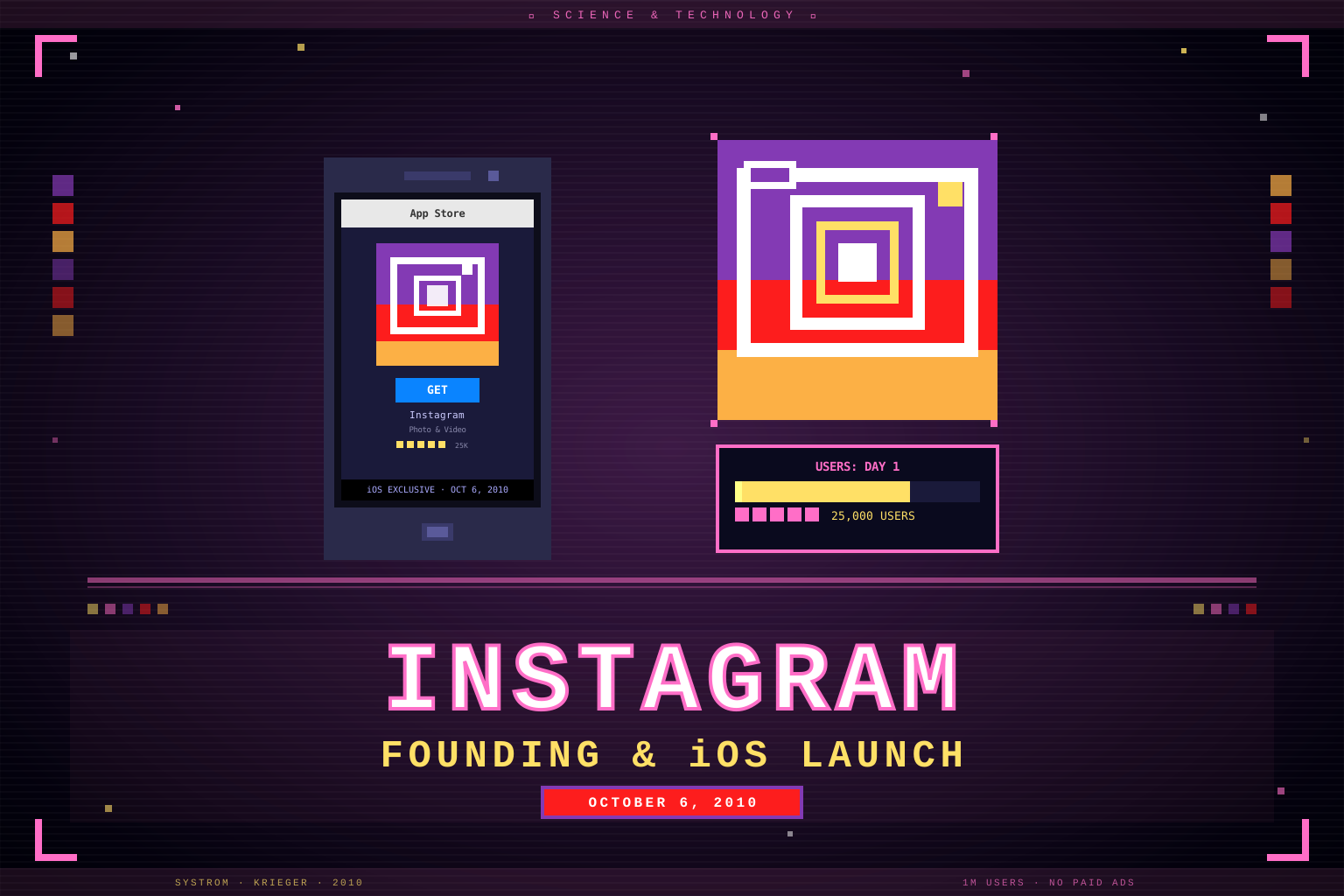
Instagram, the photo-sharing and social-networking application, launched on the Apple App Store on October 6, 2010, as an iOS-only platform. The app was built by Kevin Systrom and Mike Krieger, who had spent approximately eight weeks stripping an earlier check-in app called Burbn down to its photographic core. Instagram reached 25,000 registered users on its first day and 100,000 users within its first week — one of the fastest user-acquisition trajectories in App Store history to that point. By December 2010, Instagram had surpassed one million registered users, achieved without a single dollar of paid marketing.
By the end of 2011 — a year of rapid smartphone adoption driven by the iPhone 4S and Siri launch and the rise of the Android ecosystem — Instagram had grown to over ten million registered users on iOS alone and raised $7 million in Series A funding (February 2011) followed by a $50 million Series B in April 2012, which closed simultaneously with Facebook’s acquisition announcement.
From Burbn to Instagram
Kevin Systrom, a Stanford University graduate with a background in design and an early internship at Odeo (the podcast company that pivoted to become Twitter), began building Burbn in late 2009. The app was a location-based check-in service similar to Foursquare, with a photo-sharing component. Systrom raised a seed round of $500,000 from Baseline Ventures and Andreessen Horowitz in early 2010.
After Systrom partnered with Mike Krieger — a Stanford HCI (human-computer interaction) graduate and UX designer — the two concluded that Burbn was too complicated. They stripped everything from the app except its photo-sharing, liking, and commenting features, redesigning around three core principles:
- Speed: photos had to upload and appear in a follower’s feed faster than any competing app.
- Simplicity: the interface would have one primary action — posting a photo — with minimal secondary menus.
- Aesthetics: every photo would be square, echoing the Kodak Instamatic camera format, creating visual consistency across feeds.
The name “Instagram” combined “instant” (from instant cameras) with “telegram” (signifying rapid, direct communication).
Launch Metrics and Growth Trajectory
| Date | Milestone |
|---|---|
| October 6, 2010 | App Store launch (iOS only); 25,000 users day one |
| October 12, 2010 | 100,000 registered users |
| December 2010 | 1 million registered users |
| February 2011 | $7 million Series A (Benchmark Capital) |
| July 2011 | 5 million registered users |
| September 2011 | 10 million registered users |
| April 3, 2012 | Android version launched; 1 million new users in 12 hours |
| April 9, 2012 | Facebook acquisition announced for $1 billion (cash and stock) |
The growth curve was notable for being driven almost entirely by word-of-mouth and the network effect of existing users sharing their Instagram photos to Twitter and Facebook. During 2011, Instagram photos shared to Twitter carried a link back to Instagram’s mobile web preview, creating a viral loop that exposed non-users to the aesthetic and encouraged app downloads.
Filters, Design Philosophy, and the Square Format
Instagram launched with eleven filters — including Toaster, Walden, Valencia, Sierra, and X-Pro II — each inspired by analog photographic processes: overexposure, cross-processing, expired film, and Polaroid color shifts. The filters served a practical and psychological purpose: they transformed ordinary, mediocre smartphone photos into images that looked considered and artistic.
The square format (1:1 aspect ratio) was a deliberate departure from the 4:3 rectangular format of smartphone cameras. Systrom has cited the Kodak Instamatic and the Polaroid Land Camera as inspirations. Squareness had two advantages: it fit the standard smartphone screen width without letterboxing, and it created a uniform grid aesthetic in user profiles and feeds that rectangular photos would have disrupted.
The app’s stripped-down interface — a home feed, a search tab, a camera button, a notifications tab, and a profile tab — embodied the “less is more” design philosophy of the era. The design stood in contrast to Facebook’s feature density and even to Google+, which launched in June 2011 with a richer but more complex feature set.
Significance
Instagram’s 2010–2011 growth arc represented a decisive inflection in mobile social media. Several forces converged:
- Camera quality: the iPhone 4 (launched June 2010) featured a significantly improved 5-megapixel camera, making smartphone photography aesthetically viable for the first time for a broad consumer base.
- App Store maturity: by late 2010, the App Store had been open for two years and had a large installed base of iOS users accustomed to discovering and installing apps rapidly.
- Social graph portability: Instagram allowed users to connect their Twitter and Facebook accounts, bootstrapping their social graph without starting from zero.
The app’s rise posed an existential challenge to Flickr, Yahoo’s photo-sharing platform, which had dominated online photography sharing since 2004 but had grown slowly in the mobile era. Flickr’s registered user base stagnated through 2011 as Instagram’s surged; this shift marked the moment when mobile-native apps definitively displaced desktop-web incumbents in consumer photo sharing.
The $1 billion Facebook acquisition in April 2012, closing on the same day as Instagram’s Android launch, was the largest acquisition of a venture-backed startup with fewer than 20 employees in Silicon Valley history at the time. Instagram had 13 employees at acquisition. The deal reflected Mark Zuckerberg’s recognition that Instagram’s visual, mobile-first model represented the future of social sharing at a moment when Facebook itself was under pressure over its mobile experience. Steve Jobs died on October 5, 2011 — the day before Instagram’s first anniversary — and his death accelerated attention to Apple’s mobile ecosystem and the apps that defined it.