Category: Society & Economics
Key figures: Aaron Rodgers (Packers quarterback, Super Bowl MVP), Ben Roethlisberger (Steelers quarterback), Mike McCarthy (Packers head coach), Mike Tomlin (Steelers head coach), Jordy Nelson (Packers wide receiver), James Harrison (Steelers linebacker), Charles Woodson (Packers safety)
Summary
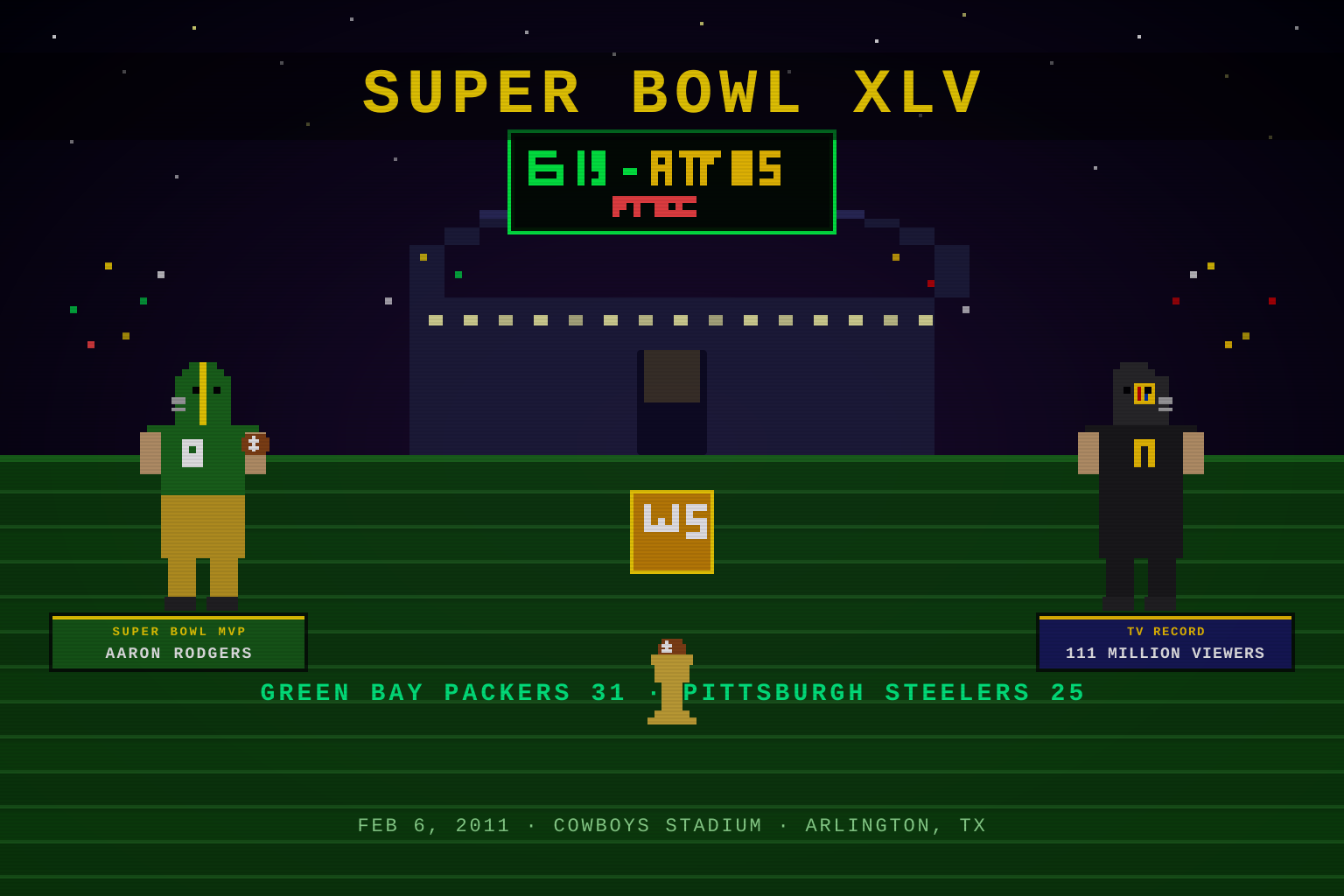
Super Bowl XLV, played on February 6, 2011 at Cowboys Stadium in Arlington, Texas, saw the Green Bay Packers defeat the Pittsburgh Steelers 31–25 in the National Football League’s championship game. Packers quarterback Aaron Rodgers was named Super Bowl MVP, completing 24 of 39 passes for 304 yards and three touchdowns with no interceptions — a performance that validated the Packers’ decision to build the franchise around the Wisconsin native after drafting him 24th overall in 2005.
The victory delivered the Packers their first Super Bowl title since January 1997 (Super Bowl XXXI) and their fourth in franchise history. With 111 million U.S. television viewers, Super Bowl XLV set a new record as the most-watched broadcast in American television history, surpassing the 106.5 million viewers who had watched Super Bowl XLIV the year prior. The game’s historic viewership underscored the NFL’s position as the dominant force in American sports entertainment.
Road to the Super Bowl
Green Bay Packers
The Packers entered the 2011 postseason as the sixth seed in the NFC with a 10–6 regular-season record — a position that required them to win three consecutive road games before reaching the Super Bowl. Their playoff run was among the most improbable in the Super Bowl era:
| Round | Opponent | Result |
|---|---|---|
| Wild Card | Philadelphia Eagles | 21–16 win (at Philadelphia) |
| Divisional | Atlanta Falcons | 48–21 win (at Atlanta) |
| NFC Championship | Chicago Bears | 21–14 win (at Chicago) |
Rodgers threw multiple touchdown passes in the road wins at Philadelphia and Atlanta before a grittier NFC Championship at Chicago, where he threw two interceptions but did enough to hold on. The Packers’ run mirrored the 2010–11 Green Bay squad’s ethos: efficient, mistake-free offense complemented by a defense that ranked fifth in the NFL in points allowed.
Pittsburgh Steelers
The Steelers entered as the second seed in the AFC with a 12–4 record, one of the most consistent franchises in NFL history and appearing in their third Super Bowl in six years. Quarterback Ben Roethlisberger led an offense ranked in the top five in the AFC for scoring efficiency, while the Pittsburgh defense — coordinated by Dick LeBeau — had held opponents to an average of 16.0 points per game during the regular season.
| Round | Opponent | Result |
|---|---|---|
| Divisional | Baltimore Ravens | 31–24 win |
| AFC Championship | New York Jets | 24–19 win |
Game Summary
First Half
Green Bay established early control of the game. Rodgers connected with Jordy Nelson for a 29-yard touchdown on an early drive to take a 7–0 lead, and safety Nick Collins returned a Roethlisberger interception 37 yards for a score to make it 14–0. After a Shaun Suisham field goal narrowed it to 14–3, a Rodgers-to-Greg Jennings touchdown extended the lead to 21–3, before Hines Ward’s 8-yard touchdown catch cut Green Bay’s halftime lead to 21–10.
The 11-point halftime deficit was among the largest the Steelers had faced all season, and Nelson’s active first half helped give the Packers a cushion they would need.
Second Half
Pittsburgh mounted a serious comeback. Rashard Mendenhall’s 8-yard touchdown run cut the lead to 21–17 in the third quarter; after Jennings’s second touchdown catch made it 28–17, Roethlisberger’s 25-yard scoring pass to Mike Wallace and a two-point conversion brought the Steelers within 28–25. Rodgers then drove the Packers into range for a Mason Crosby 23-yard field goal that restored a six-point lead, 31–25, with 2:07 to play.
The Steelers’ final drive, which needed a touchdown to win, stalled near midfield on a turnover on downs after three straight incomplete passes — allowing Rodgers to kneel out the clock and giving the Packers the championship.
Key Statistics
| Player | Team | Stat Line |
|---|---|---|
| Aaron Rodgers | Green Bay | 24-39, 304 yds, 3 TD, 0 INT |
| Ben Roethlisberger | Pittsburgh | 25-40, 263 yds, 2 TD, 2 INT |
| Jordy Nelson | Green Bay | 9 rec, 140 yds, 1 TD |
| Greg Jennings | Green Bay | 4 rec, 64 yds, 2 TD |
| Rashard Mendenhall | Pittsburgh | 14 car, 63 yds, 1 TD |
Charles Woodson, the Packers’ veteran cornerback, broke his collarbone in the second quarter and did not return — a loss that gave Pittsburgh the confidence to rally, but one that the Green Bay defense ultimately absorbed.
Venue and Spectacle
Cowboys Stadium, which had opened in August 2009 at a cost of $1.15 billion, was the largest indoor stadium in the world at the time of Super Bowl XLV. Its retractable roof spanned 660,800 square feet of indoor space, and its central video board — the largest HD screen in the world at the time — stretched 160 feet wide and 72 feet tall.
Official attendance was 103,219 — the largest crowd in Super Bowl history at that point. The game was hosted amid an unusual logistical crisis: a severe ice storm struck the Dallas–Fort Worth area in the days before the game, causing approximately 1,250 portable seats inside the stadium to be deemed unsafe and removed. Several hundred ticketed fans were unable to find seating, prompting an NFL investigation and eventual settlements.
The halftime show was performed by The Black Eyed Peas, who were joined by Slash and Usher during a 13-minute set. The performance drew mixed reviews from critics but delivered strong television ratings, with the halftime segment attracting an estimated 114 million viewers — briefly exceeding the in-game peak.
Aaron Rodgers and the Franchise Transition
Rodgers had spent three seasons on the Green Bay bench, from 2005 to 2007, learning behind Brett Favre — one of the most decorated quarterbacks in NFL history. Favre’s contentious departure from Green Bay in 2008, and the subsequent drama of his returns with the New York Jets and Minnesota Vikings, created a narrative in which Rodgers’s success was measured partly against his predecessor’s shadow.
Super Bowl XLV resolved that narrative decisively. Rodgers finished his first three seasons as a starter (2008–2010) with regular-season passer ratings of 93.8, 103.2, and 101.2 — all above the NFL average. His Super Bowl MVP performance, with no turnovers in a high-pressure environment against a historically strong Pittsburgh defense, confirmed his place among the NFL’s premier quarterbacks.
Rodgers’s efficient, low-turnover play — reflected in his 101.2 passer rating in 2010 and a 122.5 rating in the Wild Card win at Philadelphia — carried a sixth-seeded Green Bay team on an improbable run to the title.
Cultural and Economic Context
Super Bowl XLV was the first Super Bowl held in the Dallas–Fort Worth metropolitan area. The region’s economy received an estimated $1.5 billion in direct economic impact from the event, according to the Dallas Convention and Visitors Bureau, though independent economic analyses suggested a figure closer to $500 million after accounting for displacement of routine economic activity.
The game drew an international broadcast to 189 countries — reflecting the NFL’s sustained push to grow the sport globally, a campaign that would accelerate with the league’s International Series games held annually in London from 2007 onward.
Significance
Super Bowl XLV marked a generational transition in professional football. Green Bay’s victory validated a model of sustained franchise development — patient quarterback development, system coaching, organizational continuity — over the marquee free-agent assembling strategies employed by rivals. The Packers had not reached the Super Bowl since their Brett Favre–era victory in Super Bowl XXXI, but their patient investment in Rodgers produced a championship without the volatility that characterized rival franchises’ attempts at rapid rebuilding.
The game’s 111 million viewers broke the U.S. broadcast viewership record set just twelve months earlier by Super Bowl XLIV, demonstrating that NFL viewership was not plateauing but continuing to grow. Super Bowl XLV would itself be surpassed by Super Bowl XLVI the following February, beginning a sustained run of record-breaking Super Bowl audiences that continued through the mid-2010s.
See Also
- 2011 NBA Finals – Dallas Mavericks Championship — another championship underdog story in 2011, with the Mavericks defeating Miami’s assembled superteam
- Penn State Football Scandal (2011) — the year’s defining off-field sports story, contrasting sharply with the Super Bowl’s celebration of the sport
- Occupy Wall Street — the broader economic anxiety of 2011, against which the NFL’s billion-dollar spectacle played out
- 2011 Rugby World Cup — New Zealand’s parallel championship triumph, October 2011