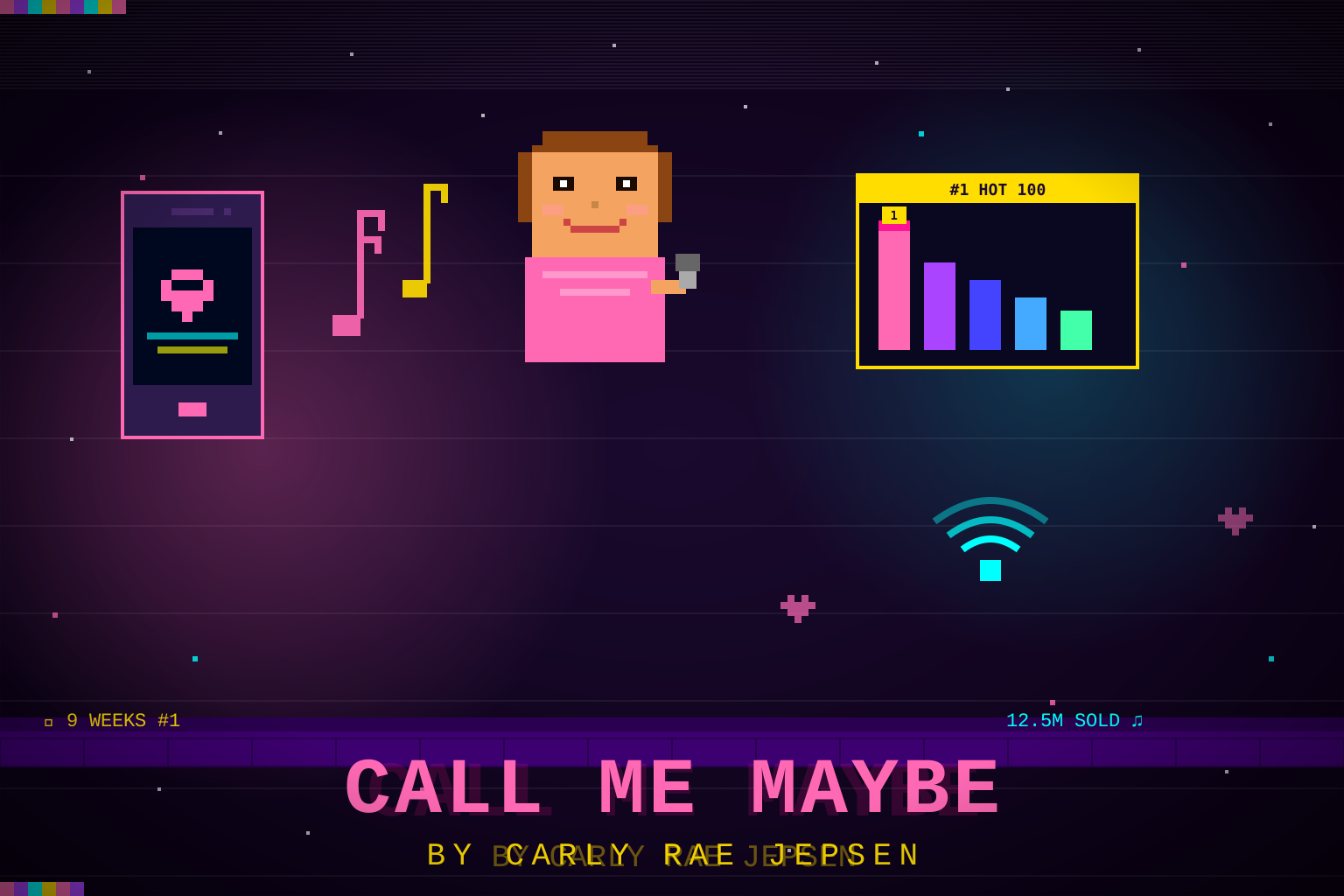
Key figures: Carly Rae Jepsen (singer, co-writer), Josh Ramsay (co-writer/producer), Tavish Crowe (co-writer), Justin Bieber and Scooter Braun (Schoolboy Records), Selena Gomez
Summary
“Call Me Maybe” is a song by the Canadian singer-songwriter Carly Rae Jepsen that grew from a modest domestic release into one of the most inescapable pop phenomena of 2012. Written by Jepsen with Josh Ramsay and Tavish Crowe, the bubblegum-pop track was first released as a single in Canada on September 20, 2011. Its transformation into a worldwide hit began after the Canadian pop star Justin Bieber publicly championed it and, with Selena Gomez and other celebrities, filmed an exuberant lip-sync video in February 2012 that went viral on YouTube and inspired thousands of imitations.
Powered by that social-media momentum, the song reached number one on the US Billboard Hot 100, where it spent nine weeks at the top — the longest run of any single in 2012, surpassing Gotye’s “Somebody That I Used to Know.” It topped the charts in Canada, the United Kingdom, and more than 18 other countries, sold roughly 12.5 million digital copies to finish as the best-selling digital single of the year, and earned Jepsen two Grammy Award nominations. The song appeared on her 2012 EP Curiosity and her second studio album, Kiss.
“Call Me Maybe” became emblematic of a new pathway to pop stardom in which a catchy single could achieve global saturation through participatory online sharing rather than traditional radio promotion alone — the same social-video dynamics that, months later, carried Gangnam Style to record-breaking ubiquity.
Origins and Release
Jepsen, who first gained attention as a third-place finalist on the fifth season of Canadian Idol in 2007, co-wrote “Call Me Maybe” with Tavish Crowe and Marianas Trench frontman Josh Ramsay, who produced the track. Originally conceived as a folk-leaning song, it was reworked in the studio into an up-tempo synth-driven pop number built around an insistent string hook. Released in Canada on September 20, 2011, it reached number one on the Canadian Hot 100 and drew the attention of fellow Canadian Justin Bieber, who tweeted his enthusiasm and, with his manager Scooter Braun, signed Jepsen to the Schoolboy Records label for international distribution.
Viral Breakthrough
The song’s global ascent was catalyzed by a homemade video posted in February 2012 in which Bieber, Selena Gomez, Ashley Tisdale, and other young celebrities danced and lip-synced along to the track. The clip spread rapidly and set off a wave of user-generated tribute videos — from the U.S. Olympic swim team to school groups, sports mascots, and military units — that turned the song into a participatory meme. The lighthearted, easily reproduced format made “Call Me Maybe” a template for the kind of low-barrier online imitation that increasingly drove pop hits in the smartphone era.
Commercial Performance
“Call Me Maybe” reached the summit of the Billboard Hot 100 in the summer of 2012 and held it for nine consecutive weeks, the longest number-one run of the year. It became a chart-topper in more than 20 countries, including Canada, the United States, the United Kingdom, and Australia. With approximately 12.5 million copies sold during the year, it was the best-selling digital single of 2012 worldwide, and its cumulative global sales made it one of the best-selling singles by a female artist of the century’s first decades. The track anchored Jepsen’s EP Curiosity (2012) and her album Kiss, released in September 2012.
At the 55th Annual Grammy Awards, held in February 2013, “Call Me Maybe” received nominations for Song of the Year and Best Pop Solo Performance, formal recognition of a single that had otherwise defined the year through sheer cultural saturation.
Significance
“Call Me Maybe” stands as a landmark example of how the mechanics of pop success shifted in the early 2010s. Rather than being broken primarily by radio programmers, the song achieved critical mass through celebrity endorsement and mass participation on YouTube and social platforms, demonstrating the promotional power of a single well-timed viral video. Its trajectory prefigured the even larger digital phenomenon of PSY’s “Gangnam Style” later the same year and reflected the broader 2012 convergence of music, mobile devices, and social media.
Though sometimes dismissed at the time as a disposable novelty, the song is now frequently cited as one of the defining pop records of its decade, and it established Jepsen — who later earned durable critical acclaim for her album Emotion (2015) — as a lasting figure in contemporary pop.
See Also
- Gangnam Style Viral Phenomenon — the year’s other globe-spanning music meme, driven by the same social-video virality
- Adele’s Album “21” — 2012 Dominance — a contrasting 2012 chart story built on album sales and critical acclaim rather than viral novelty
- Instagram Facebook Acquisition 2012 — part of the mobile-social infrastructure that made participatory music virality possible