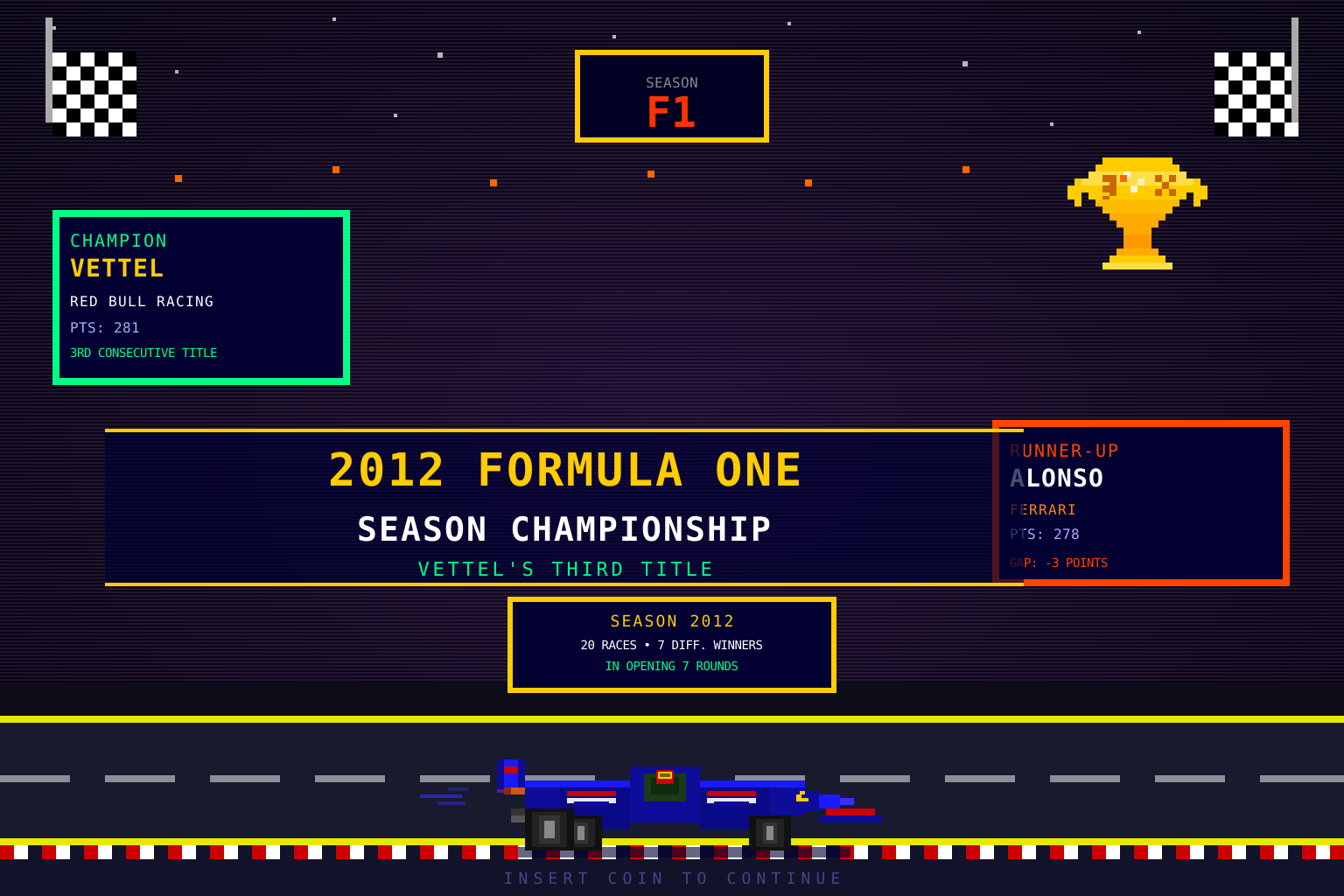
Key figures: Sebastian Vettel (Red Bull Racing, champion), Fernando Alonso (Ferrari, runner-up), Kimi Räikkönen (Lotus, third), Nico Rosberg (Mercedes), Lewis Hamilton (McLaren)
Summary
The 2012 Formula One World Championship ran from March 18 (Australian Grand Prix, Melbourne) through November 25 (Brazilian Grand Prix, São Paulo), establishing a record for season length with twenty races—surpassing the previous maximum of nineteen set in 2005. The season was defined by unusual competitive parity: the opening seven races produced seven different winners, a historic first indicating that no single team or driver dominated early momentum. The early chaos gave way to tighter championship contention as Ferrari’s Fernando Alonso emerged mid-season as the points leader, but Red Bull Racing’s Sebastian Vettel regrouped to ultimately claim his third consecutive World Drivers’ Championship by a margin of just three points over Alonso (281 to 278). Red Bull Racing also secured their third consecutive World Constructors’ Championship.
Season Calendar and Key Calendar Events
The 2012 calendar featured several notable additions and controversies:
- Return of the United States Grand Prix: The Circuit of the Americas in Austin, Texas, hosted the first United States Grand Prix since 2007 (at Indianapolis). Held on November 18, the race attracted over 117,000 spectators for race day and marked Formula One’s formal recommitment to the American market after a seven-year absence from the calendar.
- Bahrain Grand Prix reinstatement: The Bahrain Grand Prix (April 22), cancelled in 2011 due to civil unrest during the Arab Spring, was reinstated for 2012. The decision drew sustained criticism from human rights organizations, former drivers including David Coulthard, and political commentators who cited ongoing suppression of pro-democracy protests. Race weekend saw security incidents near the circuit, and several team personnel were briefly detained for observing protests.
- New venues: The race calendar also featured the return of Hockenheim (German Grand Prix, July 22) on a rotation with the Nürburgring.
Seven Different Winners in Seven Races
The first seven rounds of the 2012 season produced a unique statistical record in Formula One history: seven different winners from five different teams:
- Australia (March 18): Jenson Button (McLaren)
- Malaysia (March 25): Fernando Alonso (Ferrari)
- China (April 15): Nico Rosberg (Mercedes) — Rosberg’s first career Formula One victory
- Bahrain (April 22): Sebastian Vettel (Red Bull)
- Spain (May 13): Pastor Maldonado (Williams) — Williams’s first win since 2004; Maldonado became the first Venezuelan to win a Formula One race
- Monaco (May 27): Mark Webber (Red Bull)
- Canada (June 10): Lewis Hamilton (McLaren)
This sequence of seven different winners from rounds one through seven had never previously occurred in Formula One history (since at least the beginning of consistent statistical records in the 1950s). The parity reflected the effect of new technical regulations—particularly modifications to diffuser geometry and KERS (Kinetic Energy Recovery System) usage requirements—that narrowed the aerodynamic advantage Red Bull Racing had exploited to dominate the 2010 and 2011 seasons.
Championship Battle: Vettel vs. Alonso
Fernando Alonso emerged as the championship leader through the middle portion of the season, extracting remarkable results from a Ferrari chassis that was not considered the fastest car on the grid. His victory at the Malaysian Grand Prix, early-season consistency, and strategic race management gave him a lead that appeared potentially unassailable at mid-season.
Sebastian Vettel’s championship defense began poorly: he scored zero points in the first race in Australia (after a mechanical failure) and took time to find the RB8 car’s optimal operating window. Once Vettel and Red Bull unlocked consistent performance in the second half of the season, however, Vettel dominated: he won four consecutive races—Singapore (September 23), Japan (October 7), Korea (October 14), and India (October 28)—to overturn Alonso’s advantage.
The championship was ultimately decided at the Brazilian Grand Prix on November 25, 2012. Vettel was involved in a first-lap collision that dropped him to last place; he recovered through the field but required Alonso to finish outside the top five to secure the title regardless of Vettel’s finishing position. Alonso finished second. Vettel finished sixth, having recovered from 22nd place, and won the title by three points—one of the closest championship margins in Formula One history.
At 25 years, 4 months, and 22 days old at the time of his third title, Vettel became the youngest three-time World Drivers’ Champion in Formula One history.
Nico Rosberg’s Breakthrough
Nico Rosberg drove for Mercedes AMG Petronas in 2012, the manufacturer team’s third season after their return to Formula One as a constructor. At the Chinese Grand Prix (Round 3) on April 15 in Shanghai, Rosberg secured both his first career Formula One pole position and his first career victory. The win was significant: it was Mercedes’s first as a constructor since their return and demonstrated the team’s upward trajectory. Rosberg finished the season ninth with 93 points. His 2012 breakthrough presaged Mercedes’s eventual total domination of the sport from 2014 onward—a dynasty that would see Rosberg become World Drivers’ Champion in 2016.
Kimi Räikkönen’s Return
Kimi Räikkönen, the 2007 World Drivers’ Champion, returned to Formula One in 2012 after a two-year hiatus in which he competed in the World Rally Championship and NASCAR. Driving for Lotus-Renault, he adapted rapidly and secured third place in the Drivers’ Championship with 207 points, taking one victory (Abu Dhabi Grand Prix, November 4) and demonstrating consistent pace throughout the season. His return signaled that elite Formula One talent could persist through multi-year absences from the series.
Constructors’ Championship
| Position | Constructor | Points |
|---|---|---|
| 1 | Red Bull-Renault | 460 |
| 2 | Ferrari | 400 |
| 3 | McLaren-Mercedes | 378 |
| 4 | Lotus-Renault | 303 |
| 5 | Mercedes | 142 |
Contrast with Other 2012 Sports Stories
The 2012 Formula One season’s drama unfolded against a backdrop of major international sporting events. The London 2012 Olympics, held July 27–August 12, dominated global sports attention over the same summer period, with Formula One’s mid-season break overlapping the Games. The season also coincided with the Lance Armstrong USADA investigation, which concluded in October 2012 and resulted in Armstrong’s lifetime ban from competitive cycling—a reminder of the persistent doping governance challenges facing international sport, a conversation that touched Formula One’s own historical controversies with technical regulations and, in prior years, engine performance enhancement.
Significance
The 2012 season’s unprecedented early-season parity stood in sharp contrast to Red Bull’s recent dominance and challenged conventional understanding of Formula One’s competitive dynamics. The seven different winners in the opening seven races exemplified how narrowed technical advantages could temporarily equalize the field, producing a form of entertainment value that broadcast rights holders and circuit promoters had long sought. The tight championship finish between Vettel and Alonso—decided by only three points in the season’s final race—underscored Ferrari’s technical and strategic resurgence and the high stakes of points-maximization in what had become an increasingly close series.
Rosberg’s maiden victory was a breakthrough moment for Mercedes, the constructor that would come to dominate the sport from 2014 through 2021. The return of the US Grand Prix represented a significant commercial and political milestone for Formula One’s ongoing global expansion. The Bahrain reinstatement controversy, by contrast, highlighted tensions between Formula One’s commercial interests and broader questions of international sports governance and human rights that would continue to affect the sport’s relationship with government-sponsored events throughout the following decade.
See Also
- London 2012 Olympics — the summer’s dominant sporting event, overlapping the Formula One mid-season break
- Lance Armstrong USADA Investigation 2012 — the year’s defining sports-integrity story, concluding in October 2012
- UEFA Euro 2012 Football Championship — another of 2012’s marquee international sporting competitions, held June–July
- Nico Rosberg’s 2012 Breakthrough — the maiden pole and victory at the Chinese Grand Prix, one of the season’s seven first-time-of-year winners