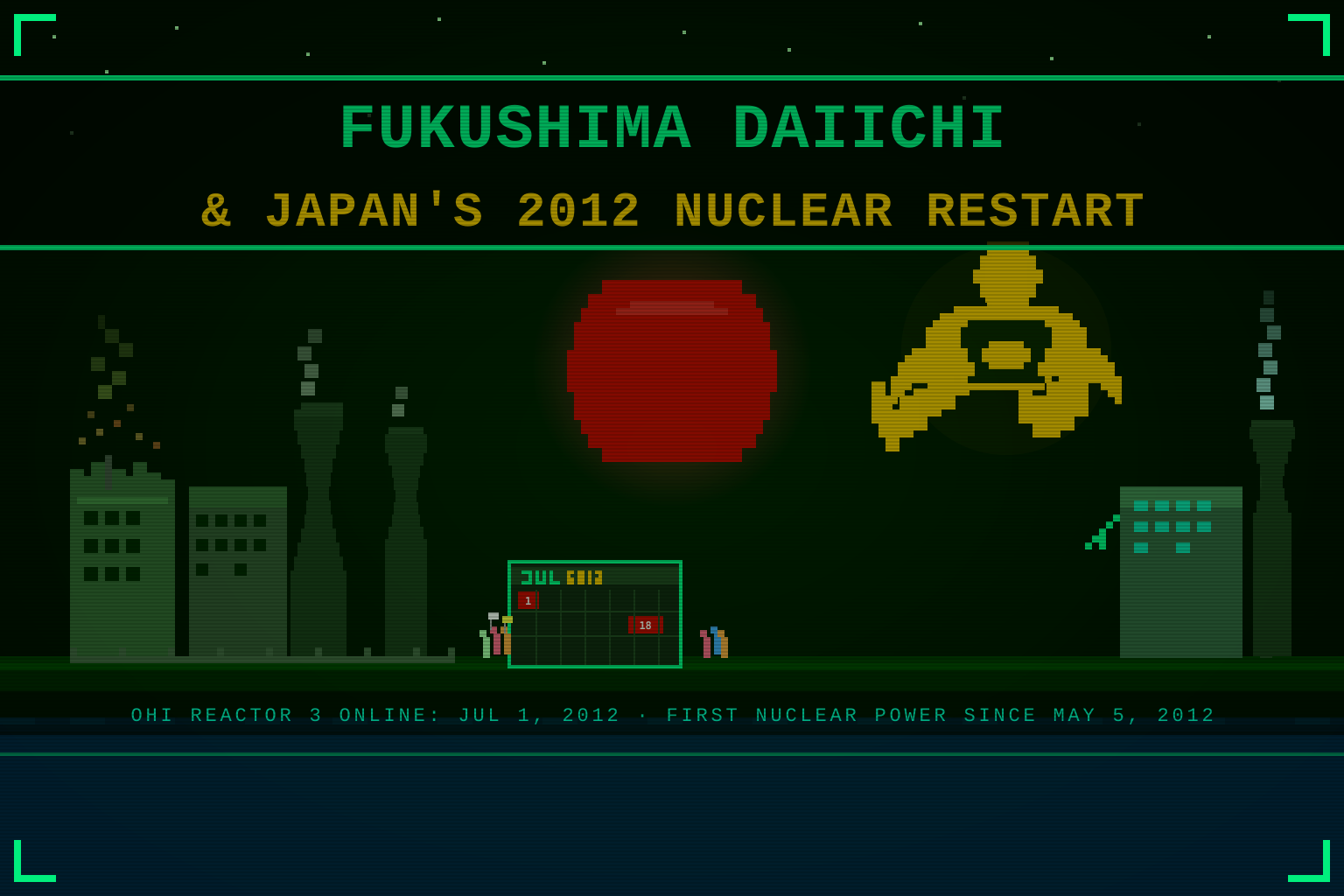
Key figures: Noda Yoshihiko (Prime Minister); Kansai Electric Power Co. (KEPCO); Nuclear Regulation Authority (NRA); Nuclear and Industrial Safety Agency (NISA); Tokyo Electric Power Co. (TEPCO)
Summary
On July 1, 2012, Japan restarted reactor 3 at the Ohi nuclear power plant in Fukui Prefecture — the first commercial nuclear reactor to resume operation in the country since the Fukushima Daiichi disaster of March 2011. Reactor 4 at Ohi followed on July 18, 2012. The restarts ended a roughly two-month period beginning May 5, 2012, when the last operating reactor in Japan — Tomari Unit 3 in Hokkaido — had gone offline for routine inspection, leaving the nation without nuclear power for the first time since 1970.
The decision was justified by the Noda government on economic grounds: with nuclear’s pre-Fukushima 30% share of electricity replaced almost entirely by imported liquefied natural gas (LNG), coal, and oil, Japan’s fossil-fuel import bill had risen by approximately ¥3.6 trillion in fiscal year 2011 (roughly US$45 billion at prevailing rates), contributing to Japan’s first trade deficit in three decades. KEPCO, which operated Ohi, had warned of severe summer power shortages in the Kinki region without the additional generation capacity.
The restarts proceeded despite continued triple-meltdown clean-up efforts at the Fukushima Daiichi site and against a backdrop of mass anti-nuclear public opposition. The two Ohi reactors operated until September 2013, when they entered routine maintenance; new post-Fukushima safety standards imposed by the newly created Nuclear Regulation Authority (NRA) prevented them from restarting again for years.
Background: The Fukushima Daiichi Accident
The Fukushima Daiichi nuclear disaster was triggered by the magnitude 9.0 Tōhoku earthquake and tsunami of March 11, 2011 — the most powerful earthquake recorded in Japan’s history. The tsunami inundated the Fukushima Daiichi plant’s backup diesel generators, eliminating the cooling systems for reactors 1, 2, and 3. All three reactor cores suffered meltdowns between March 11 and March 15, 2011, making Fukushima the worst nuclear accident since Chernobyl in 1986 and the second event ever rated Level 7 (the maximum) on the International Nuclear Event Scale (INES). TEPCO declared a cold shutdown state on December 16, 2011, though intensive decontamination and decommissioning work — estimated to span 30–40 years and ultimately priced by the Japanese government at approximately ¥21.5 trillion (roughly US$200 billion) — was only beginning.
The accident forced the evacuation of roughly 154,000 residents from the area surrounding the plant. It also triggered the sequential shutdown of all 50 of Japan’s commercial nuclear reactors as they came due for routine inspection and could not be restarted without additional safety reviews and local government approvals.
The Nuclear-Free Interlude and Energy Pressures
From May 5, 2012 — when Tomari Unit 3 shut down — until the Ohi restart on July 1, Japan operated entirely without nuclear electricity, the first such gap since 1970, when fission first became a continuous part of the national grid. The gap exposed the structural dependence that 30% nuclear capacity had masked. Japan lacked the domestic fossil fuel resources to compensate cheaply: its LNG imports, already rising, drove wholesale electricity costs sharply higher. TEPCO, which had provided roughly a third of Japan’s electricity from its nuclear fleet, received a ¥1 trillion government credit facility in March 2012 — effectively a bailout — before the government moved to a de facto nationalization in July 2012, acquiring approximately two-thirds of the company’s shares through the Nuclear Damage Liability Facilitation Fund.
Kansai Electric Power Co., whose service area (the Kinki region, centred on Osaka) was particularly exposed, warned it faced a 15% power shortfall during the summer of 2012 without the Ohi reactors. Some industrial customers pre-emptively arranged alternative power contracts or backup generators. Residential electricity tariffs in TEPCO’s service area rose roughly 8.5% in September 2012 — the first tariff increase in thirty years — with KEPCO implementing its own increases. The economic disruption underpinned the Noda government’s political justification for the restart.
The Ohi Restart Decision
Prime Minister Noda Yoshihiko personally defended the restart decision in a June 8, 2012 press conference, framing it as a choice between managed risk and certain economic damage. The formal approval for Ohi 3 and 4 came from three-step government sign-off: a panel of five senior ministers determined the restarts were safe; Minister of Economy, Trade and Industry Yukio Edano briefed the local Fukui Prefecture governor; and the governor gave his conditional assent — critically, under a 2011 agreement that extended a de facto veto right to host communities — in late June.
The safety basis for the restarts was provided by the existing Nuclear and Industrial Safety Agency (NISA), the pre-Fukushima regulator then still under the Ministry of Economy, Trade and Industry (METI). Critics pointed out that the same organizational structure that had failed to prevent Fukushima was now certifying the restarts — a conflict of interest that the subsequent NRA reform was designed to correct. NISA’s stress tests, conducted in two stages from December 2011, were nonetheless used as the procedural basis for authorizing the restarts.
Anti-Nuclear Public Opposition
The Ohi restarts occurred against unprecedented levels of public opposition to nuclear power in Japan. Weekly demonstrations outside the Prime Minister’s Official Residence in Tokyo, organised loosely by a coalition of citizen groups under the hashtag campaign #kantei (after the official title Kantei), drew growing crowds from spring 2012. On July 16, 2012 — a fortnight after the Ohi 3 restart — a major rally at Yoyogi Park in Tokyo drew estimates of 170,000 to 200,000 participants, one of the largest Japanese protest gatherings since the 1960s Anpo (US–Japan Security Treaty) demonstrations. The protests continued through the summer; organisers cited the August demonstrations outside the PM’s residence as collectively drawing the same scale of opposition.
Opinion surveys conducted throughout 2012 consistently showed majorities favouring a phase-out of nuclear power: Asahi Shimbun polls in the period recorded 70–80% support for eventual elimination of nuclear generation, though levels of support for immediate shutdown were lower and divided on timescale. The public debate was shaped both by Fukushima itself and by a Diet-mandated independent investigation (the National Diet of Japan Fukushima Nuclear Accident Independent Investigation Commission, or NAIIC) whose July 2012 report concluded that the disaster was “fundamentally man-made” — the result of collusion between government, regulators, and TEPCO — and “could and should have been foreseen and prevented.”
Regulatory Reform: Creating the NRA
The political and reputational damage from Fukushima forced a fundamental restructuring of Japan’s nuclear regulatory architecture. On June 20, 2012, the Diet passed the revised Nuclear Reactor Regulation Law, which:
- Imposed a 40-year operational limit on nuclear reactors, with the possibility of a single extension of up to 20 years upon passing a “special inspection” process;
- Established the Nuclear Regulation Authority (NRA) as an independent commission outside METI’s control, placed instead under the Ministry of the Environment;
- Separated the promotional and safety-regulation functions that had been combined in NISA, eliminating what critics called “regulatory capture.”
The NRA formally came into existence on September 19, 2012. Its first chairman was Tanaka Shunichi, a former Japan Atomic Energy Commission member. The NRA proceeded to develop new post-Fukushima safety standards — addressing external-hazard protection, filtered venting, hydrogen recombiners, and on-site spent fuel storage — which reactors would have to satisfy before being permitted to restart. When the Ohi 4 reactor shut down for maintenance in September 2013, neither it nor Ohi 3 could pass the new NRA review for years. Japan’s nuclear generation dropped back to zero in September 2013 and did not resume until the Sendai nuclear plant’s Unit 1 restarted under NRA clearance in August 2015.
The September 2012 Zero-Nuclear Policy (and Its Reversal)
On September 14, 2012, the Noda Cabinet announced the “Innovative Strategy for Energy and the Environment,” which articulated a goal of achieving zero dependence on nuclear power “in the 2030s” — a significant departure from the pre-Fukushima target of expanding nuclear to 50% of the electricity mix by 2030. The announcement was a political concession to the protests and the NAIIC report. However, the government immediately hedged: the strategy did not specify a binding timetable, and business groups, including Keidanren, objected loudly to the economic implications.
When the Abe Shinzō government came to power following the December 2012 Lower House election — fought under the shadow of Japan’s first trade deficit in three decades and rising electricity costs — it declined to endorse the zero-nuclear target, instead beginning a multi-year process of reviewing the NRA standards, rewriting Japan’s Basic Energy Plan (eventually published in April 2014 to describe nuclear as an “important base-load power source”), and working to restart as many approved reactors as possible. The 2012 policy reversal arc thus captured the central paradox of post-Fukushima Japan: democratic pressure for nuclear phase-out in tension with structural economic dependence on nuclear generation.
Key Facts
| Item | Detail |
|---|---|
| Triggering disaster | Fukushima Daiichi accident, 11 March 2011 (INES Level 7) |
| Japanese reactors offline | All 50 commercial reactors, by 5 May 2012 |
| First restart | Ohi Unit 3, 1 July 2012 (KEPCO, Fukui Prefecture) |
| Second restart | Ohi Unit 4, 18 July 2012 |
| Largest 2012 protest | ~170,000–200,000 in Tokyo, 16 July 2012 (Yoyogi Park) |
| NAIIC report | July 2012 — concluded disaster was “fundamentally man-made” |
| NRA established | 19 September 2012 |
| 40-year reactor limit | Imposed by revised Nuclear Reactor Regulation Law, June 2012 |
| Zero-nuclear policy | Announced 14 September 2012; reversed under Abe government from December 2012 |
| Ohi closure | Both reactors returned to maintenance, September 2013; did not restart until after 2015 |
See Also
- European Debt Crisis — 2012 Escalation — the global economic pressures that made Japan’s fossil-fuel import surge — contributing to its first trade deficit in three decades — particularly damaging
- 2012 Arctic Sea Ice Minimum — a parallel 2012 story of energy choices and climate consequence, as Japan’s emergency fossil-fuel substitution added to global carbon emissions at a critical juncture
- NFIB v. Sebelius: Supreme Court Upholds Affordable Care Act — another 2012 high-stakes regulatory ruling in which courts, legislatures, and public opinion clashed over the scope of government authority over a major economic sector
- Xi Jinping’s 2012 Elevation to General Secretary — the concurrent leadership transition in China, Japan’s most consequential neighbour and a country navigating its own energy and environmental policy pressures in 2012
- Spain’s 2012 Banking and Property Crisis — a contemporaneous case of an advanced economy absorbing the structural costs of a prior investment bet gone wrong, with similarly contentious public debate over austerity versus recovery
Sources
- Japan halts last nuclear reactor at Ohi — BBC News
- Update on the Restarting of Nuclear Power Plants in Japan — Japan for Sustainability
- Nuclear Power in Japan — World Nuclear Association
- The National Diet of Japan Fukushima Nuclear Accident Independent Investigation Commission — Executive Summary (2012)
- Nuclear Regulation Authority — Japan (official site)