Key figures: Bob Diamond (Barclays chief executive); Marcus Agius (Barclays chairman); Jerry del Missier (Barclays chief operating officer); Martin Wheatley (UK Financial Services Authority, author of the Wheatley Review)
Summary
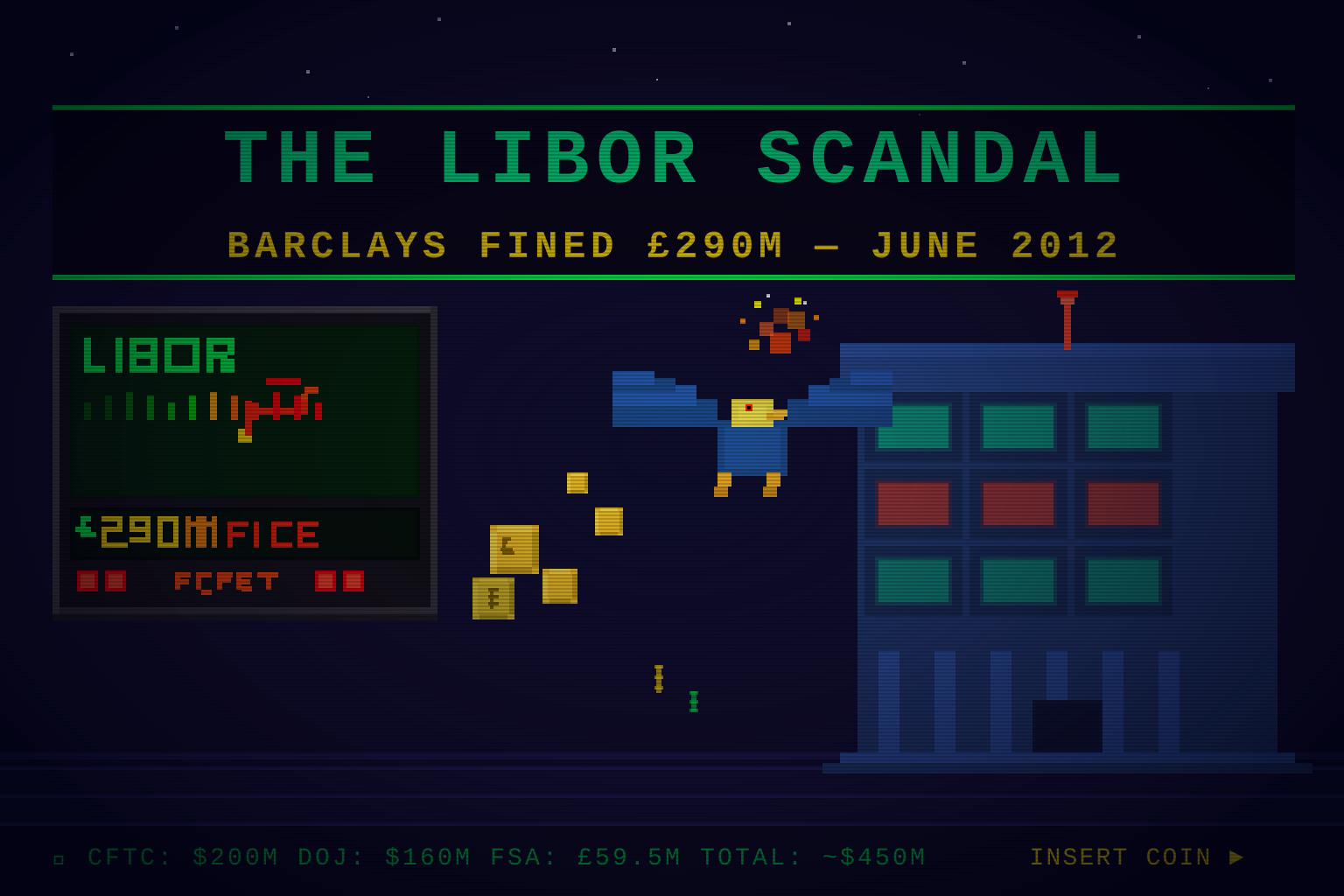
On 27 June 2012, the British bank Barclays reached settlements with regulators in the United Kingdom and the United States, agreeing to pay about £290 million (roughly $450 million) for manipulating the London Interbank Offered Rate (LIBOR) and its euro equivalent, EURIBOR. The penalties comprised $200 million to the U.S. Commodity Futures Trading Commission, $160 million to the U.S. Department of Justice, and £59.5 million to the UK Financial Services Authority (FSA) — at the time the largest fine the FSA had ever levied. Barclays was the first bank to settle in what became a sprawling, multi-year international investigation.
LIBOR was a benchmark interest rate meant to reflect the average cost at which major banks could borrow from one another. It was calculated each day from rate submissions by a panel of banks and administered by the British Bankers’ Association (BBA). Because LIBOR underpinned an estimated $300–350 trillion in financial contracts worldwide — mortgages, student loans, corporate debt, and interest-rate derivatives — even tiny distortions carried enormous financial consequences. Regulators found that Barclays traders had, from at least 2005, requested artificially high or low submissions to profit their derivatives positions, and that during the 2007–2009 financial crisis the bank had “lowballed” its submissions to appear healthier and cheaper to fund than it actually was.
The disclosure of internal messages — in which traders thanked colleagues for favours with offers of champagne — made the scandal a symbol of banking-sector culture after the global financial crisis. Within a week of the settlement, three of Barclays’ most senior figures resigned: chairman Marcus Agius announced his departure on 2 July 2012, and chief executive Bob Diamond and chief operating officer Jerry del Missier both stepped down on 3 July 2012. Diamond appeared before a UK parliamentary committee the same week to answer for the bank’s conduct.
Significance
The Barclays settlement opened a global reckoning over the integrity of financial benchmarks. Investigations widened to other panel banks: UBS was fined about $1.5 billion in December 2012, and the Royal Bank of Scotland, Deutsche Bank, and others settled in the following years, producing cumulative penalties in the billions of dollars and several criminal convictions of individual traders. The affair demonstrated that a rate quietly assembled from banks’ own estimates — rather than from verifiable market transactions — was vulnerable to manipulation and conflicts of interest.
In response, the UK government commissioned the Wheatley Review, led by FSA managing director Martin Wheatley and published on 28 September 2012. It recommended stripping the BBA of its role, anchoring submissions in actual transactions, delaying publication of individual banks’ figures, and creating criminal penalties for manipulation. LIBOR administration became a regulated activity in 2013 and passed in 2014 to NYSE Euronext’s successor, Intercontinental Exchange (ICE). Regulators ultimately moved to retire LIBOR altogether in favour of transaction-based benchmarks such as SOFR and SONIA, with most LIBOR settings ceasing between 2021 and 2023.
The scandal deepened public distrust of the banking industry during a period already defined by the European sovereign-debt crisis and Spain’s banking and property collapse, and it sharpened political demands for tougher financial regulation on both sides of the Atlantic.
Key Facts
- Settlement date: 27 June 2012
- Total Barclays penalty: about £290 million (~$450 million) — $200M (CFTC), $160M (US DOJ), £59.5M (UK FSA)
- Benchmark manipulated: LIBOR (and EURIBOR), then administered by the British Bankers’ Association
- Manipulation period: routine trader-driven rigging from at least 2005; crisis-era “lowballing” during 2007–2009
- Scale of exposure: LIBOR underpinned an estimated $300–350 trillion in global contracts
- Resignations: chairman Marcus Agius (2 July 2012); CEO Bob Diamond and COO Jerry del Missier (3 July 2012)
- Reform: the Wheatley Review (28 September 2012); administration moved to ICE (2014); LIBOR largely phased out 2021–2023
- Wider fallout: UBS fined ~$1.5 billion (December 2012); further multibillion-dollar bank settlements followed
See Also
- European Debt Crisis — 2012 Escalation — the sovereign-debt turmoil that formed the backdrop to the banking-sector reckoning
- Spain’s 2012 Banking and Property Crisis — a parallel 2012 crisis of confidence in European banks
- Facebook Initial Public Offering 2012 — another 2012 episode that tested trust in major financial institutions