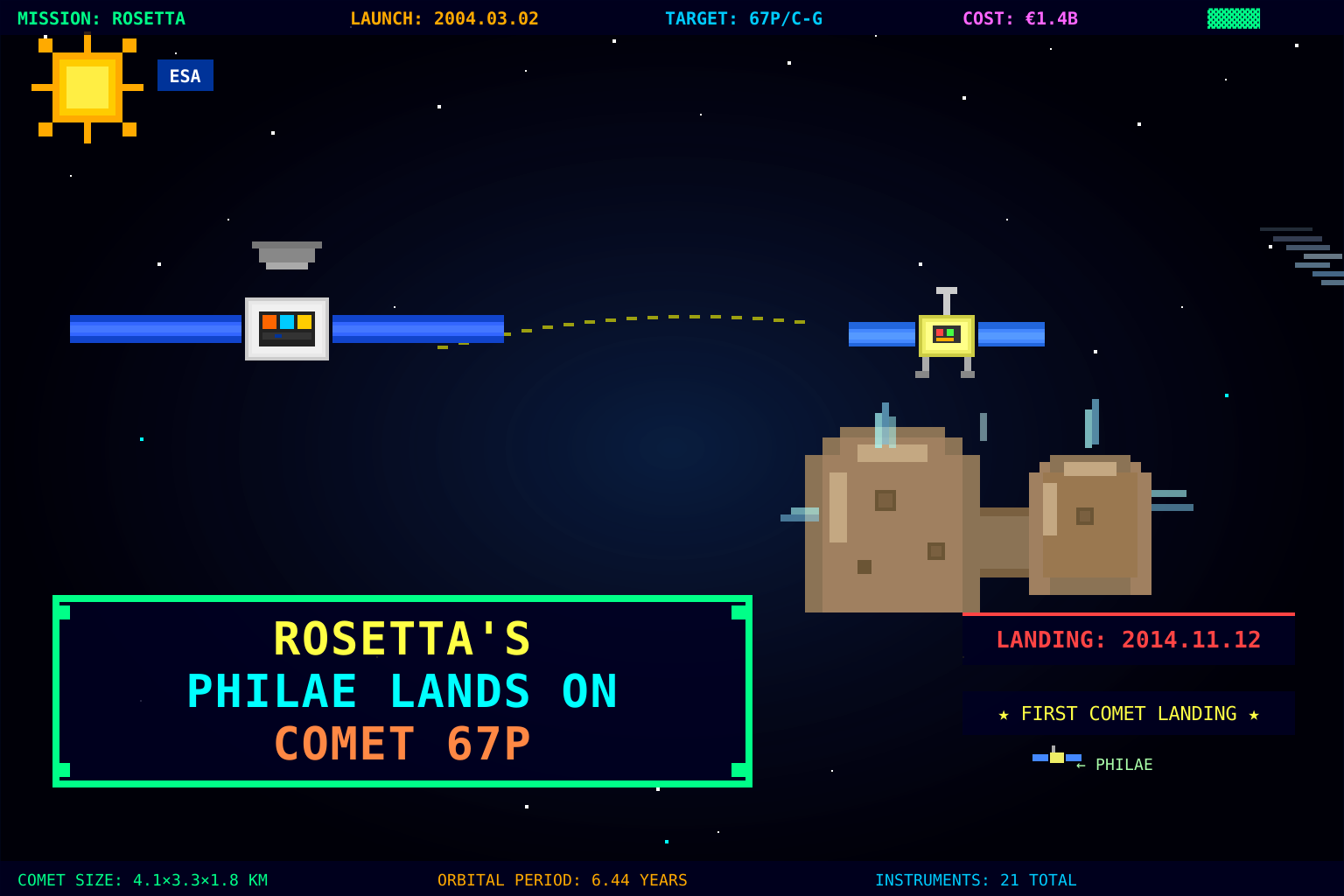
Key figures: European Space Agency (ESA), Matt Taylor (Rosetta project scientist), Jean-Pierre Bibring (Philae lead scientist)
Mission Origins
The Rosetta mission was conceived in the 1990s as ESA’s cornerstone mission for solar system exploration. The spacecraft launched on March 2, 2004, from the Guiana Space Centre in Kourou, French Guiana, atop an Ariane 5 rocket. The total mission cost was approximately €1.4 billion (roughly $1.7 billion USD). Named after the Rosetta Stone — the ancient artifact that unlocked Egyptian hieroglyphics — the spacecraft was intended to “decode” the primordial chemistry of the early solar system preserved in cometary ice.
Rosetta carried 11 scientific instruments on its main body and dispatched the Philae lander (named after Philae Island in Egypt, connected to the Rosetta Stone discovery) carrying a further 10 experiments. Together they represented the most sophisticated cometary science package ever flown.
The Target: Comet 67P/Churyumov-Gerasimenko
Comet 67P/Churyumov-Gerasimenko was discovered in 1969 by Soviet astronomers Klim Churyumov and Svetlana Gerasimenko. It has a distinctive rubber duck or bilobate shape, approximately 4.1 × 3.3 × 1.8 km in size — the result of two separate bodies that collided and merged at low speed in the early solar system. The comet orbits the Sun every 6.44 years, traveling between the asteroid belt and the orbit of Jupiter.
When Rosetta reached the comet on August 6, 2014, after a 10-year, 6.4 billion kilometer journey, the spacecraft was approximately 500 million kilometers from Earth. At that distance, radio signals — traveling at the speed of light — took about 28 minutes one-way to reach mission controllers in Darmstadt, Germany, making real-time intervention impossible.
Approach and Landing Site Selection
During the August–November approach and orbital phase, Rosetta mapped the comet’s surface in detail, revealing a complex terrain of cliffs, boulders, smooth plains, and deep pits. Scientists initially selected a landing site named Agilkia on the smaller of the two lobes. The site was chosen after evaluation of five candidate zones for relative flatness, adequate solar illumination, and scientific interest.
Philae separated from Rosetta at 08:35 UTC on November 12, 2014, beginning a seven-hour descent to the surface under very low gravity — the comet’s gravitational pull was roughly 100,000 times weaker than Earth’s. The lander carried ice screws and harpoons to anchor itself on touchdown.
The Bouncing Landing
At approximately 15:34 UTC, Philae made first contact with the comet’s surface at Agilkia. However, the harpoons designed to anchor the lander failed to fire. In the comet’s micro-gravity, Philae bounced twice — the first bounce lasted nearly two hours, carrying the lander approximately 1 km above the surface — before settling nearly 1 km away from the intended target zone in a location later named Abydos, in the shadow of a cliff.
The final resting position proved scientifically mixed: the cliff left Philae in shadow for most of each 12.4-hour comet day — the lander received only about 1.5 hours of sunlight per rotation — severely limiting solar power generation. The lander had approximately 60 hours of battery life from its primary cells, independent of solar charging.
Scientific Findings
Despite the awkward landing, Philae’s instruments operated for about 57 hours before the primary battery was exhausted on November 15, 2014. In that window, the lander:
- Detected 16 organic (carbon-bearing) compounds in the cometary coma via its COSAC mass spectrometer, including 4 compounds never previously detected in space — among them methyl isocyanate, acetone, and propionaldehyde.
- Drilled into the surface with the SD2 instrument, though the sample collection outcome was uncertain due to the comet’s unexpectedly hard surface.
- Captured high-resolution panoramic images of the landing site with the CIVA cameras.
- Measured the comet’s sub-surface temperature and interior structure via MUPUS (hammer instrument) and SESAME (surface electrical and acoustic monitoring).
- Conducted a radio sounding experiment (CONSERT) with the Rosetta orbiter, probing the comet’s interior and confirming it had a porous, largely homogeneous core.
The CONSERT radio science results, published in Science in January 2015, indicated that 67P’s interior was between 75–85% empty space (porous ice-dust mixture).
Philae’s Revival and Mission End
On June 13, 2015, as the comet neared perihelion and solar illumination increased, Philae briefly awoke and transmitted 85 seconds of data, confirming it remained largely functional. Subsequent contact attempts were unsuccessful, and ESA declared Philae’s mission ended in July 2016.
Rosetta itself continued orbiting 67P until September 30, 2016, when it performed a controlled impact onto the comet’s surface, returning close-range images up to the moment of impact. The mission formally ended after 12 years of operations spanning four planetary flybys (Earth three times, Mars once) and two asteroid flybys (Steins in 2008, Lutetia in 2010).
Scientific Legacy
The Rosetta mission’s most profound contribution was to the debate over Earth’s water and the origin of life’s building blocks. The ROSINA mass spectrometer found that 67P’s water ice had a deuterium-to-hydrogen ratio roughly three times higher than Earth’s oceans — suggesting that Jupiter-family comets like 67P were not the primary source of Earth’s water (in contrast to earlier hypotheses). The organic compound detections strengthened the case that comets delivered key prebiotic molecules to the early Earth.
The mission also transformed scientific understanding of cometary surfaces: rather than pristine, undifferentiated bodies, 67P proved geologically complex and dynamic, with active jets, cliff collapses, and seasonal changes driven by solar heating.
Sources
- Rosetta’s Philae Makes Historic First Landing on a Comet — NASA JPL
- Touchdown! Rosetta’s Philae probe lands on comet — ESA
- First detection of molecular oxygen in a comet, and other Rosetta findings — Nature/Science archives
- Comet 67P/Churyumov-Gerasimenko — ESA Science
- CONSERT results: Comet’s interior — Science (2015)