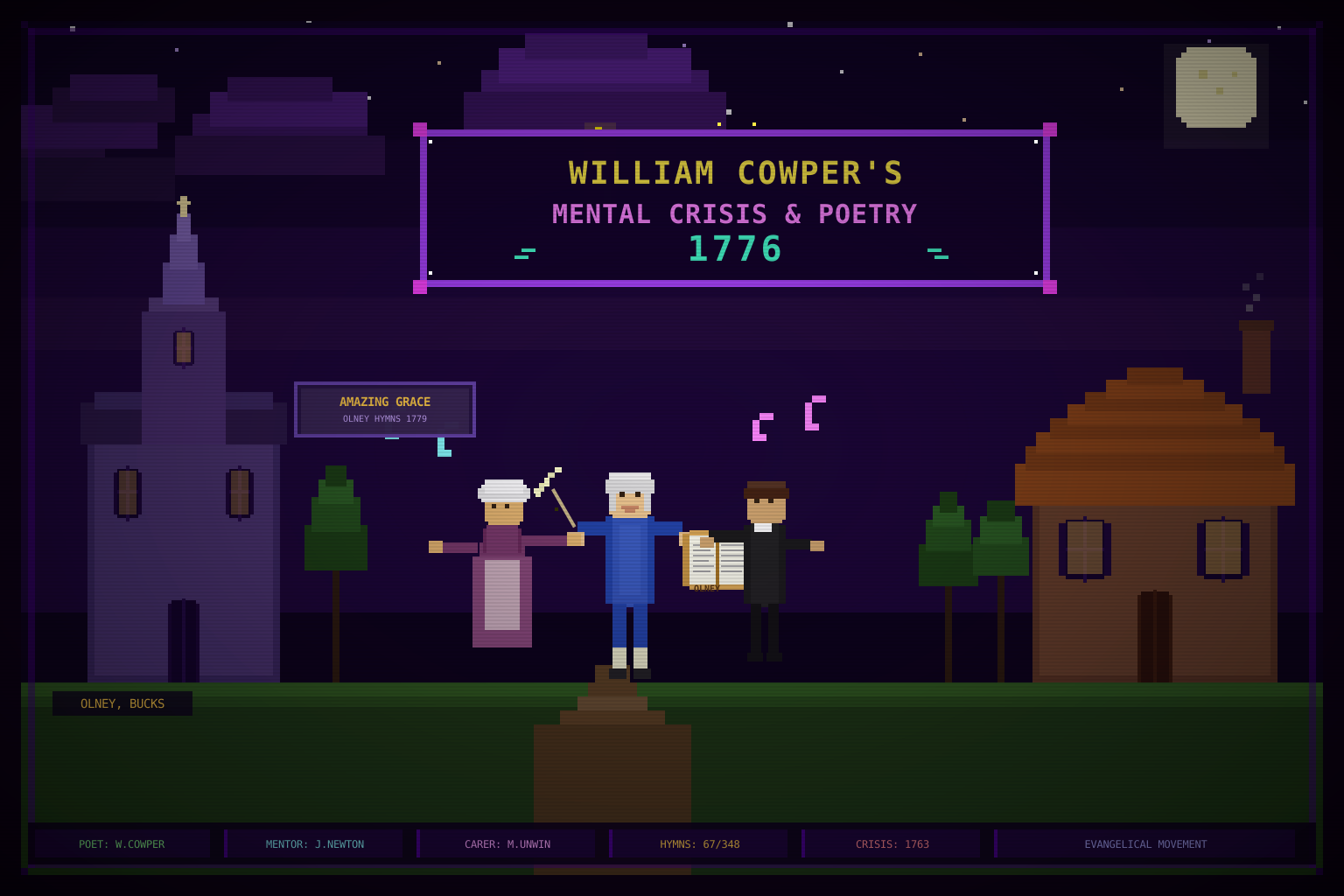
Key figures: William Cowper, John Newton (spiritual mentor), Mary Unwin (companion and caregiver), Lady Austen, the Evangelical movement
Summary
William Cowper (1731–1800) was an English poet whose career intersected with profound personal suffering and spiritual struggle during the 1770s. By 1776, Cowper had survived multiple mental crises — including a severe breakdown in 1763 that led to a suicide attempt and confinement at St Albans asylum — and had found refuge and spiritual guidance through his friendship with John Newton, the Evangelical clergyman best remembered as the author of “Amazing Grace.” During 1776, Cowper was living in relative seclusion in Olney, Buckinghamshire, with Newton and Mary Unwin, his companion and caregiver for nearly two decades.
Cowper and Newton had been resident in Olney since 1767, when Cowper moved there following his recovery from the asylum. The town became the unlikely centre of a significant literary and religious collaboration. In the mid-1770s, Cowper and Newton undertook the Olney Hymns project (published 1779), a collection of 348 evangelical hymns that blended doctrinal clarity with lyric beauty. By 1776, this project was well underway, with Cowper composing hymns that would become central to English Evangelical worship.
Cowper’s hymns from this period — roughly 67 of the 348 total were his contribution — addressed themes of divine grace, human sinfulness, redemption, and Christian consolation, themes drawn directly from his own psychological torment and spiritual recovery. Although Cowper was largely unknown to the general public in 1776, the work accomplished during this period laid the foundation for his later fame as the author of The Task (1785) and John Gilpin (1782), and established him as one of the most influential English poets of the late eighteenth century.
Cowper’s Psychological Landscape in 1776
Cowper’s mental constitution was unusual for his era. He suffered from what modern psychiatry would likely categorise as severe recurrent depression with psychotic features — during his worst episodes he was convinced that he was damned and that God had specifically excluded him from salvation. The 1763 crisis came when, facing examination for a government clerkship, he attempted suicide by hanging, drowning, and taking opium in rapid succession, none of which succeeded; he was subsequently hospitalised at the asylum of Nathaniel Cotton in St Albans for eighteen months.
The recovery Cowper found in Olney under Newton’s care was partial and fragile. By 1776 he was functional enough to write, garden, care for animals, and socialise in a limited way, but he remained susceptible to relapses that Newton and Unwin monitored closely. His correspondence — extensive and among the finest prose letters in English — records in detail the oscillation between relative calm and acute anxiety that characterised this period. A particularly severe relapse in 1773 had again brought suicidal despair, and the subsequent recovery shaped the quieter, more meditative tone of his mid-1770s verse.
This psychological landscape gave Cowper’s poetry a quality absent from most verse of the period: genuine vulnerability and transparency about interior suffering. In an era dominated by rational Augustan aesthetics and the polished heroic couplet, Cowper’s willingness to write about depression, doubt, and what he called “the hiding of God’s face” was both courageous and unusual. It anticipates the Romantic lyric of the following generation — particularly Keats and Coleridge — while remaining rooted in Evangelical Protestant theology.
The Olney Hymns Project
The Olney Hymns, published in July 1779 but substantially composed between 1771 and 1779, represent the most important artistic achievement of Cowper’s years in Olney. John Newton proposed the collaboration shortly after Cowper’s arrival; Newton composed the majority (281 hymns) while Cowper contributed 67. The hymnbook was intended for use at the weekly prayer meetings Newton held at Olney’s Great House — a large mansion that served as a meeting place for Evangelical gatherings and which Cowper attended regularly during stable periods.
Among Cowper’s most celebrated contributions were “God Moves in a Mysterious Way” (Hymn 35 in Book 3), written around 1774 and still sung widely today; “O for a Closer Walk with God” (Hymn 1, Book 1); and “There Is a Fountain Filled with Blood” (Hymn 15, Book 3). “God Moves in a Mysterious Way” is particularly notable: according to tradition, Cowper composed it just before a severe relapse, making it both a statement of faith and a poignant document of psychological crisis.
Newton’s Olney Hymns preface described the work as aimed at “plain people” — the working-class and artisan congregation at Olney — rather than learned readers. This democratic impulse connected to the broader Evangelical revival associated with John Wesley and George Whitefield, which had brought emotional, accessible religion to audiences excluded from Anglican formality. The Olney Hymns thus stood in a similar relationship to popular religious culture as Thomas Paine’s Common Sense stood to popular political culture — both bridged the gap between learned tradition and broad popular readership.
Social Commentary and Emerging Literary Identity
Beyond the hymn work, by 1776 Cowper was developing the satirical and moral poetry that would characterise his mature secular work. His correspondence from this period reveals an intensely self-reflective mind engaging with social and political questions — the American Revolution, colonial slavery, the corruption of British political life — alongside more personal themes.
Cowper’s position on slavery is notable: he became one of the earliest English poets to write explicitly against the slave trade, a position shaped partly by his Evangelical theology and partly by Newton’s own prior history as a slave-ship captain who had undergone religious conversion. Newton’s autobiography and Cowper’s poetic responses to it prefigure the abolitionist campaigns of the 1780s and 1790s, in which Cowper’s poem “The Negro’s Complaint” (1788) played a significant role. By 1776, these convictions were forming, though not yet fully expressed in published verse.
The Evangelical network in which Cowper moved also connected him to a wider literary culture than his Olney seclusion might suggest. Through Newton he knew figures associated with the Clapham Sect and with the broader Dissenting intellectual world; through his correspondence he engaged with literary figures across England. He was aware of, though largely indifferent to, the work of Grub Street — the commercial literary culture represented by journals like The Pennsylvania Magazine in America and its English equivalents. His ambitions were more purely literary, tied to the classical tradition of Pope and Dryden while departing from their formal rationalism.
Significance
William Cowper’s 1776 crisis and subsequent creative work represented an important development in English literary culture — the emergence of intensely personal, introspective verse that challenged the rationalist aesthetics of the age. His willingness to write openly about depression, mental illness, and the darker aspects of human psychology made him a significant precursor to Romantic poetry while maintaining connections to Evangelical Christian tradition.
Cowper’s poetry uniquely bridged the worlds of popular religious devotion and literary sophistication. The Olney Hymns became beloved in churches across the English-speaking world while maintaining poetic merit that distinguished them from much hymn writing of the period. His dual audience — both literary and devotional — demonstrated the power of poetry to speak to intellectual and spiritual needs simultaneously during a period of social transformation.
His mental health struggles and his literary response to them also challenged contemporary assumptions about creativity, rationality, and psychological wellbeing. As Enlightenment thinkers celebrated reason, Cowper’s work demonstrated the limitations of rationalism in the face of human suffering. This challenge resonated with the broader cultural tensions of 1776 — a year in which the rational optimism of Enlightenment philosophy confronted the violence of revolution and war. The same religious currents in the American Revolution that informed political discourse also shaped Cowper’s theological wrestling and the revival piety of Newton’s Olney congregation.
Cowper’s position in 1776 — relatively unknown but intensely productive, isolated yet spiritually engaged, struggling with mental illness yet creating enduring works — exemplified the complex relationship between personal crisis and artistic creation that would characterise late-eighteenth-century culture and anticipate the Romantic valorisation of the wounded artist.
His later influence was considerable: Jane Austen’s characters quote Cowper approvingly; the Romantics admired his blank verse and his capacity for domestic observation; and his abolitionist verse contributed directly to the campaign that ended the British slave trade in 1807. All of this was grounded in the work accomplished during the quiet, difficult years at Olney in the 1770s.
Sources
- William Cowper — Wikipedia
- William Cowper — Britannica
- William Cowper — Oxford Dictionary of National Biography
- Olney Hymns — Project Gutenberg
- John Newton and the Evangelical Revival — Oxford Research Encyclopedia of Religion
- James King, William Cowper: A Biography — Duke University Press, 1986
- Vincent Newey, Cowper’s Poetry: A Critical Study and Reassessment — Liverpool University Press, 1982