Key figures: Lord North, John Adams, Rhode Island colonists, Admiral John Montagu, Deputy Governor Darius Sessions
Summary
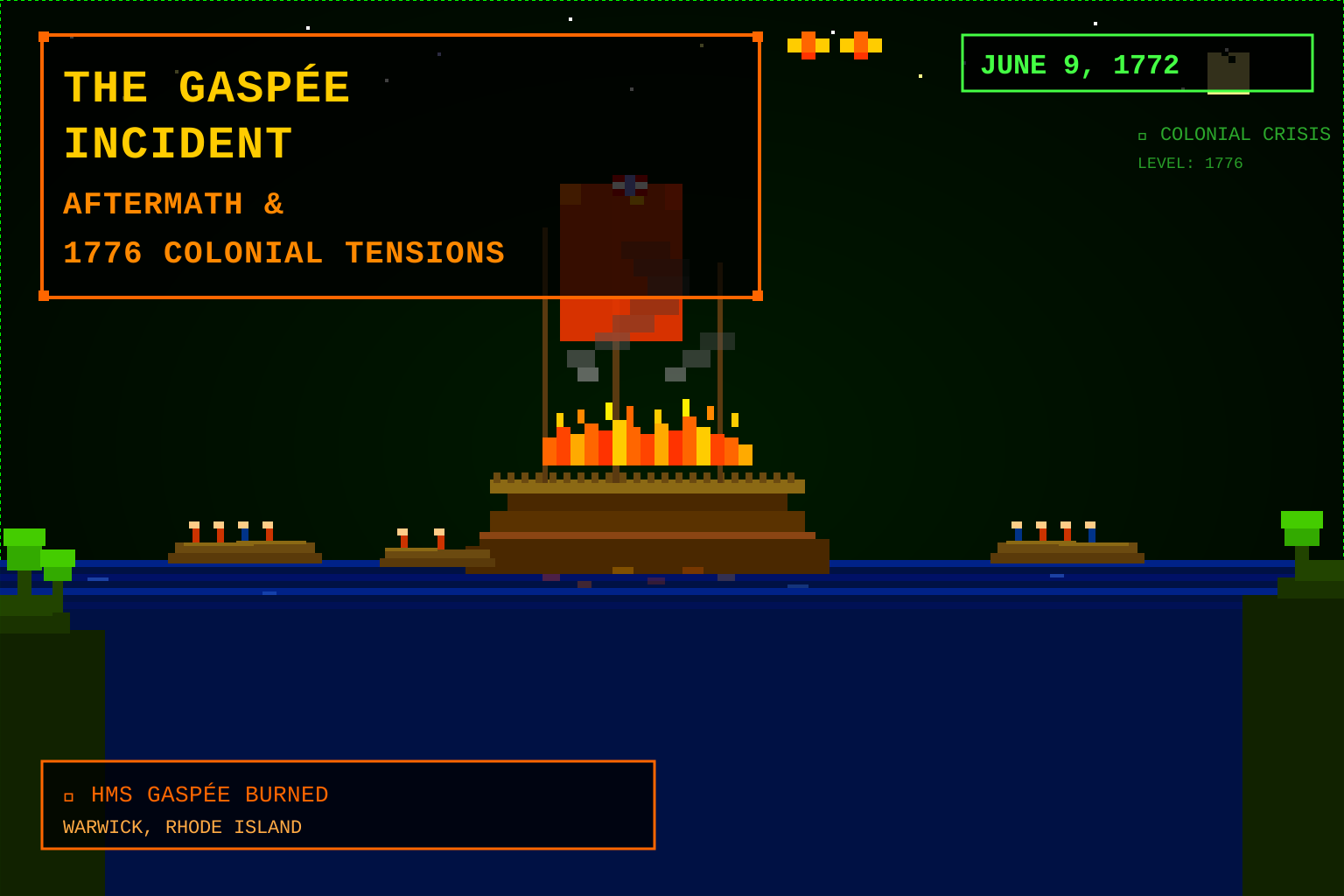
The Gaspée incident of June 9, 1772—when Rhode Island colonists boarded and burned the British revenue cutter HMS Gaspée after it ran aground near Warwick, Rhode Island—created lasting constitutional and diplomatic tension that had still not been resolved by 1776. The Gaspée was an armed schooner under Lieutenant William Dudingston that had been rigorously enforcing customs laws and seizing colonial vessels, generating intense resentment among Rhode Island merchants. On the night of June 9, approximately 55 to 75 armed colonists rowed out to the grounded vessel, overpowered the crew, wounded Dudingston in the groin, and set the ship ablaze.
King George III appointed a royal commission in December 1772—the Gaspée Commission—to investigate and identify suspects. The commission was empowered to send the accused to England for trial, bypassing colonial juries entirely. This provision—trial outside the accused’s colony—became one of the most inflammatory grievances cited in colonial protests. Despite the commission’s broad powers, Rhode Island colonists refused to cooperate, witnesses would not testify, and no prosecutions were ever completed. The investigation was formally abandoned in June 1773.
By 1776, the Gaspée affair had become more than a local grievance. John Adams cited it as evidence of systematic British disregard for colonial due process, and it figured in the chain of events that led to the formation of Committees of Correspondence—Virginia’s House of Burgesses created its own inter-colonial committee in March 1773 specifically in response to the Gaspée Commission’s threat to strip colonists of trial-by-jury rights. These committees of correspondence became the organizational backbone of revolutionary coordination, eventually evolving into the Continental Congress itself.
The Legal Crisis: Trial Outside the Colony
The Gaspée Commission’s power to send suspects to England for trial struck at the heart of colonial English constitutional tradition. The right to be tried by a jury of one’s peers—a right recognized since Magna Carta (1215)—was interpreted by colonists as including the right to a local jury. British authorities argued that the commission’s powers were necessary precisely because local juries could not be trusted to convict fellow colonists. This circular logic—colonists won’t convict, therefore we bypass them—was taken by colonial leaders as proof that Britain had abandoned any pretense of applying English law equally on both sides of the Atlantic.
John Adams, writing in the Boston Gazette under the pseudonym “Novanglus” in 1775, would later argue that the Gaspée Commission represented a constitutional rupture: Parliament was not merely taxing without representation but was dismantling the judicial framework that made colonial rights meaningful. By 1776, Adams’s arguments had moved from legal theory to political program: the Declaration of Independence explicitly lists “depriving us in many cases, of the benefits of Trial by Jury” and “transporting us beyond Seas to be tried for pretended offences” among its grievances—both charges traceable directly to the Gaspée Commission. See also: John Adams in 1776.
Connection to the Prohibitory Act (December 1775)
The Gaspée incident was part of a longer pattern of maritime law enforcement that culminated in the Prohibitory Act of December 22, 1775. That act declared all American vessels, cargo, and crews to be forfeit as prizes of war—a measure that the Continental Congress compared to a formal declaration of war by Britain against its own subjects. When Congress debated the Prohibitory Act in early 1776, delegates drew explicitly on the Gaspée precedent: Britain had been seizing colonial shipping with impunity since 1772, and Parliament had now merely formalized this into open economic war. See also: The Prohibitory Act, 1776.
Committees of Correspondence: The Gaspée’s Organizational Legacy
The most consequential long-term effect of the Gaspée affair was institutional. Virginia’s House of Burgesses, alarmed by the threat that the Gaspée Commission’s extraterritorial trial powers posed to all colonists, created a standing Committee of Correspondence in March 1773 and invited every other colonial legislature to do the same. By February 1774, twelve of the thirteen colonies had established such committees. This inter-colonial communication network:
- Coordinated responses to the Intolerable Acts (1774)
- Organized the First Continental Congress (September 1774)
- Provided the communication infrastructure that sustained the Second Continental Congress through 1775–1776
The Gaspée affair thus contributed not merely a grievance to 1776 but an organizational innovation. The Continental Congress—which voted for independence on July 2, 1776—was institutionally descended from the inter-colonial coordination Virginia launched in direct response to the Gaspée Commission. See also: The Declaration of Independence, July 4, 1776.
1776: The Festering Wound
By June 1776, the Gaspée affair was four years old and still unresolved. No one had been convicted. No restitution had been made to Lieutenant Dudingston (who lost his vessel) or to the colonial merchants who had had cargo seized. No reform of maritime enforcement had been enacted. This stalemate illustrated for colonial leaders that the imperial system was incapable of self-correction:
- Britain could not enforce customs laws without provoking violent resistance it could not prosecute
- Britain would not negotiate substantive changes to trade enforcement without appearing to surrender parliamentary sovereignty
- Colonists could not obtain redress through legal channels because those channels required submitting to a judicial system that bypassed colonial juries
This triple impasse was still in place when Thomas Jefferson drafted the Declaration of Independence in June 1776. The Declaration’s grievance against “cutting off our Trade with all parts of the world” encompassed not only the Prohibitory Act but the entire maritime enforcement regime of which the Gaspée was an emblem. See also: Lord North in 1776, whose ministry oversaw both the Gaspée Commission and the Prohibitory Act.
Significance
The Gaspée aftermath exemplified the structural failure of colonial-imperial law and reconciliation. British authorities could not enforce customs laws without provoking violent resistance, yet could not negotiate colonial participation without appearing to yield sovereignty. This deadlock, still festering in 1776, reinforced colonists’ conviction that parliamentary authority over trade was illegitimate. The incident’s legal limbo—prosecutions stalled, no restitution, no reform—demonstrated to the Continental Congress that grievance petitions would not resolve fundamental imperial disputes. More importantly, the Gaspée’s organizational legacy in the Committees of Correspondence gave colonial resistance a durable institutional form that outlasted the incident itself and became the scaffolding of revolutionary government.
Cross-References
- John Adams in 1776 — cited Gaspée in constitutional arguments for independence
- Lord North in 1776 — whose ministry administered the Gaspée Commission and enacted the Prohibitory Act
- The Prohibitory Act, 1776 — the maritime enforcement escalation the Gaspée foreshadowed
- The Declaration of Independence — incorporated Gaspée-derived grievances about jury trial and maritime seizure
- The Albany Plan Legacy — parallel story of unresolved colonial governance failures driving 1776 constitutional thought