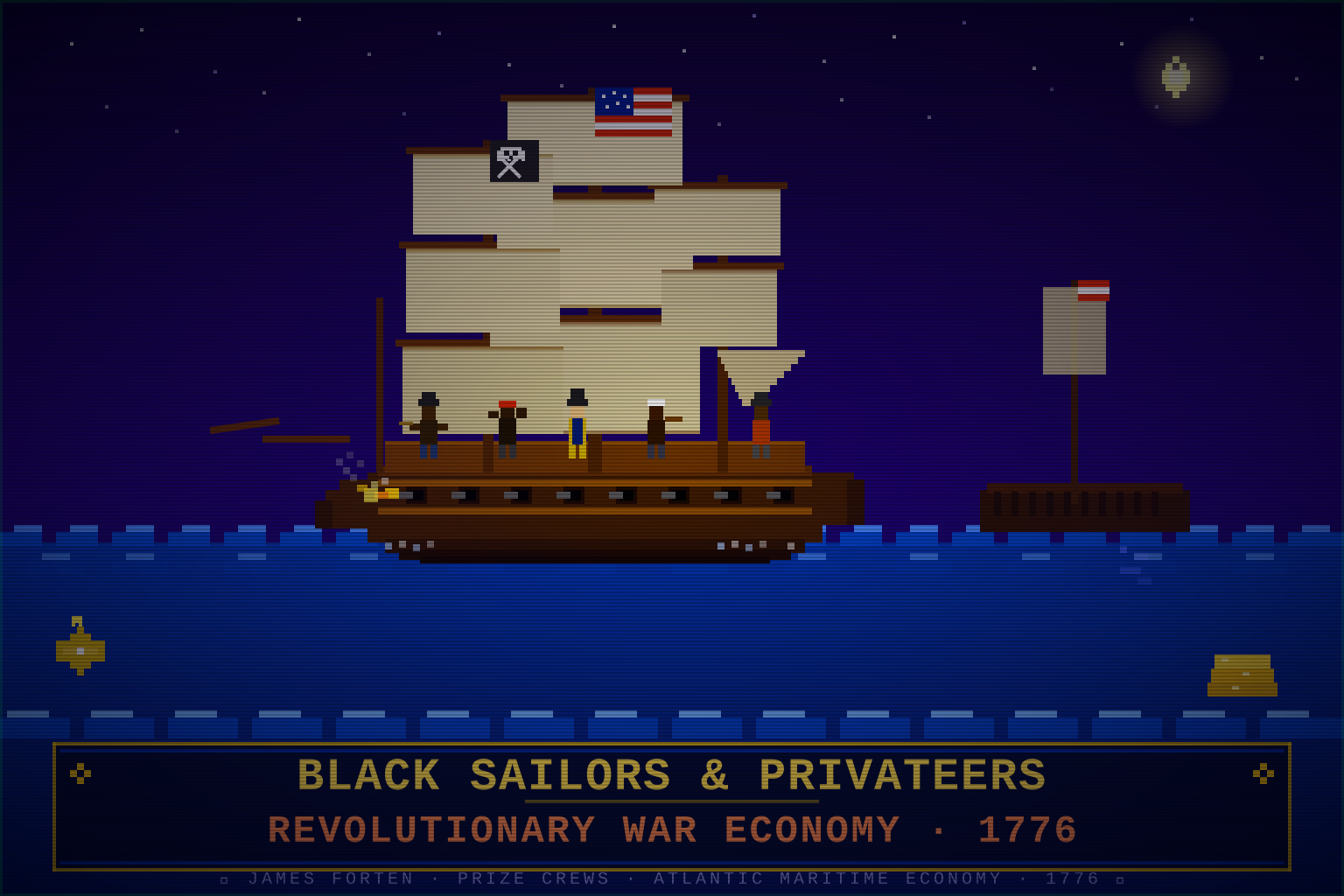
Key figures: Crispus Attucks (pre-1776), unnamed Black privateers, enslaved ship captains’ crews, James Forten (Philadelphia sailmaker’s apprentice)
Summary
The privateer fleet that Congress authorized on March 23, 1776, relied significantly on multi-racial crews drawn from the Atlantic maritime economy. Among these crews, Black sailors — both enslaved and free — worked alongside white and Indigenous sailors in the dangerous work of prize-taking and combat at sea. While Dunmore’s Ethiopian Regiment (established November 1775) is well-documented as the first large-scale Black military unit, the Black presence in the maritime theater has received less systematic attention, despite its economic importance.
Historical records from prize-court proceedings, ship manifests, and privateering commission documents indicate that Black sailors comprised a meaningful minority of privateer crews. Estimates drawn from surviving muster rolls suggest roughly 10–15% of typical privateer crews were Black, within a total force that ranged from approximately 2,000 men in early 1776 to upward of 70,000 during the full war. Some were enslaved individuals whose masters profited from their naval labor; others were manumitted — or promised manumission — as an enlistment incentive; still others were free Black men from northern seaports (Newport, Boston, Philadelphia, New York, and Providence) who had practiced maritime trades for decades.
James Forten of Philadelphia, who would later become a wealthy sailmaker and abolitionist, shipped as a powder boy aboard the privateer Royal Louis in 1781 at age 14 — his story exemplifies how the maritime economy provided one of the few routes for Black men to accumulate maritime skill and, eventually, wealth. Earlier in the war, in 1776 itself, similar boys and young men crewed vessels out of Salem, Newburyport, and Marblehead.
The Continental Navy maintained similar patterns: an estimated one-sixth of the recruits who signed aboard the first American warships in 1775–1776 were Black. John Paul Jones later noted with approval the competence and courage of Black crew members during his 1779 engagement aboard Bonhomme Richard. The Continental Navy’s recruitment orders were silent on race, and local navy agents routinely enlisted any able-bodied mariner who presented.
The Maritime Labor Market in 1776
The Atlantic maritime economy was already racially integrated by necessity by the mid-18th century. Northern seaports had long drawn on free Black labor: by 1770, Newport, Rhode Island, had one of the highest proportions of free Black seamen per capita of any American port, reflecting both the city’s deep involvement in the triangle trade and the gradual manumissions that followed. Philadelphia’s waterfront similarly employed Black caulkers, ropemakers, and common sailors. When privateering expanded the demand for maritime labor in 1776, ship captains drew on this existing pool without formal racial exclusion — the economics of crewing outweighed racial restriction.
Wage structures varied sharply by legal status:
- Enslaved sailors received no direct wages; compensation (if any) went to their enslaving masters. Some masters made informal arrangements — a portion of prize money — to incentivize performance, but this had no legal standing.
- Indentured or bonded sailors received wages that were often assigned in advance to creditors or masters.
- Free Black sailors drew full crew wages — typically £2–£3 per month for an ordinary seaman in 1776 Massachusetts currency — and received their proportionate share of prize money when a vessel was taken. Prize shares could be substantial: a captured British merchantman worth £5,000 in prize might yield a common sailor’s share of £20–£40 after adjudication by prize courts.
Freedom and Enslavement Aboard Privateer Ships
The legal status of Black sailors aboard privateers was contested and unstable. Congress’s March 23 privateering resolution and the April 3, 1776 Instructions to Privateers said nothing about race or slavery, leaving commanders and crew to negotiate these questions locally. A Black sailor who shipped as “free” in a Massachusetts port might be claimed as a runaway slave if the vessel put into a southern port; conversely, enslaved men “borrowed” by their masters for a single voyage could develop sea-skills and contacts that made escape easier.
Several documented patterns emerge:
- Master-sponsored enlistment: Slaveholders from Maryland and Virginia sent enslaved men aboard privateers or supply sloops as skilled labor (caulkers, riggers, experienced watermen from the Chesapeake oyster trade). The master received wages or prize shares; the man received nothing but occasionally negotiated a manumission promise.
- Self-organized escape: Enslaved men from coastal plantations used the disruption of 1776 — British naval presence, privateer activity, and the general loosening of surveillance — to ship aboard vessels, sometimes presenting forged free papers. Dunmore’s proclamation of November 1775 accelerated this pattern along the Chesapeake.
- Free Black seafarers: Men from northern ports who had been maritime workers for years signed freely, drew standard wages, and sometimes achieved petty officer rank (boatswain’s mate, gunner’s mate) if their experience warranted it. These men were the economic successors of sailors like Crispus Attucks, who had worked at sea before his death at the Boston Massacre in 1770.
See also the Prohibitory Act of 1776, which closed British ports to American trade and made the privateer economy — and its multi-racial crews — even more central to the American war effort.
Prize Money and Post-War Claims
Prize shares created the potential for extraordinary gains: when the privateer Rattlesnake (Salem, 1781) returned from a cruise with five prizes, a common sailor’s total earnings from the voyage might exceed two years of land-based wages. For free Black sailors, this represented one of the few pathways to capital accumulation available in 1776-era America — land ownership being barred or socially foreclosed in most states, professional apprenticeships limited, and credit markets closed.
Post-war outcomes were deeply uneven:
- Free Black veterans who had served as privateers could, in principle, petition for bounty lands or pension claims like white veterans, though in practice discrimination in the claims process left most without recognition.
- Enslaved men whose masters had profited from their service received no legal share and were typically returned to slavery, with their maritime skills now valuable but personally unrewarded.
- Some men — a small number — used prize earnings to purchase their own freedom or that of family members, though the evidence for this in 1776-specific records is fragmentary.
Significance
The Black maritime contribution to the privateering economy illustrates the Revolution’s internal contradictions on race and freedom: enslaved labor powered the commercial war effort, free Black sailors claimed military service and its rewards, and the ideological tension between independence-era rhetoric and slavery’s persistence was never resolved in 1776. Economically, Black sailors were integral to the private trade war against British commerce — without them, privateer crews would have required higher wages or alternative labor sources in an already tight maritime labor market.
The maritime experience created rare opportunities for Black men to accumulate capital (via prize shares), skill (via sea trades), and mobility (through seafaring networks) — pathways foreclosed on land by slavery, legal discrimination, and exclusion from guild trades. James Forten’s post-war rise to Philadelphia’s most prominent Black businessman traced directly back to his sea service, making the privateering economy a crucial if under-recognized chapter in Black economic history.
Related Topics
- American Privateering, 1776
- Dunmore’s Ethiopian Regiment
- Continental Navy, 1776
- Prohibitory Act of 1776
Sources
- Sylvia R. Frey, Water from the Rock: Black Resistance in a Revolutionary Age (Princeton UP, 1991)
- W. Jeffrey Bolster, Black Jacks: African American Seamen in the Age of Sail (Harvard UP, 1997)
- Gary B. Nash, The Forgotten Fifth: African Americans in the Age of Revolution (Harvard UP, 2006)
- Historic Naval Ships Visitor Center — Black Sailors in the Revolutionary War