Key figures: Congress, merchant captains, French and Spanish traders, Admiral Richard Howe, Benjamin Franklin
Summary
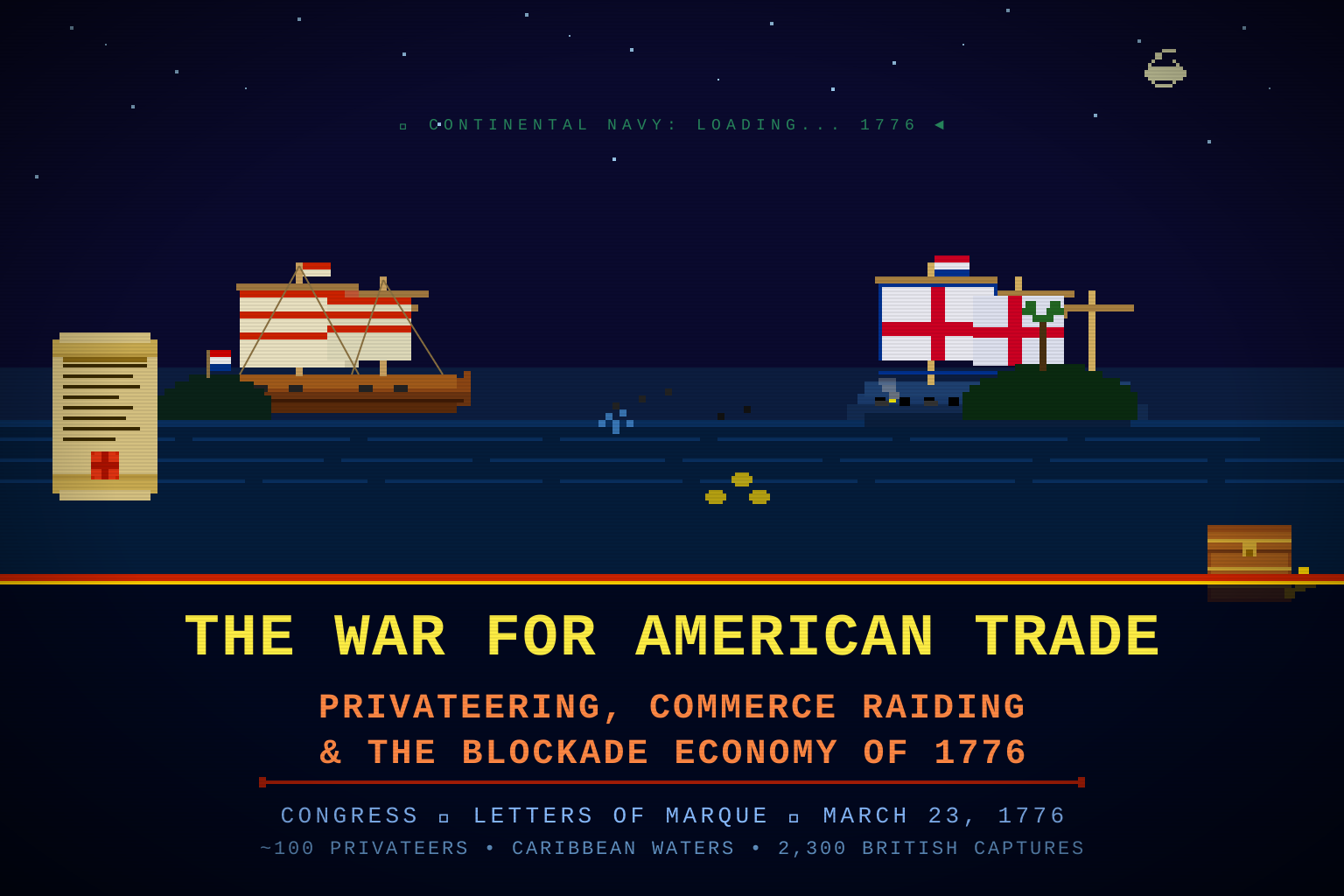
With the Continental currency collapsing and official navy operations limited by British naval superiority, Congress turned to privateering as an economic weapon in 1776. On March 23, 1776, Congress issued the first formal privateering commissions, licensing merchant captains to seize British and Loyalist vessels worldwide. By May 1776, approximately 100 privateers were operating in Caribbean waters, an economy running on licensed raiding. These armed merchantmen—faster and more numerous than the Continental Navy—operated under Letters of Marque that granted the raiders legal status under international custom while keeping them technically private enterprises, freeing Congress from the logistical burden of maintaining naval forces.
The blockade economy that accompanied privateering fundamentally reshaped commerce. Britain’s Royal Navy imposed an increasingly stringent maritime blockade along American coasts, targeting colonial exports (timber, naval stores, tobacco) while its merchant fleet faced mounting losses to privateers. American merchants adapted by developing Caribbean trade routes, smuggling networks through neutral ports (especially Dutch St. Eustatius), and provisioning the Continental Army through covert partnerships with French and Spanish traders. The privateering program yielded approximately 2,300 British vessel captures over the war’s duration, generating prize money that distributed wealth among ship owners, captains, and crews—a powerful incentive in a cash-starved economy.
The economics of privateering created perverse incentives: captains prioritized easy merchant targets over enemy warships, and disputes over prize distribution sometimes fractured crews. Yet the program achieved Congress’s immediate goal: it weakened British commercial confidence, disrupted supply lines to British colonies, and redirected merchant capital toward the Revolutionary cause. The prize money, when liquidated through prize courts, provided hard currency and supplies when the Continental government had none.
The Prohibitory Act and the Legal Framework of the Blockade
The British government’s Prohibitory Act, passed December 22, 1775, provided the legal trigger for Congress’s economic counter-measures. The Act declared all American vessels and their cargoes forfeit to the Crown, effectively placing the thirteen colonies under commercial blockade—a measure that even some British members of Parliament, including Edmund Burke and Charles James Fox, argued would drive colonists toward outright independence. When news of the Prohibitory Act reached Philadelphia in February 1776, Congress debated an equivalent response, leading directly to the March 23 privateering resolution and the April 3 Instructions to Privateers drafted largely by John Adams.
The legal architecture of privateering relied on centuries of maritime law: a Letter of Marque granted a merchant captain state authority to capture enemy vessels; a Privateer Commission designated a vessel permanently to commerce raiding. Captured prizes were brought to American admiralty courts—hastily established in the winter of 1775–1776—for adjudication, and proceeds were distributed according to set formulas: officers typically received 40% of the prize value, crews 60%. The bond posted to obtain a commission ($5,000 for smaller vessels; up to $10,000 for larger ones) was forfeited if a captain plundered neutral ships or mistreated prisoners.
By year’s end 1776, Congress and the colonial legislatures had issued 136 privateer commissions, with estimates that several hundred additional letters of marque were in operation under state authority. For the legal framework of Continental naval operations that ran parallel to privateering, see Continental Navy Establishment and Operations.
St. Eustatius: The Golden Rock of the Caribbean
The Dutch island of St. Eustatius—eight square miles of volcanic rock in the Lesser Antilles—became the primary entrepôt for American trade in 1776. The island’s status as a free port under Dutch neutrality made it a transshipment hub where American ships exchanged tobacco, rice, and indigo for European manufactured goods, weapons, and gunpowder. By mid-1776, trade through St. Eustatius had become so critical to the Continental war effort that British Admiral George Rodney would later describe the island as “the magazine of the world.”
American privateers and smugglers used St. Eustatius to:
- Re-export captured prize goods beyond British seizure range
- Receive French and Spanish war materials that could not legally pass directly to American ports
- Exchange depreciating Continental currency for Dutch guilders and Spanish silver pieces-of-eight
- Coordinate intelligence on British naval movements with French agents
The Dutch Governor of St. Eustatius, Johannes de Graeff, provided American vessels with harbor facilities throughout 1776 and authorized the famous “First Salute”—the November 16, 1776 cannon salute to the Continental brig Andrew Doria flying the American flag—the first formal recognition of the United States by a foreign government. Britain would respond in 1781 by ordering Rodney to seize the island and its warehouses, disrupting the trade network Congress had spent five years cultivating.
The Roderigue Hortalez et Compagnie supply operation, the covert French-Spanish arms channel organized by Pierre-Augustin Caron de Beaumarchais, intersected with the St. Eustatius trade: French war material was often routed through neutral Dutch waters to avoid British interception. See Roderigue Hortalez et Cie for detail on this covert supply chain.
Financial Crisis, Prize Money, and Alternative Trade Networks
The blockade economy of 1776 intersected with the deepest financial crisis Congress had yet faced. The Continental dollar, printed in quantity from 1775 onward, depreciated rapidly—by late 1776, a Continental dollar was worth roughly 80 cents in silver; by 1780 it would be worth less than one cent. Prize money from privateering provided something the printing press could not: hard currency. Captured British vessels and their cargoes, when auctioned at prize courts in Salem, Providence, New London, and Philadelphia, generated silver and goods that circulated outside the depreciation spiral of paper money.
Marine insurance markets reflected the privateering campaign’s effectiveness. British merchant insurance rates, typically 2–3% of cargo value in peacetime, rose to 15–25% and higher by mid-1776, as Lloyd’s of London was flooded with loss claims. Some routes were effectively uninsurable without Royal Navy convoy escort—a logistical burden that tied down British warships that might otherwise prosecute the war. Benjamin Franklin, in Paris from December 1776 onward, circulated prize lists to French merchants and ministers as evidence of American maritime effectiveness, directly strengthening the case for French commercial partnership and eventual military alliance.
The Model Treaty of 1776—Congress’s template for commercial agreements with European powers—reflected the vision of free trade and neutral shipping rights that privateering and blockade had made urgent. See The Model Treaty of 1776 and Continental Congress Finance for the broader fiscal context.
Adam Smith’s The Wealth of Nations, published March 9, 1776—two weeks before Congress’s privateering resolution—argued that mercantile regulation of trade distorted markets to the advantage of merchants and the cost of consumers. The blockade economy Congress was improvising in 1776 was a real-world test of Smith’s thesis: forced outside British mercantilist structures, American merchants were building exactly the diversified, market-responsive trade networks Smith described. See The Wealth of Nations.
Relationship to Continental Military and Diplomatic Strategy
Congress and General Washington held ambivalent views on privateering’s economic logic. Washington worried that privateering drained skilled sailors and potential officers from the Continental Navy and the army; in several 1776 letters he noted that a man motivated purely by prize money would desert if prizes dried up. John Adams countered that the privateers’ self-financing nature was their primary virtue: Congress could not afford to build, arm, and pay for a fleet sufficient to challenge British naval power, but could issue paper commissions at minimal cost. By some estimates, 10–15 times as many American sailors served aboard privateers as in the Continental Navy throughout the war.
The privateering fleet and the formal Continental Navy were complementary rather than competing systems. The Continental Navy pursued strategic goals (raiding British home ports, escorting diplomatic missions, protecting American harbors) while privateers focused almost exclusively on commercial prizes. For British naval operations that formed the countervailing force, see British Naval Operations in 1776.
Significance
Privateering represented the marriage of economic desperation and naval strategy. When Congress could not finance a navy, privateering became the only viable means to contest British maritime supremacy. The captured vessels and their cargoes provided military supplies, ship timber, and trade goods—tangible support the Continental government could never have purchased outright. The income from prizes sustained merchants, ship captains, and crews whose economic interests aligned with independence.
The blockade economy also hardened American self-reliance: forced to trade through neutral ports and develop alternative supply chains, American merchants began to imagine an economy independent of British mercantilism. The experience of smuggling networks, Caribbean partnerships, and economic improvisation under British constraint became the foundation for post-war commercial negotiations and the nation’s first federal trade policy.
Privateering also illuminated the friction between commercial and military interests—a tension that would persist through the early Republic. Captains who prioritized profitable merchant targets over strategically important warships frustrated naval strategists, yet the same profit motive kept the entire system functioning. This was not the patriotic navy of later American mythology, but rather a market-driven, decentralized economic instrument that proved uniquely suited to the asymmetric conditions of Revolutionary warfare.
The United States declined to sign the 1856 Declaration of Paris abolishing privateering, preserving the option in its constitutional arsenal (Article I, Section 8 explicitly authorizes Letters of Marque and Reprisal) through the twentieth century.
Related Topics
- American Privateering Commissions and Early Operations — the legal and operational specifics of the commission system
- Roderigue Hortalez et Cie — the covert French-Spanish arms supply operation
- The Prohibitory Act of 1776 — the British blockade legislation that triggered the privateering response
- Continental Navy Establishment and Operations — the formal naval counterpart to privateer raiding
- British Naval Operations in 1776 — the Royal Navy blockade and its execution
- The Model Treaty of 1776 — Congress’s vision for post-war commercial diplomacy
Sources
- Library of Congress, “Privateering in the American Revolution”
- National Park Service: “Privateers in the American Revolution”
- Smithsonian Magazine, “The Privateers of the American Revolution”
- Naval History and Heritage Command, “Letters of Marque”
- Wikipedia, “Privateering during the American Revolution”
- Wikipedia, “Sint Eustatius in the American Revolution”