Background
By late 1775, Lord John Murray, 4th Earl of Dunmore, was a Royal Governor in crisis. Patriot militias had driven him from Williamsburg in June 1775, forcing him to govern Virginia from aboard British warships anchored off Norfolk. His position ashore was untenable, his forces thin, and the rebellion showed no signs of collapsing. Dunmore needed soldiers.
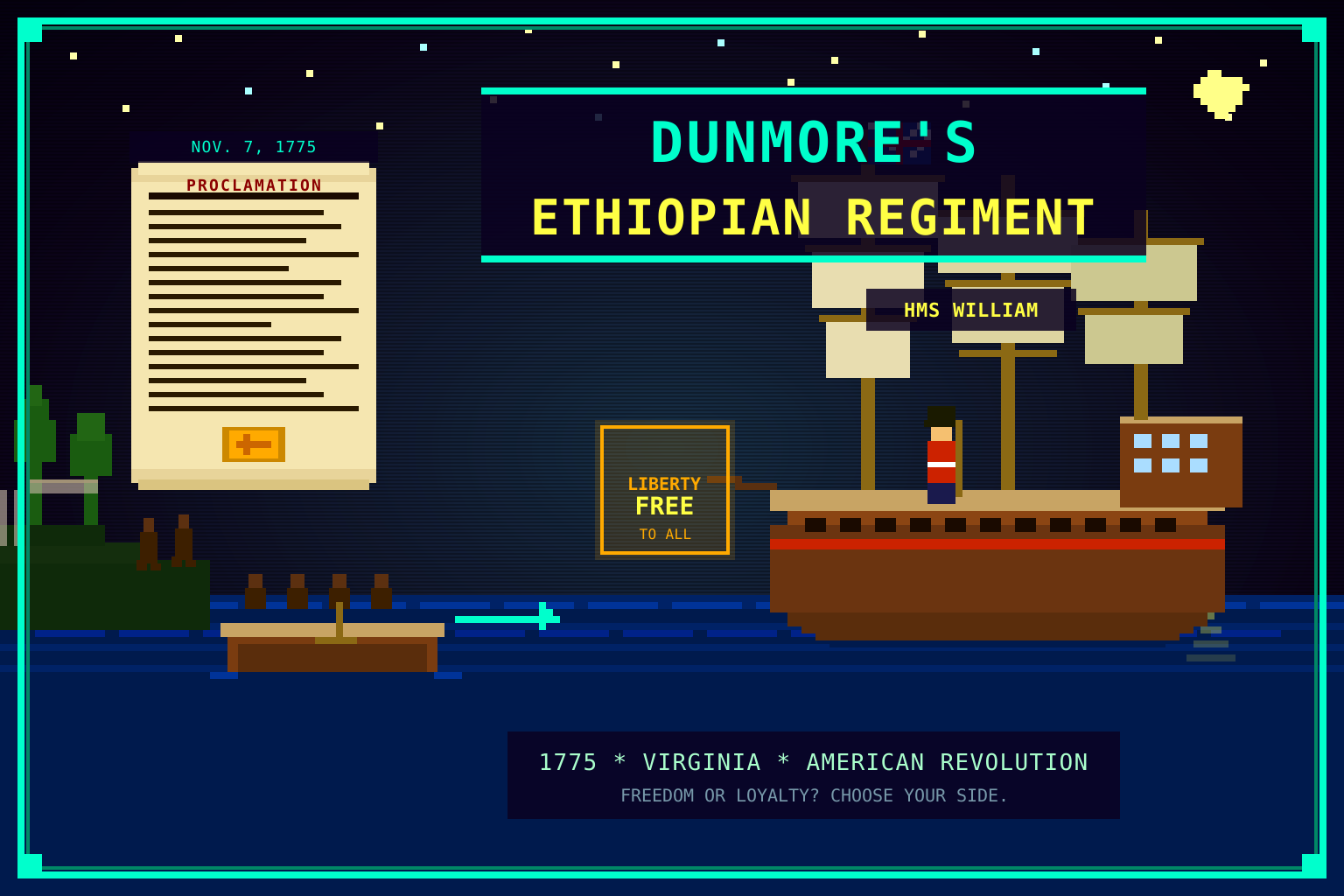
He had long recognized what Patriot leaders feared: the enslaved population of Virginia — roughly 200,000 people constituting about 40 percent of the colony’s total — represented a massive potential fighting force that the Patriots could not recruit without undermining the institution upon which their plantation economy depended. As early as April 1775, Dunmore threatened to free enslaved people if Virginia resisted British authority. On November 7, 1775, anchored aboard HMS William off Norfolk, he made good on that threat.
Dunmore’s Proclamation
Dunmore’s Proclamation declared martial law in Virginia and offered freedom — but with strict conditions. The offer extended only to enslaved and indentured servants “belonging to rebels” who were “able and willing to bear arms” and who could reach British lines. It did not free enslaved people held by Loyalists, nor did it apply to women, children, the elderly, or the infirm. Nevertheless, the impact was immediate and dramatic.
Within days, enslaved Virginians began escaping — rowing out to British ships at night, slipping through Patriot patrols on foot, and risking capture and death to reach freedom. By the end of November 1775, roughly 100 men had reached Dunmore’s fleet. Dunmore organized them into a formal military unit he called the Ethiopian Regiment (a name derived from the classical usage of “Ethiopia” to mean sub-Saharan Africa broadly). The regiment’s uniforms bore the inscription “Liberty to Slaves” — a deliberate inversion of Patriot slogans that proved a powerful propaganda statement on both sides.
The Regiment Forms
Dunmore commissioned Scottish officer Captain Andrew Snape Hamond to help organize and train the regiment. Recruits received the same arms and training as British regulars, along with pay and the promise of freedom for their families if they served. By December 1775 the regiment numbered approximately 300 men; by early 1776, six to eight new recruits were arriving daily as word of the proclamation spread across the Tidewater region. Historians estimate that ultimately between 800 and 1,000 men served in the Ethiopian Regiment across its full existence, though the precise total is uncertain due to incomplete records.
The regiment drew from both Virginia-born enslaved people and indentured servants — a deliberate expansion that undercut Patriot labor arrangements beyond the plantation system. Notable figures emerged from its ranks. A man known as Titus (later called Colonel Tye) escaped from a New Jersey Quaker planter in 1775, joined the British cause, and became one of the most effective guerrilla fighters of the entire war, leading raids on Patriot properties in Monmouth County, New Jersey well into the 1780s.
Military Engagements
The regiment’s first major action came on December 9, 1775, at the Battle of Great Bridge — a decisive engagement near Norfolk where Dunmore attempted to break the Patriot siege of his forces. Ethiopian Regiment soldiers fought alongside British regulars, but the attack failed after Patriot riflemen decimated the advancing British column. Within weeks, Dunmore abandoned Norfolk, and Patriot forces burned much of the city on January 1, 1776. (See: Burning of Norfolk.)
Through spring 1776, the regiment trained and reorganized at Tucker’s Mill Point. On January 1, 1776, Ethiopian Regiment members had participated in Dunmore’s bombardment of Norfolk’s waterfront. Later engagements were constrained by the regiment’s need to operate from ships — Dunmore’s fleet became both fortress and home for the growing community of freedom-seekers, including women and children who had escaped but could not serve militarily.
In August 1776, survivors who had transitioned into other British units participated in the Battle of Long Island (August 27, 1776), one of the largest engagements of the entire war. (See: Battle of Long Island.)
Disease and Collapse
Disease, not combat, ended the Ethiopian Regiment. In May–June 1776, when the fleet relocated to Gwynn’s Island in the Chesapeake Bay, a catastrophic smallpox outbreak swept through the crowded ships and shore encampments. Approximately 500 members died from smallpox and related disease — far exceeding all battlefield casualties combined. The terrible irony was that British forces were simultaneously practicing smallpox inoculation (variolation) in some units, but the practice was inconsistently applied, and the Ethiopian Regiment’s population of escaped enslaved people had little prior exposure and thus minimal immunity.
By late June 1776, Dunmore reported only 150 effective men remained fit for duty. A Patriot artillery attack on July 9, 1776 drove the fleet from Gwynn’s Island. The regiment evacuated north to New York. Dunmore formally disbanded the Ethiopian Regiment in late 1776 on Staten Island, though many survivors continued serving under British command as Black Pioneers — a labor and engineering unit that participated in the occupation of New York City and later the 1783 evacuation to Nova Scotia, the Bahamas, and Sierra Leone.
The smallpox epidemic that devastated the Ethiopian Regiment contrasted sharply with the Continental Army’s eventual response to the disease. In February 1777, George Washington mandated systematic inoculation of all Continental troops, a measure that helped stabilize American forces. (See: Smallpox Inoculation in the Continental Army.)
Aftermath and Legacy
Many Ethiopian Regiment veterans ultimately settled in Birchtown, Nova Scotia, the largest free Black settlement in North America at the time of its founding in 1783. Others reached the Bahamas and, in 1792, Sierra Leone — transported by the Sierra Leone Company as part of an effort to establish a free Black colony in West Africa. Their journeys illustrate how participation in the Revolutionary War projected formerly enslaved Americans across the Atlantic world.
The Patriot response to Dunmore’s proclamation was swift and revealing. Virginia’s legislature passed laws threatening death to any enslaved person who attempted to join the British, and Patriot newspapers portrayed Dunmore’s offer as barbaric. George Washington, who had initially refused to allow Black soldiers in the Continental Army, reversed course in part because of the Ethiopian Regiment’s example — by early 1776 he permitted free Black men to reenlist, and by the war’s end approximately 5,000 Black soldiers served on the Patriot side.
Significance
Dunmore’s proclamation and the Ethiopian Regiment represent a pivotal but often-overlooked dimension of the American Revolution. The proclamation demonstrated that enslaved people would seize opportunities for freedom, complicating Patriot narratives of unified colonial resistance and exposing the fundamental contradiction between Revolutionary claims of liberty and the enslaved status of thousands.
The regiment’s story challenges a persistent myth that Black Americans were passive during the founding era. Soldiers of the Ethiopian Regiment made rational, calculated decisions to pursue freedom through military alliance with whichever power offered it — a reminder that the Revolution was experienced very differently depending on one’s legal status. Though short-lived, the regiment established that Black Americans participated actively in the Revolutionary conflict on multiple sides, seeking freedom through military service more than eight decades before formal emancipation.
Sources
- Encyclopedia Virginia: Lord Dunmore’s Ethiopian Regiment
- Wikipedia: Royal Ethiopian Regiment
- George Washington’s Mount Vernon: Ethiopian Regiment
- Journal of the American Revolution: Lord Dunmore’s Ethiopian Regiment
- Colonial Williamsburg: Dunmore’s Proclamation and Black Loyalists
- Smithsonian Magazine: The First Black Regiment in American History