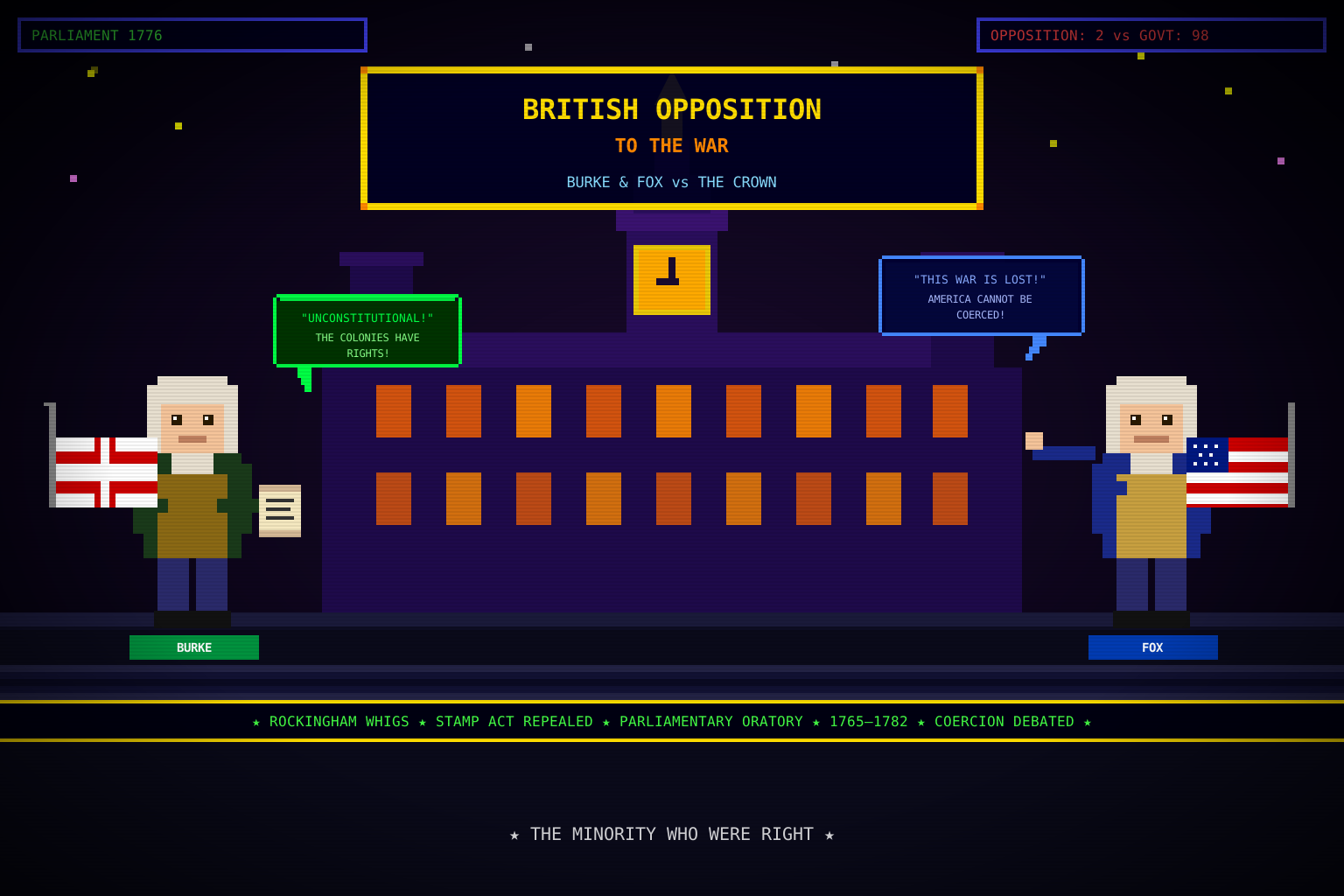
Key figures: Edmund Burke, Charles James Fox, the Marquess of Rockingham, Lord North (Prime Minister), King George III
Summary
The American Revolution was never a war Britain fought with a united political class. Within Parliament, a minority faction of Whigs — organized around Charles Watson-Wentworth, 2nd Marquess of Rockingham, and given intellectual voice by Edmund Burke and Charles James Fox — argued consistently that the coercion of the American colonies was both unconstitutional and unwinnable. By 1776, as the ministry of Lord North committed the largest expeditionary force in British history to the war, these men had become its most articulate domestic critics. They did not command the votes to change policy — government majorities on American questions were overwhelming — but they framed an opposition case that colonial leaders themselves invoked, drawing a careful distinction between the British Crown and “the people of England.” Their arguments, delivered in some of the most celebrated parliamentary oratory of the age, anticipated the war’s failure and shaped the terms on which it would eventually be concluded.
The Rockingham Whigs
The opposition to the American war centered on the Rockingham Whigs, a faction that had held power only briefly — in 1765–1766, when it repealed the Stamp Act, and again in 1782. Out of office for most of the intervening period, the group defined itself partly through its consistent opposition to the ministry’s colonial policy. Edmund Burke, an Irish-born member of Parliament and the party’s chief theorist, had served as private secretary to Rockingham and became the faction’s principal spokesman on America. His 1770 pamphlet Thoughts on the Cause of the Present Discontents had articulated a defense of organized party as a legitimate constitutional instrument — an idea that underpinned the Rockinghamite claim to principled, collective opposition rather than mere factional rivalry.
Burke’s constitutional argument against the war was developed in two landmark speeches. In his Speech on American Taxation (April 19, 1774) and, more famously, his Speech on Conciliation with America (March 22, 1775), Burke argued that the bonds of empire rested not on the assertion of abstract parliamentary sovereignty but on ties of custom, interest, and affection between the colonies and the mother country. To govern America by force, he contended, was to misunderstand the temper of a free people and to destroy the very connection Britain sought to preserve. “The use of force alone is but temporary,” he warned; a nation was “not governed which is perpetually to be conquered.”
Charles James Fox and the Opposition of 1776
Charles James Fox brought a very different temperament to the same cause. The son of Henry Fox, 1st Baron Holland, he had entered Parliament young and initially supported the North ministry, holding a seat at the Board of Admiralty and then the Board of Treasury. He resigned from the Treasury on February 18, 1774, and thereafter moved rapidly into opposition, becoming Burke’s political protégé and gravitating toward the Rockingham faction. By 1776 Fox had concluded that American independence was preferable to a costly and humiliating war, and he attacked the government’s measures with a vehemence that made him one of the most formidable debaters in the House of Commons.
Fox’s opposition reached a high point on October 31, 1776, when he responded to the King’s speech from the throne with what contemporaries judged one of his finest and most animated orations — so forceful that no member of the government rose to reply. He denounced Lord North as “the blundering pilot who had brought the nation into its present difficulties,” charging that the minister had “lost a whole continent.” Fox interpreted the American cause as a struggle for liberty against the encroachments of executive power, and he correctly predicted that Britain could not subdue the colonies by arms. He and his supporters adopted buff and blue — the colors of George Washington’s Continental Army — as a visible political symbol of their sympathy with the American cause.
The Limits of Opposition
For all its eloquence, the opposition was politically isolated. King George III and Lord North commanded large and reliable parliamentary majorities on American policy, and measures such as the Prohibitory Act (December 1775), which declared American shipping open to seizure, passed over Whig objections. Frustrated by their inability to affect events and unwilling to lend even the appearance of legitimacy to the government’s course, the Rockingham Whigs briefly seceded from Parliament in early 1777 — a deliberate, if short-lived, withdrawal in protest against the prosecution of the war. Burke set out the reasoning in a letter to Rockingham accompanying proposed addresses to the King and to the British colonists, dated January 1777.
The secession achieved little. By late 1777 Burke privately admitted to Fox that the British public was “very adverse to our politics and to the principles from whence they arise,” and the faction returned to active opposition within Parliament rather than outside it. Only the collapse of British fortunes in America — culminating in the surrender at Yorktown in October 1781 — finally vindicated the opposition’s predictions and brought down the North ministry in March 1782, ushering in a second Rockingham government with Fox as foreign secretary.
Significance
The parliamentary opposition of Burke and Fox mattered less for the votes it could muster than for the arguments it preserved. By insisting that the war was a constitutional error rather than a patriotic necessity, the Rockingham Whigs kept alive within Britain itself a critique of imperial coercion that colonial revolutionaries could cite as evidence that their quarrel lay with the Crown and ministry, not with the English people. Burke’s conception of empire as a bond of affection rather than raw sovereignty, and Fox’s early advocacy of recognizing American independence, would inform the eventual peace settlement and shape a durable strain of British liberal thought about the rights of colonial subjects. Their opposition demonstrated that the American Revolution was contested politically in London as well as militarily in New York — and that some of its sharpest critics of British policy sat in the British Parliament itself.