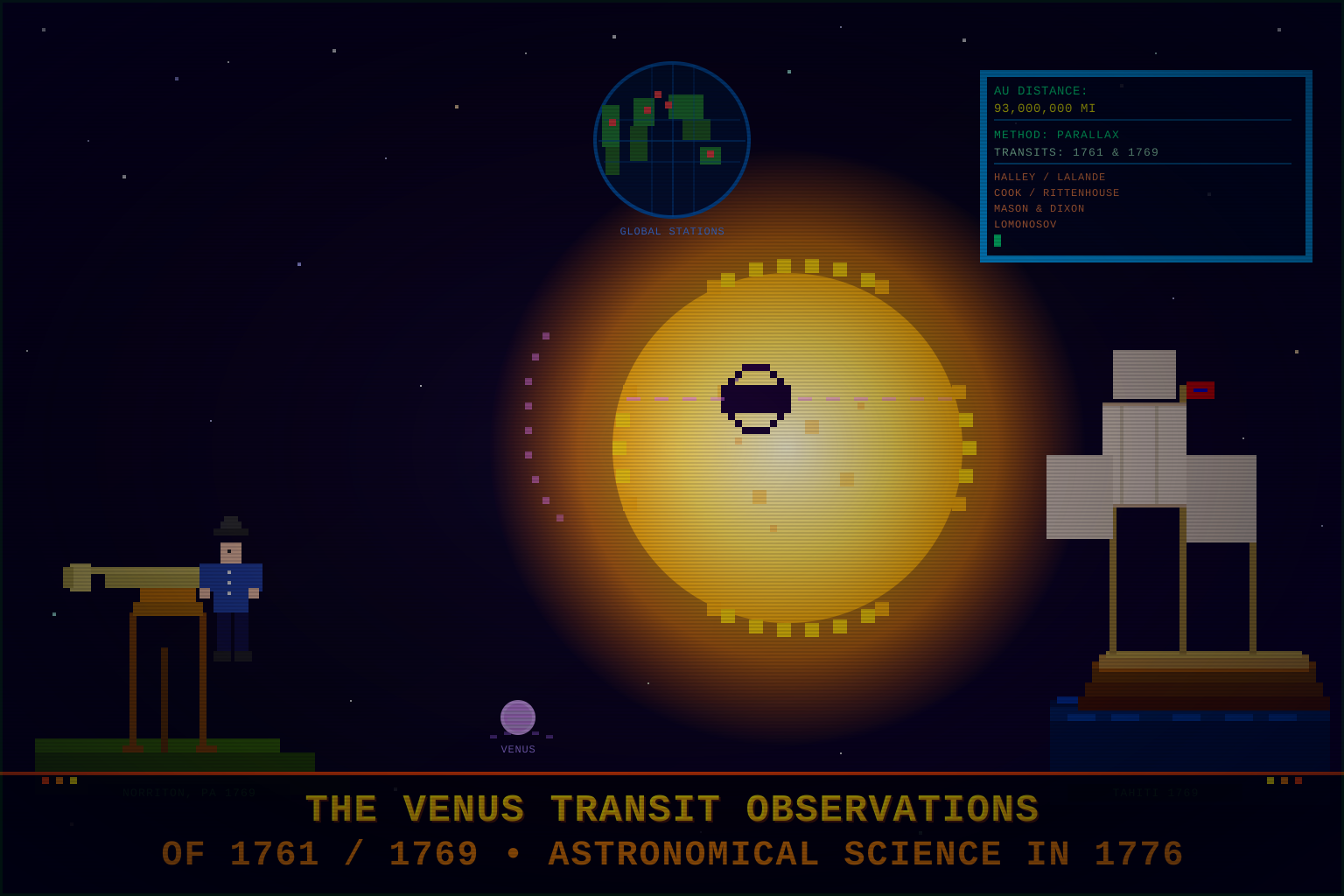
Key figures: Edmond Halley (1656–1742, originator of the method), David Rittenhouse (Norriton, Pennsylvania, 1769 observer), Charles Mason (Cavan, Ireland, 1769) and Jeremiah Dixon (Hammerfest, Norway, 1769), Captain James Cook (Tahiti, 1769), Jérôme Lalande (Paris, data compiler), Mikhail Lomonosov (St. Petersburg, 1761)
Summary
The observation of Venus’s transit across the face of the Sun in 1761 and again in 1769 represented the highest ambition of 18th-century natural philosophy: a globally coordinated scientific enterprise to measure the Earth-Sun distance through parallax observations from multiple continents. By 1776, the legacy of these expeditions permeated the scientific world — the precision of observation, the methodical reduction of data, the competition and cooperation between national scientific academies, and the collaborative ideal of the Republic of Letters all crystallized around the transit campaigns.
The resulting value of the astronomical unit — approximately 93 million miles (150 million km), derived from careful trigonometric reduction of transit timings at widely separated stations — became the foundational distance scale for all subsequent calculations of planetary orbits, stellar parallax, and the architecture of the solar system. The American astronomer David Rittenhouse, who observed the 1769 transit from his family’s Norriton estate in Pennsylvania, stood as living evidence that colonial natural philosophy had contributed to this global achievement — a credential he carried into his revolutionary-era service.
Halley’s Method and the Problem of Solar Distance
Edmond Halley, observing a transit of Mercury in 1677 and recognizing that a Venus transit would provide far superior parallax baselines, published his method in 1716 (knowing he would not live to see the 1761 transit). The principle was elegant: observers at stations separated by known distances on Earth’s surface would time Venus’s passage across the solar disk using the black-drop effect at ingress and egress. Because the planet appears to cross a slightly different chord of the Sun as seen from different latitudes, the difference in transit duration — if timing were precise enough — would yield the Sun-Earth-Venus geometry and thus the Earth-Sun distance (the astronomical unit, or AU) via simple trigonometry.
The critical dependency was timing precision, which linked the transit enterprise directly to the parallel problem of longitude and the marine chronometer. The 1769 expeditions did not yet rely on marine chronometers — Cook’s Endeavour voyage to Tahiti timed the transit with astronomical regulator clocks and fixed its longitude by lunar distances, and Larcum Kendall’s K1 (a copy of John Harrison’s prize-winning H4) would only be tested at sea on Cook’s second voyage of 1772–1775. But the two enterprises shared a foundation: both demanded absolute time accurate to a few seconds, and the transit campaigns helped drive the wider adoption of high-precision regulated clocks. Without reliable time, the contact timings that were the heart of Halley’s method could not be trusted.
The “black-drop effect” proved a persistent complication: as Venus’s limb approached the Sun’s edge, an apparent ligament of darkness seemed to connect them, making the exact moment of internal contact ambiguous. This optical artifact (now understood as a combination of solar limb darkening and diffraction) introduced systematic uncertainty that limited the final result.
The 1761 and 1769 Campaigns
The 1761 transit (June 6) mobilized an unprecedented international response: the French Academy of Sciences, the Royal Society, the Academy of Sciences of St. Petersburg, and smaller academies together dispatched observers to Siberia, India, Sumatra, Newfoundland, St. Helena, and the Cape of Good Hope — approximately 120 observers at 62 stations. The Seven Years’ War (which ended in 1763) complicated logistics severely: British vessels were at war with French ones, making some planned observations impossible. Mikhail Lomonosov, observing from St. Petersburg, noted that Venus appeared to have an atmosphere (a ring of refracted light around its limb) — one of the transit campaigns’ significant secondary discoveries.
The 1761 results were inconsistent: differing black-drop timings from different observers yielded derived AU values ranging from about 77 million to 100 million miles — a range too wide to be practically useful. Scientists recognized that the 1769 transit (June 3) would be the last opportunity for a century (the next pair would come in 1874 and 1882) and mounted a substantially larger effort.
The 1769 transit involved an estimated 150 observers at 77 stations across five continents. Key expeditions:
- Captain James Cook and Charles Green — Royal Society observers aboard HMS Endeavour to Tahiti. Cook’s primary mission was the transit observation; the circumnavigation and discovery of New Zealand and eastern Australia were secondary (and secret) orders. Cook timed the transit on June 3, 1769, with a brass quadrant and an astronomical clock.
- Charles Mason and Jeremiah Dixon — the pair who had surveyed the Mason–Dixon line (1763–1767) were dispatched separately by the Royal Society to widely spaced northern stations: Mason observed from Cavan, near Strabane in Ireland, while Dixon travelled to Hammerfest, Norway (with William Bayly stationed at North Cape), providing important high-latitude baseline data.
- David Rittenhouse, observing from Norriton, Pennsylvania (near Philadelphia), constructed his own transit instrument and led the American Philosophical Society’s observation. His timing was widely regarded as the most precise from any American station; his contact times were published in the Philosophical Transactions of the Royal Society (vol. 61, 1771). Rittenhouse reportedly became so emotionally overcome at the moment of Venus’s first contact with the Sun that he momentarily missed the exact timing — a detail later cited as evidence of genuine scientific passion.
- Alexandre Guy Pingré observed from Saint-Domingue (present-day Haiti), while Jean-Baptiste Chappe d’Auteroche carried the French effort to San José del Cabo in Baja California — where he completed his observation but died of an epidemic fever shortly afterward — together extending the observational baseline toward the tropics.
Key Results and the Astronomical Unit
The French astronomer Jérôme Lalande undertook the massive task of reducing all 1769 transit data from scores of stations, coordinating the international results. By the mid-1770s, the consensus value for the solar parallax (the angle subtended by Earth’s radius as seen from the Sun) was approximately 8.6 arc-seconds, corresponding to an Earth-Sun distance of about 93 million miles (the modern value is 92.96 million miles — a remarkable accuracy for the era).
This result grounded all subsequent astronomical work: without the AU, planetary distances and masses (calculated via Kepler’s laws) could not be known in physical units, only in ratios. By 1776, the transit-derived AU underpinned the calculation of Jupiter’s and Saturn’s masses, the prediction of cometary returns (including Halley’s Comet in 1759, which had confirmed Newton’s gravitational theory), and the early attempts to estimate the distance to the nearest stars.
See also astronomy and navigation in 1776, which covers how transit-era precision instruments and celestial mechanics were applied to the practical problems of maritime navigation — a direct operational payoff from the same scientific infrastructure.
Legacy in 1776: Science and Revolution
By 1776, the transit campaigns had been complete for seven years, but their resonance was still fresh. The American Philosophical Society’s involvement (organized by Rittenhouse, John Ewing, and others) had demonstrated that colonial Americans could practice natural philosophy at the highest level — a point of cultural significance as the same men debated independence. Thomas Jefferson cited Rittenhouse in Notes on the State of Virginia as evidence that American genius was not inferior to Europe’s, specifically referencing the transit observations.
The international character of the transit enterprise also illustrated an Enlightenment paradox that 1776 made stark: national scientific societies competed fiercely while simultaneously sharing data freely, cooperating across political borders in ways that diplomacy could not achieve. Britain and France exchanged astronomical tables even as their fleets fought in the Seven Years’ War. By 1776, this Republic of Letters ideal was being tested by the Revolutionary War: British and American scientists maintained correspondence across the battle lines (Benjamin Franklin corresponded with Sir Joseph Banks throughout the war), modeling a form of intellectual solidarity that transcended political rupture.
The transit observations also represent a direct link to the marine chronometer: precision timekeeping and precision astronomy were mutually reinforcing, and the transit campaigns accelerated the adoption of regulated clocks at sea, contributing to the revolution in navigation that was making Captain Cook’s third voyage (departing 1776) possible.
Related Topics
- David Rittenhouse, 1776
- John Harrison and the Marine Chronometer
- Astronomy and Navigation in 1776
- Captain Cook’s Third Voyage
- Lavoisier and Combustion Theory
Sources
- Transit of Venus — Wikipedia
- David Rittenhouse — American Philosophical Society
- Harry Woolf, The Transits of Venus: A Study of Eighteenth-Century Science (Princeton UP, 1959) — the standard scholarly history of the campaigns
- Steven J. Dick, ed., Sky and Ocean Joined: The U.S. Naval Observatory, 1830–2000 (Cambridge UP, 2003), ch. 1, on the transit legacy