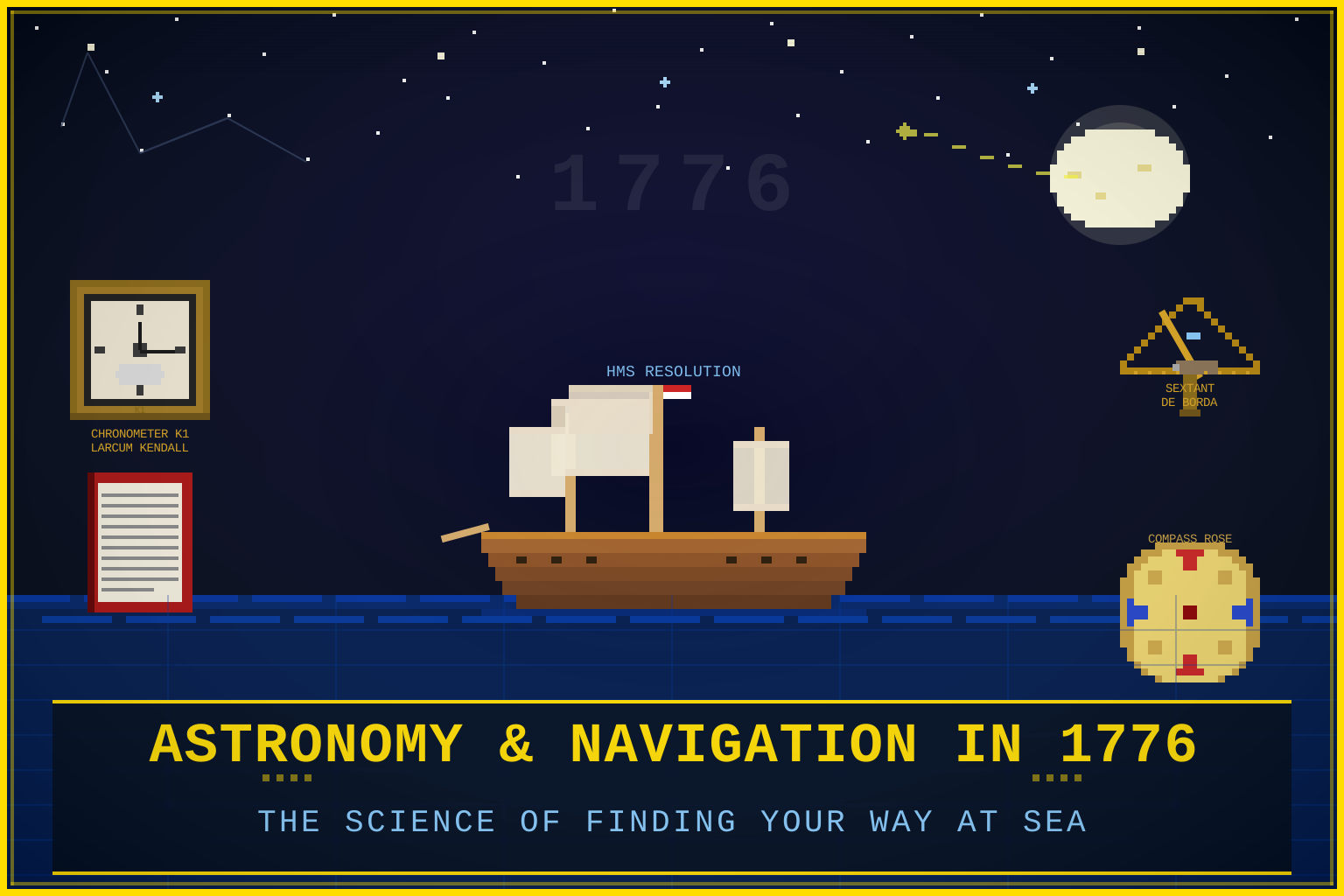
Key figures: John Harrison, Nevil Maskelyne, Captain James Cook, Larcum Kendall, David Rittenhouse, Jean-Charles de Borda
Summary
The year 1776 was a watershed in the history of celestial navigation. Captain Cook’s departure from Plymouth in July with HMS Resolution and HMS Discovery, carrying the Larcum Kendall K1 marine chronometer, represented the culmination of decades of effort to solve the “longitude problem”—the challenge of determining a ship’s east-west position at sea. John Harrison, the self-taught Yorkshire clockmaker who had solved the problem through mechanical precision, had died on March 24, 1776, at the age of eighty-two; yet his legacy traveled with Cook’s expedition. The K1 chronometer aboard Cook’s ship proved the principle of precision timekeeping was replicable and manufacturable, ending the era of navigation by dead reckoning and astronomical guesswork.
Celestial navigation in 1776 employed two primary methods: the lunar distance method and the altitude method using accurate chronometers. The lunar distance method, perfected by mathematicians at the Royal Observatory and published in the Nautical Almanac, required measuring the precise angle between the moon and a fixed star or the sun, then consulting extensive tables to derive the ship’s longitude. The chronometer method, by contrast, required nothing but accurate time and the ship’s latitude—determined by the sun’s noon altitude. These two paradigms—astronomical calculation and mechanical precision—were simultaneously in use in 1776, with different nations and commanders favoring different approaches.
American navigators in 1776 operated at the intersection of the two methods, their capabilities shaped by access, finance, and training. The Revolution and its blockade made European precision instruments expensive or unavailable, while pressing the Continental Navy and privateer fleet to operate at oceanic range.
The Board of Longitude and Harrison’s Prize
The institutional context of navigation in 1776 was the British Board of Longitude, established by the Longitude Act of 1714, which offered prizes of up to £20,000 for a practical method of determining longitude at sea. The Board’s history reflected the tension between scientific establishment and practical invention. Nevil Maskelyne, Astronomer Royal from 1765, championed the lunar distance method and oversaw publication of the Nautical Almanac beginning in 1767—a volume of pre-computed lunar distances that made the astronomical method practical for any navigator with a sextant.
Harrison’s mechanical approach had won the de facto longitude race: his H4 watch, tested in 1761–1762 on a voyage to Jamaica, was found accurate to within five seconds over 81 days—an error of roughly one nautical mile, well within the prize threshold. A second Barbados trial in 1764 confirmed it. Yet the Board withheld the full prize for a decade, demanding Harrison reveal his mechanisms and submit to further tests. Harrison’s vindication came through Parliament rather than the Board: in June 1773, at the age of eighty, he received an additional award of £8,750 recognizing his achievement. He died nine months later, in March 1776, without ever receiving a single, formal prize award.
For a detailed account of Harrison’s chronometers H1 through H5 and the Board’s political maneuvering, see John Harrison and the Marine Chronometer.
The Lunar Distance Method in Practice
The lunar distance method required five observations and several hours of calculation:
- Measure the angular distance between the moon’s limb and a reference star or the sun, using a sextant or quadrant; record to the nearest arcsecond
- Correct for parallax (the moon’s apparent displacement caused by the observer’s position on Earth’s surface), refraction, and instrumental error—three separate mathematical adjustments
- Consult the Nautical Almanac’s pre-computed lunar distance tables to identify the Greenwich time at which the corrected angle was observed
- Compare Greenwich time against local apparent time (determined by meridian altitude of the sun or star)
- Convert the time difference to longitude at the rate of 15 degrees per hour
The full calculation required upward of three hours by a skilled navigator, and any error in the initial measurement propagated through the subsequent mathematics. French navigator Jean-Charles de Borda improved the sextant design in the 1770s specifically to reduce measurement error in lunar distance work; his double-reflection circle (the “Borda circle”) was in production by 1775 and used by French naval officers throughout the Revolutionary period.
The method’s great advantage was that it required no expensive timepiece—only a good sextant and a copy of the Nautical Almanac. French and Spanish navigators, whose states were producing both, relied on it almost exclusively. British navigators who could not obtain chronometers used it as well.
The Chronometer Method and Cook’s Third Voyage
Captain James Cook’s third Pacific voyage, departing Plymouth on July 12, 1776, carried Larcum Kendall’s K1 chronometer—a direct copy of Harrison’s H4, produced at Board of Longitude expense for £450 (compared to the decades and tens of thousands of pounds Harrison had invested in originals). Cook’s ships also carried two Arnold chronometers, early-generation instruments from John Arnold’s workshop, whose accuracy Cook would compare against K1 throughout the voyage.
Cook’s navigation logs for the third voyage demonstrate the two-method system in practice: he used K1 to confirm longitudes already computed by lunar distance, cross-checking the mechanical against the astronomical to build redundant accuracy. By the standards of 1776, this was cutting-edge navigational science. Cook’s confidence in K1 was absolute: after the second voyage he had written that the chronometer had “exceeded the expectations of its most zealous advocate.”
For the scientific and geographical discoveries of Cook’s third voyage, see Captain Cook’s Third Voyage.
David Rittenhouse and American Navigational Science
American astronomical science in 1776 was concentrated in Philadelphia, where David Rittenhouse—clockmaker, astronomer, and instrument maker—represented the pinnacle of colonial scientific practice. Rittenhouse had constructed an orrery (a mechanical model of the solar system) in 1771 that the College of New Jersey and the College of Philadelphia competed to purchase. In 1769 he had organized and led the Pennsylvania observations of the Transit of Venus, which, when combined with observations from other continents, allowed calculation of the distance from Earth to the Sun with then-unprecedented precision.
In 1776, Rittenhouse served on the Pennsylvania Committee of Safety, manufacturing rifled cannon and working on military engineering. His navigational instruments—octants, telescopes, and precision clocks made to European standards—were among the best in America. The Continental Congress appointed him Treasurer of Pennsylvania in September 1776, redirecting his scientific energies to the war effort. See David Rittenhouse in 1776 for his full contributions to Revolutionary science and technology.
American privateers and the Continental Navy operated with mixed navigational methods. Some captains had chronometers captured from British prizes or obtained through French intermediaries at St. Eustatius; others relied on lunar tables and printed almanacs. The New England fishing and whaling tradition provided deep familiarity with dead reckoning—estimating position from speed, heading, and elapsed time—supplemented by coastal pilotage and star observation. American celestial navigation was technically competent rather than systematically scientific; the French alliance of 1778 brought French navigational expertise, instruments, and the more rigorous methods of the Connaissance des Temps (the French equivalent of the Nautical Almanac, published from 1679).
Navigation and the Revolutionary War at Sea
The advancement of celestial navigation in 1776 was inseparable from the Revolution itself. Accurate navigation enabled long-distance privateering operations in the Caribbean, transatlantic voyages to French ports, and the coordination of dispersed naval forces. The supply chains sustaining the Continental Army depended on ships that could reliably cross the Atlantic and Caribbean—a feat impossible without competent navigation.
The submarine technology of the period—Bushnell’s Turtle, tested in New York Harbor in September 1776—required precise positioning in an entirely different sense: the operator had to navigate a submerged vessel to an exact position beneath an anchored ship. Bushnell’s solution used a primitive compass and depth gauge rather than celestial methods, but the attempt reflected the same 1776 drive to apply scientific precision to military problems. See Bushnell’s Turtle.
The privateering fleet that depended on Caribbean navigation benefited from the same improvements. See The War for American Trade for how navigational capability enabled the commerce-raiding economy.
Significance
The broader significance of 1776 celestial navigation lay in the collision of two paradigms: the astronomical method (calculation-intensive, elegant, requiring only instruments available since the seventeenth century) and the mechanical method (requiring expensive precision instruments, but operationally simple). The transition marked the beginning of precision’s triumph over theory in practical science. The marine chronometer would become the indispensable technology of global maritime commerce in the nineteenth century, enabling the predictable shipping schedules and insurance structures that underpinned industrial capitalism.
For the new American nation, mastery of celestial navigation carried symbolic weight. The Continental Navy’s captains and privateers had to prove they could navigate as well as British sailors, and the presence of mathematicians like Rittenhouse advancing American astronomical science suggested that the new nation could match the Old World in technical sophistication. The ability to calculate latitude and longitude, to read the stars, and to measure time with precision became markers of American scientific ambition in the decades following independence.
The chronometer’s story embodied a creative archetype the Revolutionary era recognized: the self-taught inventor (Harrison) outperforming the institutions (the Admiralty’s Board of Longitude), precision outweighing tradition, and private innovation delivering solutions that governments had promised but failed to deliver. This narrative would resonate throughout the nineteenth-century American experience.
Related Topics
- John Harrison and the Marine Chronometer — Harrison’s death in March 1776 and his chronometric legacy
- Captain Cook’s Third Voyage — the 1776 expedition carrying Harrison’s K1 chronometer
- David Rittenhouse in 1776 — the leading American astronomer and instrument-maker of 1776
- Bushnell’s Turtle — the submarine experiment testing precision positioning underwater
- The War for American Trade: Privateering and the Blockade Economy — how navigational capability enabled Caribbean commerce raiding
Sources
- National Maritime Museum, “John Harrison and the Longitude Problem”
- Wikipedia, “Nautical Almanac”
- Wikipedia, “Lunar distance (navigation)”
- Wikipedia, “Larcum Kendall”
- Wikipedia, “Board of Longitude”
- Dava Sobel, Longitude: The True Story of a Lone Genius Who Solved the Greatest Scientific Problem of His Time (Walker & Company, 1995)
- Derek Howse, Nevil Maskelyne: The Seaman’s Astronomer (Cambridge University Press, 1989)