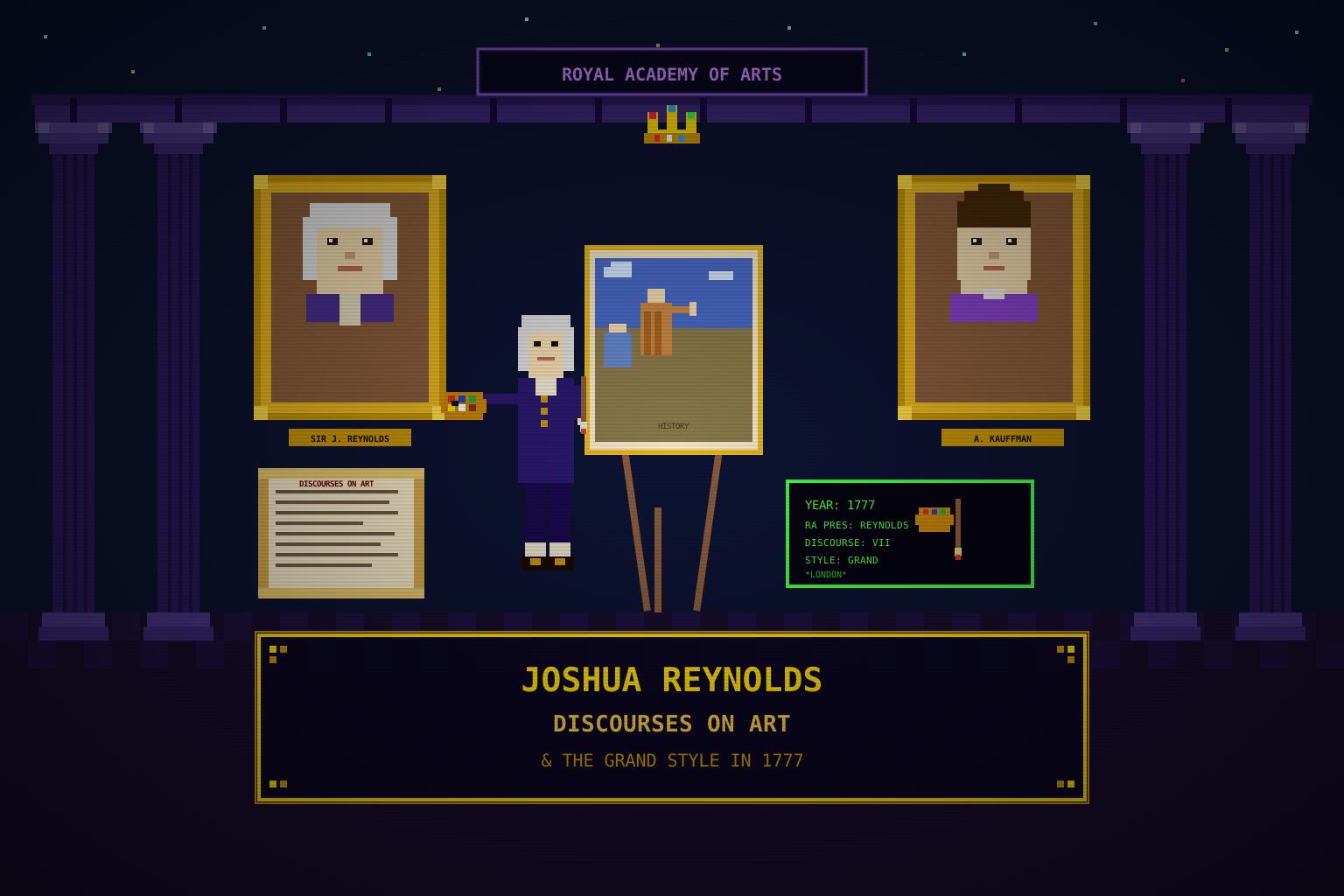
Key figures: Sir Joshua Reynolds, Edmund Burke, Samuel Johnson, Thomas Gainsborough, Angelica Kauffman, Benjamin West
Summary
Sir Joshua Reynolds (1723–1792), first President of the Royal Academy of Arts since its founding by royal charter on December 10, 1768, stood in 1777 at the peak of his authority over British painting and taste. Knighted by George III in April 1769 — only the second English artist so honored — Reynolds had spent nearly a decade delivering a periodic series of lectures, the Discourses on Art, to Academy students at the biennial distribution of prizes. No new Discourse was delivered in 1777 itself: Discourse VII, “The Reality of a Standard of Taste, as well as of Corporal Beauty,” had been read on December 10, 1776, and Discourse VIII would not follow until December 10, 1778. But the doctrine those lectures had already established — the neoclassical “Grand Style,” grounded in idealization, generalized nature, and a hierarchy of genres crowning history painting — governed the Academy’s teaching and exhibitions throughout 1777, the year in which Reynolds exhibited A Fortune-Teller and Portrait of Lady Bampfylde at the Royal Academy’s ninth annual exhibition.
The Royal Academy and Its President
The Royal Academy of Arts was established when George III gave his personal approval to its founding document on December 10, 1768, and Reynolds — already England’s leading portrait painter — was the near-unanimous choice as its first president. He delivered his inaugural Discourse at the Academy’s opening on January 2, 1769, and continued in the role for the rest of his life. The Academy’s annual exhibition, then held at Pall Mall (it would not move to Somerset House until 1780), opened for its ninth iteration on April 24, 1777, showing works by Reynolds alongside those of Thomas Gainsborough, John Singleton Copley, Angelica Kauffman, and other members of the founding generation.
The Discourses: Structure and Timing
Reynolds delivered fifteen Discourses to Academy students between 1769 and 1790, timed to the ceremonial distribution of student prizes. The first four (1769–1771) were annual; from Discourse VI onward the lectures settled into a biennial rhythm — Discourse VI on December 10, 1774, Discourse VII on December 10, 1776, and Discourse VIII on December 10, 1778. This schedule means 1777 fell in the gap between two Discourses rather than containing one of its own; no primary source supports a Discourse delivered that September or at any other point in 1777. What 1777 did contain was the continuing circulation and application of Discourse VII’s argument, delivered only months earlier, that taste and beauty rest on objective, discoverable standards rather than individual caprice.
The Grand Style and Idealized Nature
The theoretical core of Reynolds’s teaching — articulated most fully in Discourses III (1770) and IV (1771) and still current in 1777 — was the doctrine of the “Grand Style” (or “Great Style”). Reynolds argued that the highest art did not consist in the faithful, minute imitation of any single natural object, but in the artist’s capacity to abstract “central forms” from wide observation of nature and represent the general, idealized character of a subject rather than its incidental particulars. He ranked the Roman, Florentine, and Bolognese schools — exemplified above all by Raphael and Michelangelo — above the Venetian and Dutch traditions, which he criticized for prioritizing sensory color and surface detail over intellectual and moral grandeur. This doctrine placed history painting, which allowed the fullest scope for idealized, morally elevated subject matter, at the top of the Academy’s hierarchy of genres, with portraiture and landscape ranked below it.
The Standard of Taste and the Sublime
Discourse VII, delivered barely four months before 1777 began, extended this argument into aesthetics generally, contending that “the general idea of nature” — understood as encompassing both the forms nature produces and the constitution of the human mind itself — supplied a fixed, universal standard against which taste in painting, poetry, and sculpture alike could be judged, refuting contemporary claims that taste was merely a matter of individual or national preference. This built on a distinction Reynolds had drawn earlier, in Discourse IV (1771), between the sublime and the elegant: “the sublime impresses the mind at once with one great idea; it is a single blow: the elegant indeed may be produced by a repetition, by an accumulation of many minute circumstances.” Reynolds’s close friendship with Edmund Burke, whose Philosophical Enquiry into the Sublime and Beautiful (1757) had established the sublime as a distinct aesthetic category in English criticism, shaped this vocabulary; Samuel Johnson, another intimate friend, is traditionally credited with polishing the prose of the early Discourses.
Reynolds’s Practice in 1777
In practice, Reynolds’s own livelihood depended overwhelmingly on the portraiture his theory ranked beneath history painting, a tension he addressed by elevating his sitters through classical poses, allegorical allusion, and painterly reference to old-master compositions — a mode later termed the “grand manner portrait.” By the 1770s Reynolds commanded the highest fees of any painter in England (having charged 80 guineas for a full-length portrait as early as 1761, with rates rising substantially thereafter) and kept a punishing schedule of five or six sitters a day during the London season. Works exhibited or painted in 1777, including A Fortune-Teller (today at Waddesdon Manor) and Portrait of Lady Bampfylde (today at Tate Britain), show him continuing to apply Grand Style idealization even within the ostensibly lesser genre of portraiture, in implicit dialogue with the theoretical program he had laid out to his students.
Significance for 1777
By 1777 Reynolds’s Discourses had already fixed the theoretical vocabulary — Grand Style, ideal beauty, the standard of taste, the sublime and the elegant — through which the Royal Academy trained a generation of British artists and by which British painting increasingly measured itself against Continental neoclassicism. Though no new Discourse was delivered that year, the doctrine of Discourse VII, read to students only months before, and the Grand Style theory of the earlier Discourses remained the operative aesthetic framework governing the Academy’s 1777 exhibition and Reynolds’s own late-career practice, cementing his role as the chief theorist and arbiter of English neoclassical art in the 1770s.
Sources
- Sir Joshua Reynolds — Britannica
- Joshua Reynolds — Wikipedia
- Discourses on Art — full text, Project Gutenberg
- Discourse VII, “The Reality of a Standard of Taste” — Authorama
- Wark, Robert R., ed. Discourses on Art, by Sir Joshua Reynolds. Yale University Press, 1975 (critical edition with dated Discourse chronology).
- 1777 in art — Wikipedia
Related
- Edward Gibbon and the Decline and Fall of the Roman Empire — concurrent Enlightenment intellectual culture; Gibbon shared Reynolds’s Literary Club circle with Johnson and Burke
- The School for Scandal — concurrent triumph of the London arts scene in 1777, Sheridan another member of Reynolds’s circle
- Wolfgang Amadeus Mozart’s 1777 Tour — concurrent cultural achievement reshaping European arts in 1777