Key figures: Albrecht von Haller, Hermann Boerhaave (teacher), Francis Glisson (predecessor concept), Gottlieb Emanuel von Haller (son)
Summary
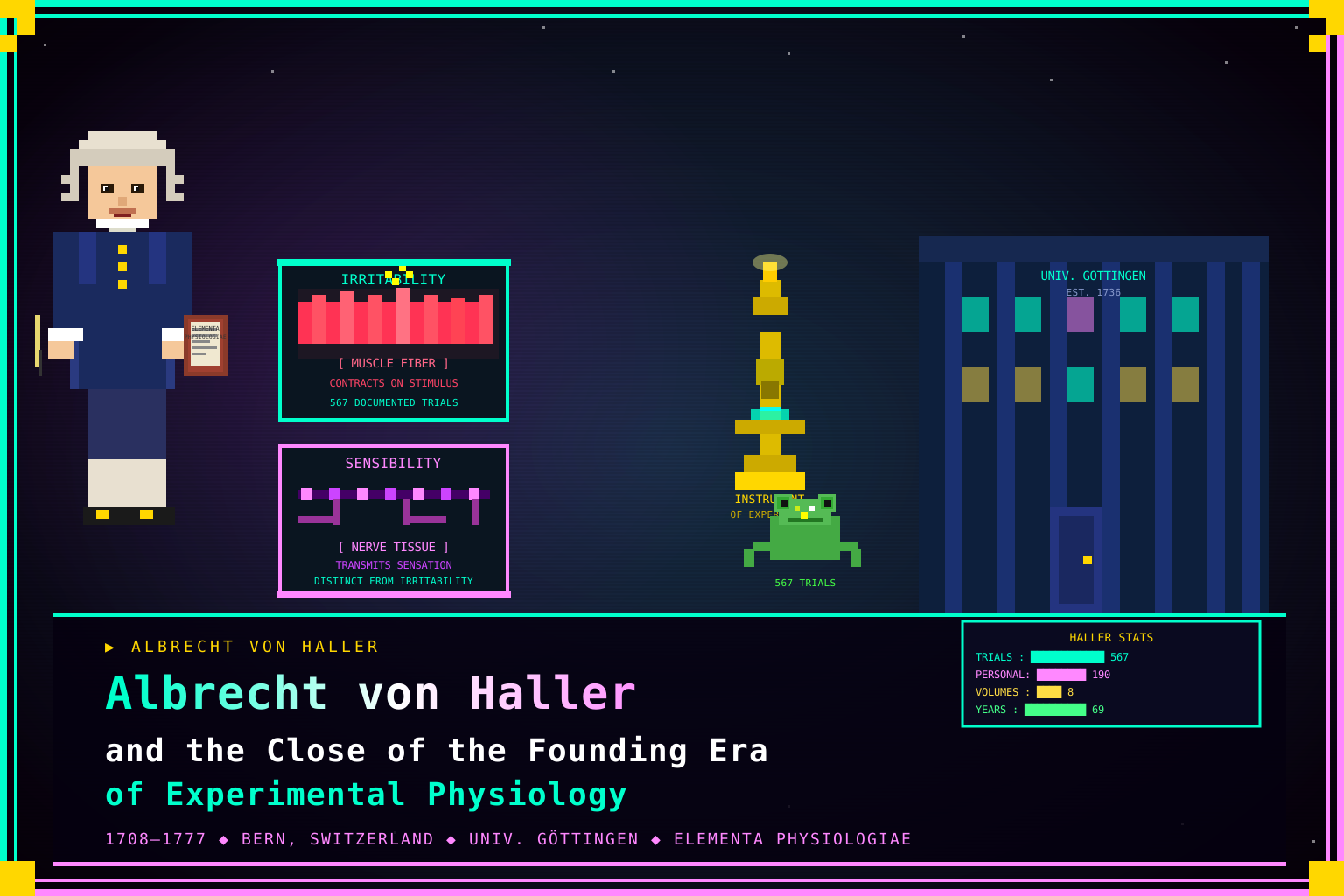
Albrecht von Haller, the Swiss anatomist, physiologist, botanist, and poet widely credited as the founder of experimental physiology, died in Bern on December 12, 1777, at age 69, closing out a research career that had redefined how the medical sciences understood the living body. Trained under Hermann Boerhaave at Leiden and later a founding professor at the University of Göttingen (1736–1753), Haller conducted a landmark program of animal experimentation — 567 documented trials, 190 performed personally — establishing that “irritability” (the capacity of muscle fiber to contract when stimulated) and “sensibility” (the capacity of nerve tissue to transmit sensation) were two physiologically distinct properties of living tissue. This distinction, synthesized in his eight-volume Elementa Physiologiae Corporis Humani (1757–1766), gave physiology its first coherent, experimentally grounded foundation as a discipline independent of anatomy, and remained the reference framework for nerve-and-muscle physiology in the year of his death and for decades afterward.
Career and the Göttingen Years
Born October 16, 1708, in Bern, Haller studied medicine first at Tübingen and then at Leiden under Hermann Boerhaave, one of the era’s most influential clinical teachers. In 1736 he was recruited to the newly founded University of Göttingen, where he held a professorship until 1753 and helped establish the Göttingen Academy of Sciences (Königliche Gesellschaft der Wissenschaften), later serving as its first president. During these Göttingen years he conducted the bulk of the experimental work on irritability and sensibility that would define his scientific legacy, building on but substantially extending an idea of tissue “irritability” the English physician Francis Glisson had proposed a century earlier without Haller’s systematic experimental support.
Irritability, Sensibility, and the Elementa Physiologiae
Haller’s central scientific achievement was to show, through hundreds of controlled experiments on animal tissue, that irritability — measurable, self-generated contraction of a muscle fiber under stimulus, independent of any nerve connection — was a property specific to muscle, while sensibility, the transmission of perceptible sensation, was a property specific to nerve tissue alone. This clean separation of muscular and nervous function, first advanced in a 1752 Göttingen thesis and defended through repeated experimental replication over the following years, ran counter to prevailing assumptions that muscle contraction was itself a nervous phenomenon, and it laid essential groundwork for the eventual emergence of modern neurology. Haller synthesized this research, along with a comprehensive survey of circulation, respiration, digestion, and reproduction, in the Elementa Physiologiae Corporis Humani, published in eight volumes between 1757 and 1766 by Marc-Michel Bousquet in Lausanne — a work so encyclopedic that contemporaries called it “that cursed book in which everything can be found,” and one credited with establishing physiology as a discipline in its own right, separate from anatomy and general medicine.
Final Years and Death
After resigning his Göttingen chair in 1753 and returning to his native Bern, Haller held minor civic office (obtained, by Bernese custom, through a lottery post as Rathausmann) and devoted his remaining decades to an immense bibliographic project, the Bibliotheca, cataloguing tens of thousands of publications across botany, anatomy, surgery, and medicine, alongside three didactic political novels — Usong (1771), Alfred (1773), and Fabius und Cato (1774) — exploring different systems of government. His health declined sharply after 1773, and in his final years he came to rely on opium, publishing a clinical account of its effects to the Royal Society of Göttingen in 1776; medical historians generally regard his long-term opium dependence as a contributing factor in his death on December 12, 1777, in Bern.
Standing Among Contemporaries
By the time of his death Haller was a Fellow of the Royal Society (elected 1743), a foreign member of the Royal Swedish Academy of Sciences, and had been ennobled in 1749 in recognition of his scientific standing. Between the publication of his 1752 irritability thesis and his 1777 death, roughly 120 dissertations and papers by other European physiologists engaged directly with his experimental findings, evidence of how thoroughly his framework had come to structure debate on nerve and muscle function across the Continent — a controversy that would continue to be argued over the following decade under the terms Haller had set.
Significance for 1777
Haller’s death in December 1777 marked the close of the founding generation of Enlightenment experimental physiology: the Elementa Physiologiae, completed a decade earlier, stood as the field’s first comprehensive, evidence-based synthesis, and the irritability/sensibility distinction it systematized remained the operating framework for the study of nerve and muscle function at the moment of his death. His career — spanning experimental physiology, systematic botany, scientific bibliography, and literature — exemplified the polymathic, empirically driven science of the mid-eighteenth century just as that generation began to give way to the chemists and physicians (Lavoisier among them, then only beginning his own 1777 investigations into combustion and respiration) who would carry Enlightenment life science into its next phase.
Sources
- Albrecht von Haller — Wikipedia
- Albrecht von Haller — Britannica
- Father of Physiology — Science (AAAS)
- Steinke, Hubert. Irritating Experiments: Haller’s Concept and the European Controversy on Irritability and Sensibility, 1750–90. Clio Medica 75. Rodopi, 2005.
- Albrecht von Haller (1708–1777) — Journal of the History of Medicine and Allied Sciences (Oxford Academic)
Related
- Smallpox Inoculation and Variolation in 1777 — concurrent advance in Enlightenment medical science
- Lavoisier’s Oxygen Theory — the emerging chemistry of respiration and animal heat that would carry Enlightenment life science beyond Haller’s generation
- Leonhard Euler — contemporary polymath of the mid-eighteenth-century sciences, productive into the same decade