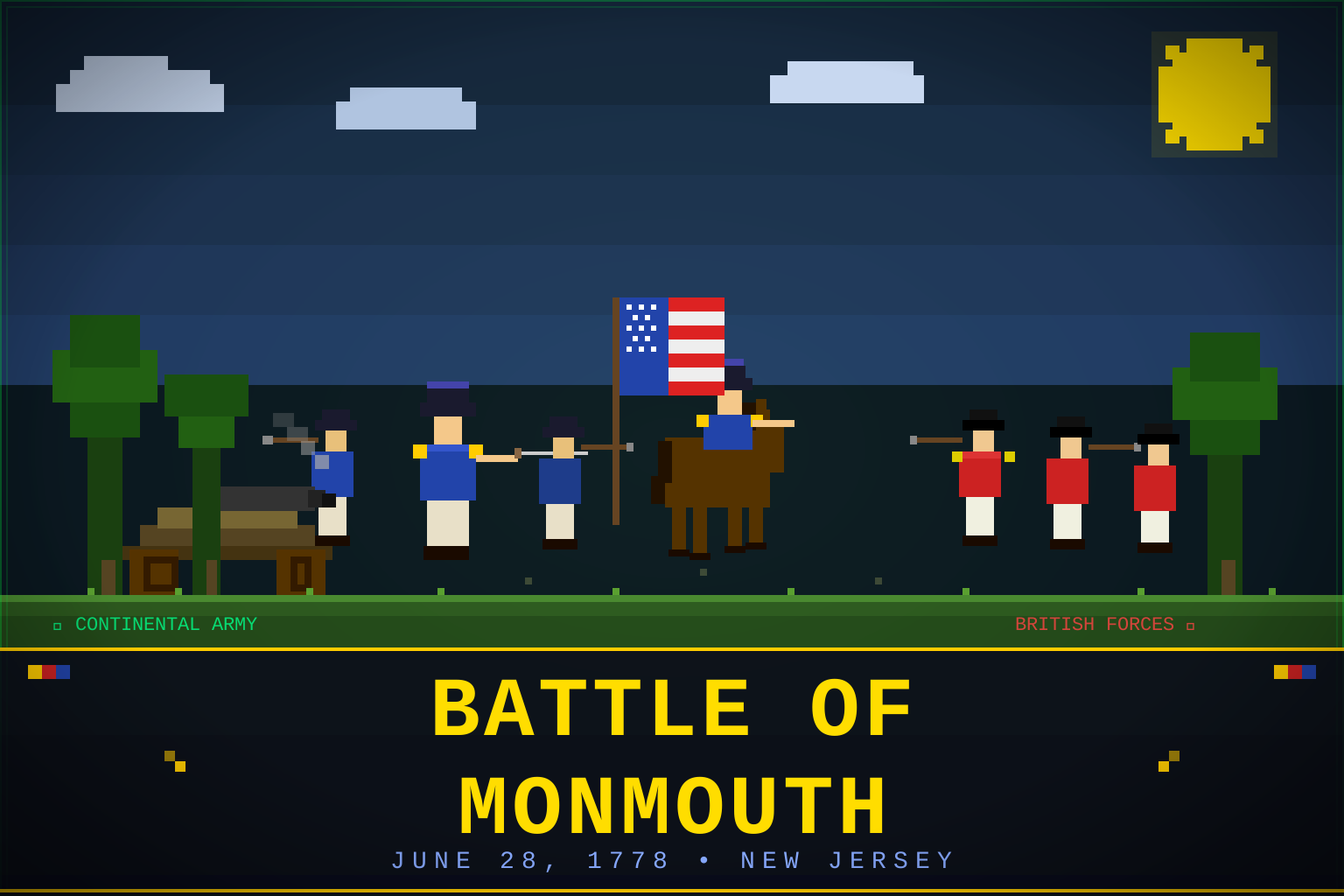
Key figures: General George Washington, General Henry Clinton, General Charles Lee, General Nathanael Greene, General Anthony Wayne, Baron Friedrich Wilhelm von Steuben, Henry Knox (Chief of Artillery), Molly Pitcher (Mary Ludwig Hays)
Summary
On June 28, 1778, near Monmouth Courthouse in central New Jersey (present-day Freehold), the Continental Army under General George Washington engaged British General Henry Clinton’s army during Clinton’s march from Philadelphia toward New York. Though the battle achieved no decisive tactical victory for either side, it marked a symbolic turning point: after months of hardship at Valley Forge and Baron von Steuben’s intensive winter training, Washington demonstrated that his army could stand against British regulars in open-field combat. The engagement — stretching across nearly twelve hours of brutal summer heat — involved roughly 10,000–12,000 men on each side, produced approximately 360 American and 400 British casualties (excluding heat exhaustion deaths), and ended with a dramatic confrontation between Washington and his own second-in-command, General Charles Lee, that would define the officer corps for years.
Background: The Strategic Situation in 1778
The battle’s roots lay in strategic decisions made throughout 1777. Burgoyne’s catastrophic defeat at Saratoga in October 1777 had convinced France to enter the war openly, and the Franco-American Treaty of Alliance was signed on February 6, 1778. This transformed the war’s calculus entirely: France’s entry meant British naval superiority in American waters was no longer guaranteed, and supplying Philadelphia via sea became acutely dangerous.
British General Henry Clinton, newly appointed Commander-in-Chief in America in May 1778 (replacing William Howe), received orders from London to evacuate Philadelphia, consolidate forces in New York City, and protect Caribbean possessions from French attack. On June 18, 1778, Clinton began his withdrawal — moving his entire army of roughly 10,000–12,000 troops, accompanied by perhaps 3,000 Loyalist refugees and a supply train stretching nearly twelve miles across New Jersey toward Sandy Hook.
Washington, encamped at Valley Forge with approximately 13,500 troops, saw opportunity. The retreating column moved slowly, encumbered by wagons and civilians. A council of war among his generals debated strategy: General Charles Lee argued against risking pitched battle with British regulars, while General Nathanael Greene, General Anthony Wayne, and the Marquis de Lafayette advocated aggressive pursuit. Washington sided with the aggressive faction, ordering an advance guard under Greene and Lee to harry Clinton’s column and find ground for a major engagement.
The Valley Forge Factor: Von Steuben’s Training
What made Monmouth possible was the transformation of the Continental Army during the Valley Forge winter of 1777–1778. When Baron Friedrich Wilhelm von Steuben arrived at Valley Forge in February 1778, he found an army that barely functioned as a military organization. Soldiers did not know how to march in formation, load muskets in sequence, wheel to face new threats, or maintain supply discipline.
Von Steuben drilled a model company of one hundred men, teaching standardized European tactics adapted to American conditions. He wrote the Regulations for the Order and Discipline of the Troops of the United States — still the foundational document of American infantry doctrine — and by spring 1778 had transformed the Continental Army’s capacity for coordinated maneuver. At Monmouth, this training would be decisive: when Lee’s advance faltered and Washington rallied the broken units, the troops responded to commands with a discipline that simply had not existed a year earlier.
The Battle: Initial Collapse and Washington’s Recovery
At dawn on June 28, temperatures were already rising toward 100°F. Lee commanded the advance guard of approximately 5,000 men, ordered to attack Clinton’s rear guard before it could close with the main British column.
Lee’s advance was halting from the start. Uncertain of the terrain and skeptical of the engagement, Lee deployed his units piecemeal across several miles of ravines, orchards, and scrubland. Clinton, sensing the disorganized pressure on his rear, wheeled Lieutenant General Charles Cornwallis’s division back to counterattack. British light infantry and dragoons struck Lee’s dispersed detachments, driving several units backward in confusion. A retreat began — then accelerated — until Washington, riding forward from the main army, encountered soldiers streaming rearward without orders.
Eyewitnesses, including the Marquis de Lafayette and Alexander Hamilton, recorded Washington’s reaction as one of barely controlled fury. Riding to the front in full view of the enemy, Washington reportedly confronted Lee directly, demanding an explanation for the retreat. (Lee’s exact words and the exchange between them were disputed at court-martial; Hamilton’s account described Washington using “profanity” toward Lee — notable given Washington’s usual dignity.) Washington then personally positioned artillery under Henry Knox on Perrine Ridge, stabilized the retreating infantry, and established a defensive line that halted the British advance.
Artillery Dominance and the Long Afternoon
Once Washington stabilized the Continental line near Monmouth Courthouse, the battle settled into a grinding artillery duel. Henry Knox, the self-taught Boston bookseller who had become Washington’s Chief of Artillery, positioned eighteen-pounder and six-pounder guns on Perrine Ridge in interlocking fields of fire. Clinton’s infantry made repeated assaults against this position across the afternoon — each driven back by artillery fire more coordinated than in any previous American engagement.
The heat was catastrophic. By midday, temperatures exceeded 100°F with high humidity. Men on both sides collapsed from heat exhaustion by the hundreds; modern estimates suggest that more soldiers died of heat than of combat wounds. Ammunition ran short; water supplies were exhausted; wounded men died lying in the sun waiting for retrieval.
Molly Pitcher at Monmouth
Mary Ludwig Hays, the wife of artillerist William Hays, moved across the battlefield carrying water from a nearby spring to cool the guns and supply soldiers — giving rise to the “Molly Pitcher” legend (the nickname “Molly Pitcher” was applied generically to women who brought water on the battlefield, but Mary Hays is the most documented individual). When her husband collapsed — possibly from heat exhaustion or a wound — accounts record that Mary Hays took his place at the cannon, ramming and swabbing the gun throughout the afternoon. Her actions were later corroborated by multiple witnesses, and in 1822 the Pennsylvania legislature granted her an annual pension of $40 for her service.
Aftermath: Nightfall, Withdrawal, and Lee’s Court-Martial
By 5 p.m., Clinton’s attacks had spent themselves. Washington considered a counter-assault but lacked fresh infantry. As evening fell, both armies remained in place — exhausted, depleted, short of water and ammunition. During the night of June 28–29, Clinton quietly resumed his march to Sandy Hook, embarking his army on British ships for New York by July 5. Washington, hoping to continue the engagement, found the British gone at dawn.
British losses at Monmouth totaled approximately 400 killed and wounded, plus an unknown number of heat casualties and desertions (German Hessian troops deserted in significant numbers during the New Jersey march). American losses were approximately 362 killed and wounded, with additional heat deaths.
The controversy between Washington and Charles Lee, however, proved lasting. Lee, who believed he had performed correctly and had been scapegoated by Washington, publicly demanded a court-martial to vindicate himself. Washington, feeling his authority challenged, pressed charges: disobeying orders, misbehavior before the enemy, and disrespect to the Commander-in-Chief.
The court-martial convened in July 1778 and ran through December. The proceedings divided the officer corps: Lee’s defenders argued he had wisely avoided a catastrophic battle with superior British forces; Washington’s supporters insisted Lee had disobeyed direct orders and undermined morale at a critical moment. Lee was convicted on all three charges and suspended from command for one year. When he attempted to return to service in 1780, Congress permanently dismissed him. He died in Philadelphia in 1782, bitter and largely forgotten.
Strategic Significance and Legacy
The Battle of Monmouth produced no territorial change and no decisive military outcome. Clinton’s army reached New York intact; Washington did not destroy a significant British force. Yet the battle’s significance was felt immediately in the political and psychological dimensions of the war:
-
Proof of concept for von Steuben’s training. The Continental Army’s ability to rally, re-form under fire, and conduct coordinated defensive operations demonstrated that the Valley Forge winter had produced a genuine military force — something doubtful before June 1778.
-
Artillery as a battle-winning arm. Henry Knox’s performance confirmed that well-sited artillery could offset British infantry superiority — a lesson Washington applied in subsequent campaigns and that Knox institutionalized when he became the first Secretary of War.
-
Washington’s authority consolidated. The Lee court-martial, though contentious, demonstrated that challenges to Washington’s command were fatal to the challenger’s career. Washington’s political dominance over the officer corps was stronger after Monmouth than before it.
-
European diplomatic signal. Reports of the battle reached France by late July 1778, reinforcing the narrative that the Continental Army could fight British professionals and bolstering the Franco-American alliance. The Comte de Vergennes, the French Foreign Minister who had championed alliance, cited Monmouth in dispatches as evidence that American commitment was durable.
The battle has been commemorated at the Monmouth Battlefield State Park in Freehold Township, New Jersey, which preserves approximately 1,500 acres of the original battlefield, including Perrine Ridge, where Washington’s artillery made its decisive stand.
Sources
- Wikipedia: Battle of Monmouth
- Britannica: Battle of Monmouth
- Library of Congress: American Memory — Battle of Monmouth Primary Sources
- Founders Online: George Washington Papers — June 1778 Dispatches
- American Battlefield Trust: Battle of Monmouth
Related articles: