Category: Military Events
Key figures: General Henry Clinton, General Israel Putnam, Governor George Clinton, Colonel James Clinton
Summary
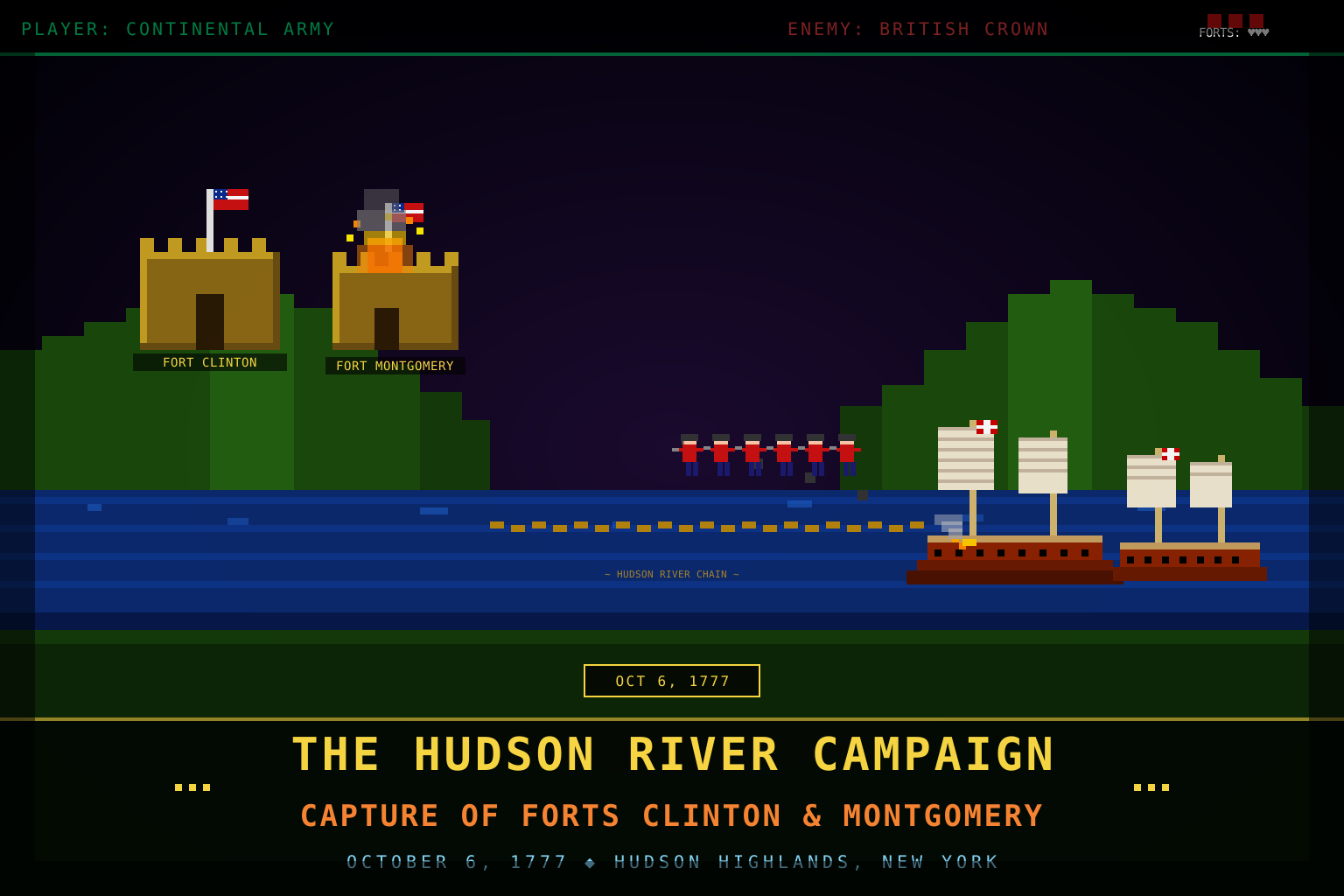
The capture of Forts Clinton and Montgomery on October 6, 1777, represented a daring British offensive up the Hudson River aimed at breaking through American defenses and potentially relieving General John Burgoyne’s beleaguered northern army. Under the command of General Henry Clinton, a coordinated British and Hessian force of approximately 3,000 troops struck at the two American-held forts in the Hudson Highlands near present-day Peekskill, New York. Though the assault succeeded tactically—the forts were captured and partially destroyed—it arrived too late to affect Saratoga’s outcome, as Burgoyne surrendered within eleven days on October 17, 1777. The campaign also produced the burning of the provincial capital Kingston on October 16, further demonstrating British reach—but none of it reversed the war’s turning point already set in motion at Saratoga.
The Hudson Valley Strategic Picture
The Hudson River held critical importance to both armies in 1777. For the British, control of the river meant the ability to move supplies from New York City northward and potentially to link Howe’s army in the south with Burgoyne’s forces advancing from Canada. For the Americans, the river served as a supply artery, and the Highlands forts were positioned to deny British passage. Forts Clinton and Montgomery sat at a narrow point in the river, approximately 45 miles north of New York City at the rocky promontory of Bear Mountain, commanding the approaches and equipped with artillery to threaten British shipping.
The two forts occupied adjacent strategic ground on the river’s western bank: Fort Montgomery lay immediately north of Popolopen Creek, while Fort Clinton sat to the south of the same creek. Together, they were defended by roughly 700 to 900 American troops under the immediate command of Brigadier General James Clinton (Governor George Clinton’s brother) and Major John Lamb, commander of the artillery. The American garrison consisted primarily of militia and newly raised Continental regiments, lacking the training and cohesion of the British regulars arrayed against them.
A large iron chain and a boom of logs stretched across the river between the two forts to impede British naval movement. This obstacle—a precursor to the more famous Great Chain later installed at West Point—was a central element of American defensive strategy. If the forts fell, the chain could be broken or removed, opening the river to British shipping.
The British Plan and Force Composition
General Henry Clinton, commanding British forces in New York, conceived the Highland operation as a supporting move to Burgoyne’s northern campaign. While General William Howe pursued his Philadelphia strategy (having landed at Head of Elk, Maryland, in late August), Clinton was directed to send what assistance he could northward. A force under Clinton’s personal command assembled at the lower Hudson in early October 1777.
The assault force numbered around 3,000 men and included: the British 52nd, 57th, and 7th Regiments of Foot; Hessian troops; a contingent of Loyalist volunteers; and a supporting naval squadron under Commodore William Hotham, including the flagship HMS Preston, the galley Dependence, and several armed sloops and transport vessels. The plan called for a two-pronged assault—a feint toward Verplanck’s Point (Fort Independence) on the river’s eastern shore to draw American attention, followed by the main crossing to the western bank to assault both Forts Clinton and Montgomery simultaneously from the landward side where defenses were less prepared.
Beverley Robinson, a prominent Loyalist officer familiar with the Hudson Valley terrain, accompanied Clinton’s force and provided local intelligence critical to the operation’s planning.
The American Defenders and Their Challenges
Governor George Clinton—who wore two hats as both New York’s elected governor and a Continental Army brigadier general—held overall responsibility for the Highlands defense. His immediate subordinate, Brigadier General James Clinton, commanded the forts’ garrisons directly. General Israel Putnam, commanding the broader Hudson Valley theater from Peekskill, was responsible for the region’s overall coordination but did not have sufficient troops to concentrate in the Highlands without abandoning other critical positions.
The American garrison’s fundamental problem was manpower: the forts required far more defenders than were available. Washington had stripped the region of experienced Continental troops to reinforce the main army, leaving Governor Clinton with militia and short-term enlistees. The iron chain across the river, while a genuine obstacle to British ships, could not compensate for the garrison’s numerical inferiority on land.
The Battle: October 6, 1777
American scouts detected British ships moving up the river on October 5, and Governor George Clinton alerted nearby militia. He rushed what reinforcements he could gather—several hundred additional men—toward the Highlands on the morning of October 6. They arrived too late to alter the outcome.
The British feint at Verplanck’s Point succeeded in drawing American attention to the eastern shore. Meanwhile, Clinton’s main force crossed the river and landed on the western bank. The assault columns advanced through rough Highland terrain toward the forts’ landward approaches, guided by Loyalist scouts with local knowledge. By mid-afternoon of October 6, the British assault had begun in earnest on both forts.
The fighting proved sharp and costly. American defenders at Fort Montgomery mounted a determined resistance, inflicting casualties on the British assault columns as they advanced through the rocky, wooded approaches. Major Lamb’s artillery crews fired effectively until overrun. At Fort Clinton, Brigadier General James Clinton was wounded by a bayonet thrust during the final melee as British troops breached the fortification. American casualties numbered approximately 50 killed and around 150 captured; British and Hessian casualties were estimated at 140 to 200 killed and wounded—substantial losses that reflected the ferocity of the American defense.
Governor George Clinton himself escaped capture in dramatic fashion, fleeing across a creek in the gathering darkness as British troops closed in. Brigadier General James Clinton also escaped, wounded, through the surrounding forest.
The Chain and the Opening of the River
Once both forts fell, the British moved quickly to remove or break the iron chain and log boom stretched across the river. With the obstacle cleared, a British flotilla under Sir James Wallace advanced upriver. British gunboats and galleys captured or burned the small American vessels Congress and Montgomery, eliminating whatever naval presence the Americans had maintained on the upper river.
Supply ships began moving northward through what had been an impenetrable American barrier. Commodore Wallace’s squadron advanced as far north as Kingston, New York—then serving as the New York State’s provisional capital—which British forces put to the torch on October 16, 1777. The burning of Kingston destroyed most of the town’s buildings and scattered the state’s wartime government, serving as a demonstration of British punitive reach.
The Aftermath: Strategic Implications
Despite the tactical success, the timing proved decisive for its futility. Burgoyne surrendered at Saratoga on October 17—just eleven days after the Highlands forts fell and one day after Kingston burned. The British naval advance northward toward Albany stalled when word arrived of Burgoyne’s capitulation; there was no longer any point in continuing the relief expedition.
The captured forts themselves were destroyed by the British rather than held permanently—the garrison required to defend them would have been too large and too exposed. American forces quickly moved to reconstruct defenses higher up the river, culminating in the more formidable works at West Point that would later become the army’s most critical position.
The operation nonetheless confirmed Clinton’s strategic thinking and revealed a genuine vulnerability in the American defensive line. For General Putnam, the loss became a source of continuing controversy. Critics argued that he had not adequately concentrated forces in the Highlands or coordinated the regional defense; defenders pointed out that Putnam faced impossible force ratios across an enormous operational area. Washington issued no formal rebuke but took closer personal interest in the Hudson Valley’s fortification in the months that followed.
Significance
The Hudson River campaign illustrated the scale of British logistical challenges in suppressing the American rebellion. Despite tactical victories and numerical superiority in the Lower Hudson Valley, British operations in 1777 failed to achieve their strategic objectives. Howe’s Philadelphia campaign and Clinton’s Highland thrust captured territory but could not destroy the Continental Army or secure the decisive Loyalist support they anticipated.
The opening of the Hudson River by October 1777 came after Saratoga had already transformed the war’s political dynamics, convincing France that American independence was achievable and worthy of French military support. The Franco-American alliance, formalized in February 1778, changed the entire strategic calculus—converting a colonial rebellion into a global war that Britain would ultimately find unwinnable.
For subsequent American strategy, the near-loss of the Hudson Valley galvanized efforts to build impenetrable defenses at West Point. The second Great Chain—installed across the river at West Point in April 1778, as engineer Thaddeus Kosciuszko directed the fortification of that position—reflected hard lessons learned from October 1777. That chain was never successfully challenged for the remainder of the war.
Sources
- Flexner, James Thomas. George Washington in the American Revolution. Little, Brown, 1967.
- Chernow, Ron. Washington: A Life. Penguin Press, 2010.
- Ketchum, Richard M. Saratoga: Turning Point of America’s Revolutionary War. Henry Holt, 1997.
- Diamant, Lincoln. Chaining the Hudson: The Fight for the River in the American Revolution. Citadel Press, 1994.
- American Battlefield Trust. “Hudson River Campaign.” Accessed 2024. https://www.battlefields.org
- U.S. National Archives. “General Henry Clinton Papers.” Accessed 2024. https://www.archives.gov