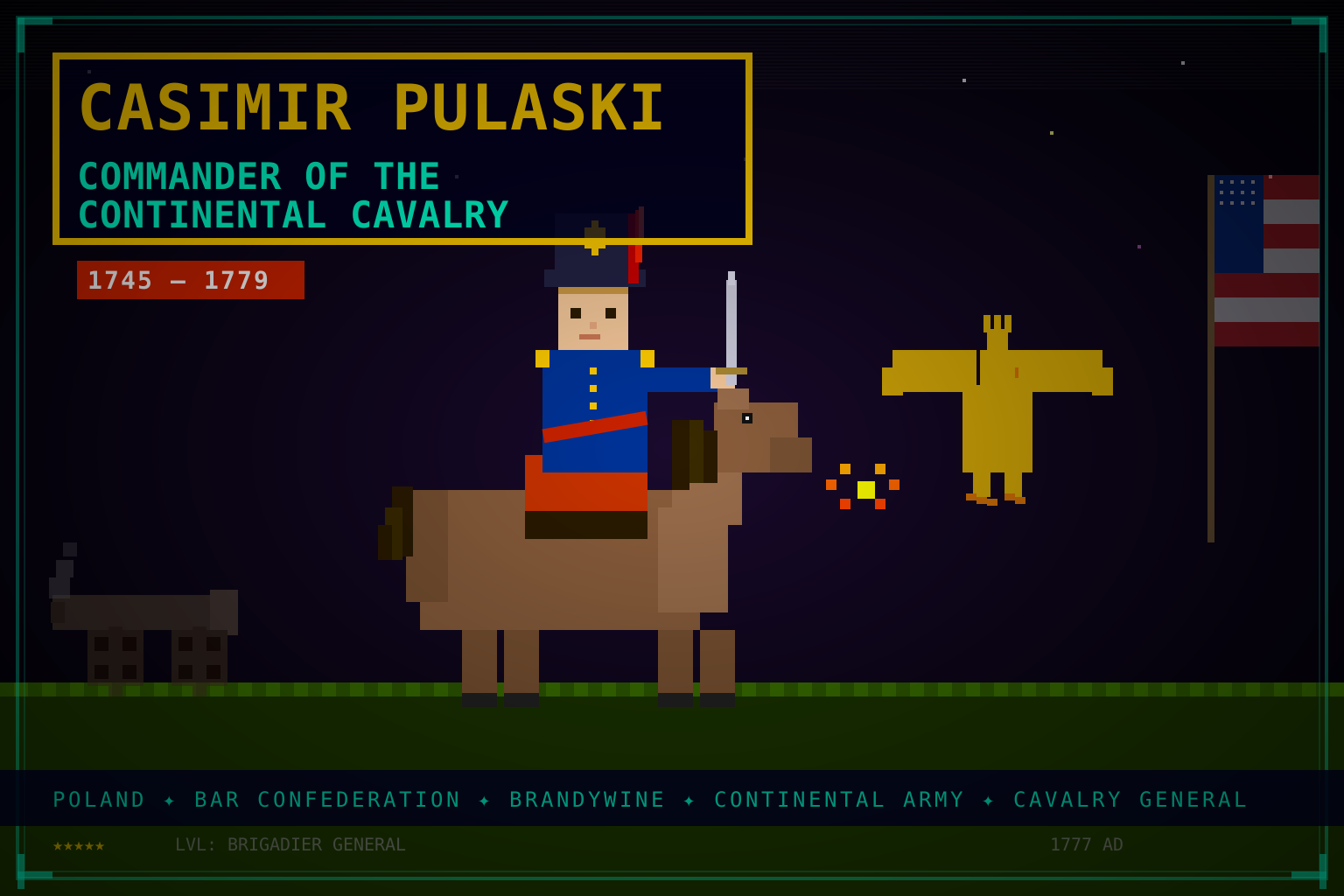
Key figures: Kazimierz (Casimir) Pulaski (1745–1779), Benjamin Franklin (recruiter in Paris), Silas Deane (American commissioner in Paris), General George Washington (Continental Army commander-in-chief), Marquis de Lafayette (fellow European volunteer)
Summary
Kazimierz Pułaski, known in America as Casimir Pulaski, was a Polish nobleman and cavalry officer who became one of the most prominent European volunteers in the Continental Army. Born in 1745, Pulaski had won distinction in Poland as a leader of the Bar Confederation, an armed movement of the Polish nobility resisting Russian domination of the Polish-Lithuanian Commonwealth; after the confederation’s defeat, he was condemned in absentia for an alleged plot against the Polish king and fled into exile across Europe. In Paris he was recruited to the American cause by Benjamin Franklin and Silas Deane, who furnished him with letters of introduction to General Washington, and Pulaski arrived in America in July 1777.
Pulaski’s first major action came at the Battle of Brandywine on September 11, 1777, where he served as a volunteer with Washington’s headquarters. As the American right flank collapsed under Cornwallis’s assault, Pulaski led a mounted reconnaissance and screening action that helped cover the retreat of Washington’s forces and, by some accounts, may have averted the general’s own capture. His conduct at Brandywine impressed Washington enough that he recommended Pulaski for a senior cavalry command. On September 15, 1777, four days after the battle, the Continental Congress commissioned Pulaski a brigadier general and appointed him “Commander of the Horse,” making him the chief of the Continental Army’s cavalry.
In that role, Pulaski set about reorganizing the Continental Army’s scattered, poorly disciplined mounted units into a more coherent fighting arm, introducing European cavalry drill and tactics; this work later earned him the informal title “father of the American cavalry.” Dissatisfied with the constraints of the position and friction with subordinate officers, he resigned the general cavalry command in March 1778 and, with Congressional authorization, raised an independent mixed corps of cavalry and light infantry known as Pulaski’s Legion, which he led in the war’s southern theater. He was mortally wounded by grapeshot while leading a cavalry charge at the Siege of Savannah on October 9, 1779, and died two days later aboard the merchant brig Wasp.
Command of the Continental Cavalry
Pulaski’s September 1777 appointment placed a foreign volunteer with no prior service to the United States in command of an entire branch of the Continental Army, a measure of both the shortage of experienced cavalry officers among American-born commanders and Washington’s willingness to entrust senior roles to capable Europeans, following the earlier precedent of the Marquis de Lafayette. Pulaski brought Polish and broader European cavalry doctrine — emphasis on shock action, reconnaissance, and mobility — to an American mounted arm that had previously functioned largely as scattered, locally raised troops of horse.
Significance
Pulaski’s arrival and appointment exemplify the broader pattern of European volunteer officers whose military expertise and, in several cases, personal fortunes and family connections abroad helped internationalize and professionalize the Continental Army during 1777, alongside figures such as Lafayette and Baron von Steuben. His posthumous reputation in the United States has been substantial: numerous towns, counties, and monuments bear his name, and in 2009 the United States Congress passed a resolution making him one of only a handful of individuals to receive honorary United States citizenship. His death at Savannah and his organizational work in 1777 mark him as a central figure in the history of the Continental Army’s cavalry.
Sources
- Casimir Pulaski — Wikipedia
- Casimir Pulaski — Encyclopædia Britannica
- Casimir Pulaski — American Battlefield Trust
Related
- Battle of Brandywine — Pulaski’s cavalry screening action there led directly to his Continental Army commission
- Marquis de Lafayette — fellow European volunteer wounded at Brandywine and given senior command by Washington
- Benjamin Franklin — recruited Pulaski in Paris and provided his introduction to Washington
- General George Washington — recommended Pulaski for cavalry command after observing his conduct at Brandywine