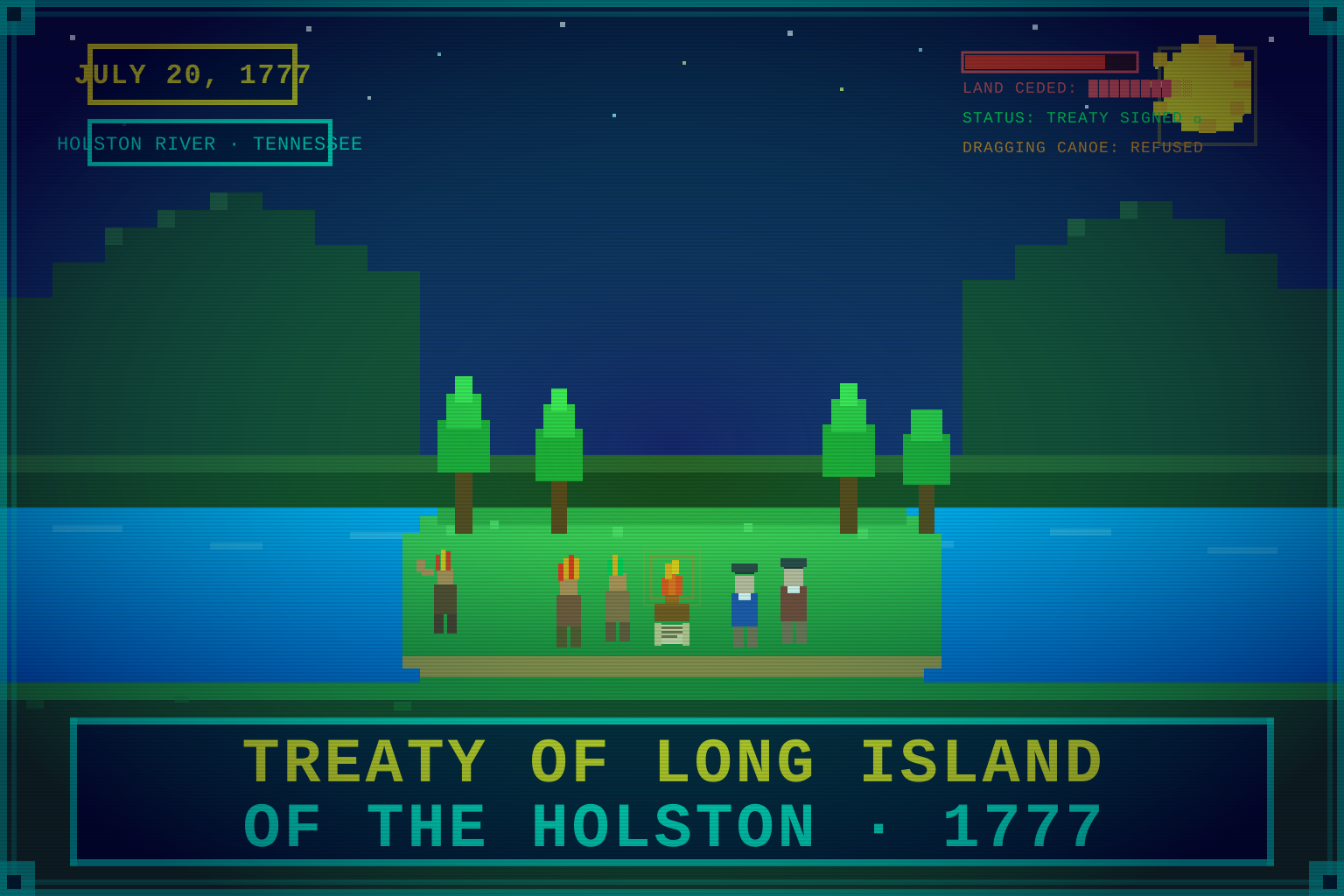
Key figures: Waightstill Avery (North Carolina Indian commissioner), William Sharpe (North Carolina Indian commissioner), Colonel Andrew Williamson (South Carolina, Cherokee War campaign), General Griffith Rutherford (North Carolina, Cherokee War campaign), Colonel William Christian (Virginia, Cherokee War campaign), Old Tassel / Corn Tassel (Overhill Cherokee, principal civil chief and lead negotiator), Hanging Maw (Overhill Cherokee war leader), Dragging Canoe (Cherokee war leader, rejected the treaties and founded the Chickamauga)
Summary
On July 20, 1777, commissioners representing Virginia and North Carolina concluded the Treaty of Long Island of the Holston with leaders of the Overhill Cherokee at a council ground on Long Island in the Holston River, near present-day Kingsport, Tennessee. The treaty, following a nearly identical agreement signed with South Carolina and Georgia two months earlier at DeWitt’s Corner, formally ended the Cherokee War of 1776 and forced the Cherokee to cede large tracts of land in what is now western North Carolina, eastern Tennessee, and southwestern Virginia. Together, the two 1777 treaties marked a decisive turning point on the southern frontier, opening land to American settlement while driving militant Cherokee factions further west and hardening a decades-long cycle of conflict.
The Cherokee War of 1776
In the spring of 1776, encouraged by British Indian agents seeking to open a southern front against the rebellious colonies, Cherokee leaders — most prominently the young war leader Dragging Canoe — issued an ultimatum demanding that settlers vacate lands west of the Appalachians. When the demand went unmet, Cherokee war parties struck frontier settlements across the Carolinas, Georgia, and Virginia beginning in June and July 1776. The colonial response was swift and overwhelming: more than 7,000 militia from four colonies mounted coordinated punitive expeditions into Cherokee territory in the late summer and fall of 1776. Colonel Andrew Williamson led roughly 1,100 South Carolinians against the Lower Towns; General Griffith Rutherford led 2,400 North Carolina militia through the Middle and Valley Towns; and Colonel William Christian led some 1,800 Virginians against the Overhill Towns. The campaigns destroyed more than fifty Cherokee towns, burning houses and food stores, felling orchards, and killing or displacing hundreds of Cherokee.
Facing devastation, most Cherokee town leaders sought peace by early 1777. Dragging Canoe and his followers refused to submit, instead relocating during the winter of 1776–77 to new settlements near Chickamauga Creek, close to present-day Chattanooga, from which they continued raiding American settlements independently of the wider Cherokee nation for years afterward — a movement that became known as the Chickamauga Cherokee.
Long Island of the Holston as a Treaty Ground
Long Island of the Holston — known in Cherokee as Sakatagiwahi, or “where the river divides” — was a large river island in the South Fork of the Holston River at present-day Kingsport, Tennessee. For generations it had served as a neutral council ground and meeting place between the Cherokee and English colonial authorities; the island’s very neutrality, guaranteed by centuries of custom, made it the natural site for peace negotiations. The island had previously hosted the Treaty of Fort Stanwix (1768) boundary discussions and multiple inter-colonial meetings, and its selection in 1777 signaled that both sides understood the agreement as a formal act of statecraft rather than a battlefield capitulation.
Cherokee Leaders at the Council
The Overhill Cherokee who met the American commissioners at Long Island were led by civil chiefs rather than war leaders, since Dragging Canoe and his followers had already withdrawn. The most prominent figure on the Cherokee side was Old Tassel — also called Corn Tassel, Cherokee name Kaiyah-tahee — the principal civil chief of the Great Tellico town and the man who would serve as the paramount voice of Overhill accommodation with the American states for the following decade. Old Tassel was a skilled diplomatist whose influence rested on his ability to articulate Cherokee grievances in terms American commissioners would respect; at Long Island and in subsequent councils through the early 1780s, he consistently argued that the cessions his people were forced to make under military duress violated the law of nations, and that the American states owed the Cherokee compensation rather than conquest.
Other Overhill chiefs present included Hanging Maw (also known as Scootie), a war leader who chose peace over continued resistance, and Scolacutta, principal chief of the Citico town. Together these men represented the faction of the Overhill Cherokee — the towns farthest west and least exposed to Rutherford’s 1776 campaign — who retained enough standing after the destroyed towns’ dispersal to speak for a negotiating position. Their authority, however, had been weakened by the displacement of thousands of townspeople and the defection of the militant faction, so that the agreement they reached was less a voluntary cession than a ratification of territorial facts already established by superior American force.
The Treaties of 1777
The remaining Cherokee leadership negotiated peace in two separate settlements, reflecting the divided colonial jurisdictions of the southern frontier. On May 20, 1777, at DeWitt’s Corner in present-day South Carolina, roughly 600 Cherokee met commissioners from South Carolina and Georgia — including Colonel Andrew Williamson, Leroy Hammond, William Henry Drayton, and Daniel Horry — and signed the Treaty of DeWitt’s Corner, ceding nearly all remaining Cherokee land within South Carolina, including territory in what became Anderson, Greenville, Oconee, and Pickens counties. The cession amounted to roughly 2.5 million acres and left the Cherokee with virtually no land base within South Carolina’s boundaries.
Two months later, on July 20, 1777, North Carolina and Virginia concluded their own settlement with the Overhill Cherokee at Long Island of the Holston. North Carolina’s commissioners, William Sharpe and Waightstill Avery, played so prominent a role that the agreement was afterward often called “Avery’s Treaty.” The negotiations were driven partly by urgency: Virginia and North Carolina sought to secure a peace with the Cherokee before British agents could conclude a rival alliance — the same concern that, in the northern theater that same August, made the Oneida’s choice to side against British-aligned Cherokee counterparts so significant for the integrity of American frontier strategy.
The Overhill Cherokee ceded lands east of a boundary running roughly along the Appalachian ridgeline in North Carolina — encompassing what is today roughly Burke, McDowell, and Rutherford counties — along with a strip of territory in present-day Sullivan and Carter counties in Tennessee and the extreme southwest corner of Virginia, establishing new boundary lines intended to separate Cherokee territory from advancing American settlement. Virginia’s share of the cession secured the upper Holston and Clinch River valleys, which were strategic corridors to Kentucky and the trans-Appalachian interior.
Significance
The two 1777 treaties ended the general Cherokee War of 1776 and opened vast stretches of the southern frontier to American settlement, accelerating the migration of settlers into what would become western North Carolina, upstate South Carolina, and East Tennessee. For the Cherokee nation, the cessions represented catastrophic territorial loss imposed under military duress rather than negotiated on equal terms — a pattern of coerced land cession that would recur throughout the following decades of American westward expansion.
The treaties did not end the wider conflict: Dragging Canoe and the Chickamauga Cherokee rejected both agreements outright and continued to raid American settlements from their new towns on Chickamauga Creek for nearly two decades, in a conflict later called the Chickamauga Wars (1776–1794), demonstrating that the formal treaties bound only part of a nation whose political authority had itself fractured under the pressure of war.
The Chickamauga’s first major action after the treaty came in April 1778, when raiding parties struck the Watauga and Nolichucky settlements in what is now northeast Tennessee, killing settlers and driving others to take shelter in fortified stations. By the late summer of 1779, Virginia and North Carolina authorities organized a punitive expedition under Colonels Evan Shelby and John Montgomery that destroyed eleven Chickamauga towns along the creek, temporarily dispersing Dragging Canoe’s followers — who simply relocated further west, to a set of five settlements known as the Five Lower Towns near present-day Chattanooga and further down the Tennessee River. This pattern of destruction and relocation proved characteristic of the Chickamauga conflict: American expeditions could scatter the towns but could not compel the fighters to accept peace.
By the mid-1780s, the Chickamauga had attracted warriors from multiple nations — including Shawnee, Creek, and some Loyalist advisors — making them one of the most persistent armed resistance forces on the early American frontier. Dragging Canoe lived until 1792, presiding over a network of resistance that outlasted the Treaty of Paris, outlasted the Articles of Confederation, and continued into the first years of the United States Constitution’s operation, eventually being suppressed only by a series of large federal expeditions in 1794 that finally compelled the surviving Chickamauga towns to negotiate.
The Long Island treaty’s timing, concluded as Burgoyne’s campaign was underway in the north, illustrates the breadth of Britain’s 1777 strategy: simultaneous pressure from British-aligned Indigenous nations on both the northern and southern frontiers was intended to stretch American forces and morale. This coordinated use of Indigenous alliances had been promoted in London by Secretary of State Lord George Germain, who regarded southern frontier pressure and the Iroquois Confederacy’s northern alliance as force multipliers that would extend British reach far beyond what its professional army could achieve alone. The collapse of that strategy — Cherokee forced to peace in July, the Iroquois Confederacy split at Oriskany in August, and Burgoyne’s surrender in October — eroded Britain’s credibility as a reliable partner for Native allies across the continent and began to reduce the effectiveness of its Indigenous alliance network for the remainder of the war.
Sources
- Treaty of Long Island of Holston — Britannica
- Planting the Corn and Hunting the British: The Treaty of the Long Island of the Holston and the American Revolution — East Tennessee Historical Society
- Treaty of Dewitt’s Corner — Wikipedia
- Cherokees Seek Peace After Rutherford Expedition — North Carolina Department of Natural and Cultural Resources
- Dragging Canoe — Wikipedia