Key figures: Petrus Camper (1722–1789), Dutch anatomist, naturalist, and artist
Summary
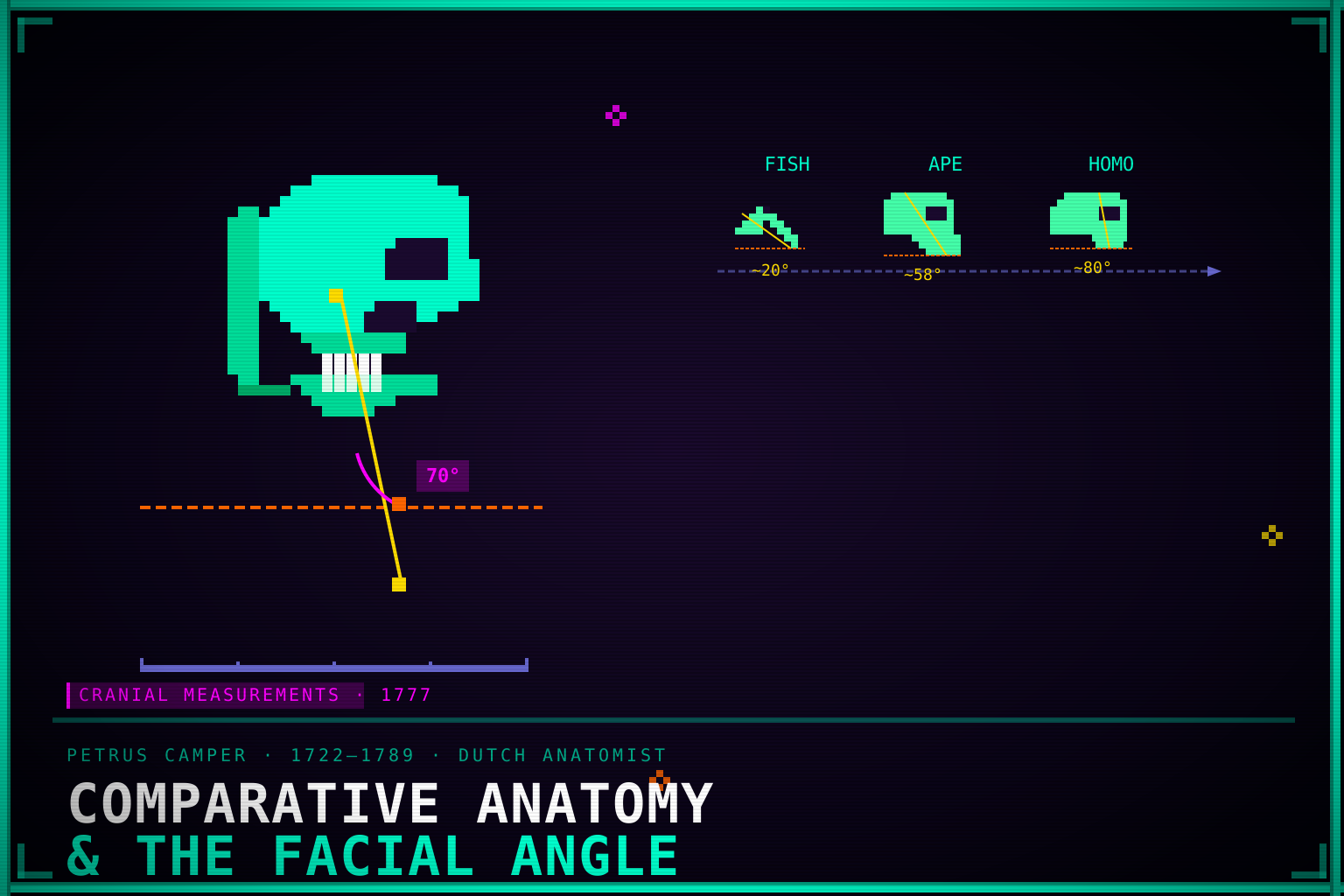
In 1777, Dutch anatomist and naturalist Petrus Camper advanced his groundbreaking work in comparative anatomy through systematic studies of cranial measurements, particularly the “facial angle” — the geometric angle formed by a line drawn from the upper lip to the forehead, compared against a horizontal plane through the ear canal. Camper developed and refined quantitative methods for measuring and comparing anatomical structures across different animals, establishing a scientific foundation for understanding variation in form and the relationships between species.
His 1777 lectures and publications elaborated this methodology in detail, applying it systematically to a range of species from fish through primates to humans, and demonstrating that the facial angle changed progressively across this series. The work represented a decisive shift from purely descriptive natural history toward quantitative, comparative methodology, laying crucial groundwork for what would become evolutionary anatomy and physical anthropology.
Camper’s Life and Intellectual Context
Petrus Camper was born in Leiden in 1722 into a family of clergymen and scholars. He proved extraordinarily versatile: he earned doctorates in both medicine and philosophy, practiced as a physician and surgeon, painted, drew, and sculpted, and held professorships in medicine and surgery at the University of Franeker and later at Groningen. His artistic training proved directly valuable to his scientific work, as precise observation and representation of anatomical forms required the same skills as figurative drawing.
Camper was well connected in the European scientific community. He corresponded with Buffon, the leading French naturalist, and with Carl Linnaeus in Sweden. He was a fellow of the Royal Society of London and a member of learned societies across the Continent. This network meant that his methodological innovations circulated quickly among leading natural historians across Europe.
The Facial Angle: Methodology and Findings
The facial angle — sometimes called the “Camperian angle” — was Camper’s most influential methodological contribution. By drawing two lines (one horizontal through the ear canal, one from the upper lip to the frontal bone) and measuring the angle between them, Camper created a simple, reproducible metric that could be applied consistently across specimens. The angle varied, he found, from approximately 58 degrees in fish through 70 degrees in chimpanzees to about 80 degrees in what Camper considered average human facial geometry, with Classical Greek sculpture representing an idealized 100 degrees.
Camper presented these findings in a series of public lectures in Amsterdam in the late 1770s. The lectures were illustrated with Camper’s own drawings, which were notably precise and artistically accomplished. The full text of these lectures was published posthumously in Dutch (1791), French (1791), German (1792), and English (1794) under the title The Works of the Late Professor Camper on the Connexion between the Science of Anatomy and the Arts of Drawing, Painting, Statuary, etc. — a title that reflects the explicitly interdisciplinary nature of his project.
Scientific Context in 1777
Camper’s comparative anatomy work in 1777 appeared within a broader ferment of scientific activity that year. Lavoisier was developing his oxygen theory in Paris, remaking chemistry on quantitative foundations. Coulomb was advancing electrostatics. Albrecht von Haller’s physiology reached the close of its founding era with his death that December. Across natural philosophy, quantification and systematic measurement were replacing purely qualitative description as the scientific standard — and Camper’s facial angle was a contribution to this methodological revolution in the life sciences.
The natural history context was equally charged: Buffon’s Histoire Naturelle was still appearing in volumes throughout the 1770s, and the question of how to classify and relate the diversity of animal forms was one of the central problems of European science. Camper’s comparative measurements offered one answer — a geometric, empirically grounded framework for arranging different species along a morphological continuum.
Significance
Why 1777 Matters:
- Methodological Innovation: Camper’s systematic use of measurements and geometric analysis transformed anatomy from a descriptive to a genuinely quantitative science, establishing protocols for comparative study that would become standard in 19th-century anatomy and physical anthropology.
- Species Relationships: By quantifying anatomical differences across species through facial angle analysis, Camper contributed empirical evidence to the emerging study of how different organisms related to one another — questions that would eventually inform evolutionary theory.
- Primate-Human Comparison: His work on the facial angles of primates versus humans was notable in treating human anatomy as part of a continuum with other animal species rather than as uniquely separate — a perspective that challenged anthropocentric assumptions deeply embedded in both religious and philosophical traditions.
- Interdisciplinary Bridge: Camper’s explicit connection between anatomy and the arts — his claim that sculptors and painters needed to understand the facial angle to represent human and animal forms correctly — made comparative anatomy accessible to a much broader educated audience than purely technical publications could reach.
- Influence on Later Science: His quantitative approach influenced 19th-century comparative anatomists. The facial angle was cited extensively in debates about human evolution following the publication of Darwin’s On the Origin of Species (1859), and Camper’s method informed the emerging discipline of physical anthropology.
Later Reputation and Misappropriation
Camper’s legacy has been complicated by the posthumous misuse of his work. Although Camper himself rejected racial hierarchies — he argued in his lectures that differences in facial angle between human populations were minor, variable, and aesthetically irrelevant — later 19th-century ethnologists selectively adopted the facial angle as a tool for supposedly scientific racial ranking. This misappropriation distorted his actual findings and intentions, and the subsequent association of craniometry with scientific racism has clouded assessment of Camper’s original contributions.
Historians of science have increasingly recovered the complexity and genuine innovation of Camper’s work, situating it correctly as a contribution to comparative anatomy and the theory of form rather than to racial classification.
Significance for 1777’s Scientific Year
Camper’s comparative anatomy work was one of several major scientific advances associated with 1777. Alongside Lavoisier’s oxygen theory and Coulomb’s electrostatics, it demonstrated that the quantitative revolution in physical science was extending into the life sciences — with consequences that would unfold over the following century. Herschel’s telescope work and Laplace’s nebular hypothesis completed a picture of 1777 as a year of methodological ambition across virtually every branch of natural philosophy.
Sources
- Landmark dates in biology at the time of the Enlightenment - NormaleSup.org — timeline entry on 1777 scientific achievements including comparative anatomy
- 1777 in science - Wikipedia — comprehensive listing of scientific developments
- Petrus Camper - Wikipedia — comprehensive biography covering his anatomical methods, publications, and legacy
- Facial angle - Wikipedia — detailed article on the Camperian angle, its measurement, and its scientific and cultural afterlife
Related
- Lavoisier’s Oxygen Theory — companion scientific breakthrough of 1777, quantifying chemistry as Camper quantified anatomy
- Coulomb’s Electrostatics — another 1777 contribution to the quantitative revolution in natural philosophy
- Haller’s Physiology — parallel life-sciences achievement of 1777
- Herschel’s Telescopes and Deep-Sky Observation — methodological companion in astronomy
- Leonhard Euler — leading mathematician of the era whose work on quantitative methods informed scientific practice broadly