Key figures: Carl Wilhelm Scheele (Swedish-German apothecary-chemist), Joseph Priestley (English natural philosopher), Antoine Lavoisier (French chemist), Torbern Bergman (Swedish chemist and mentor)
Summary
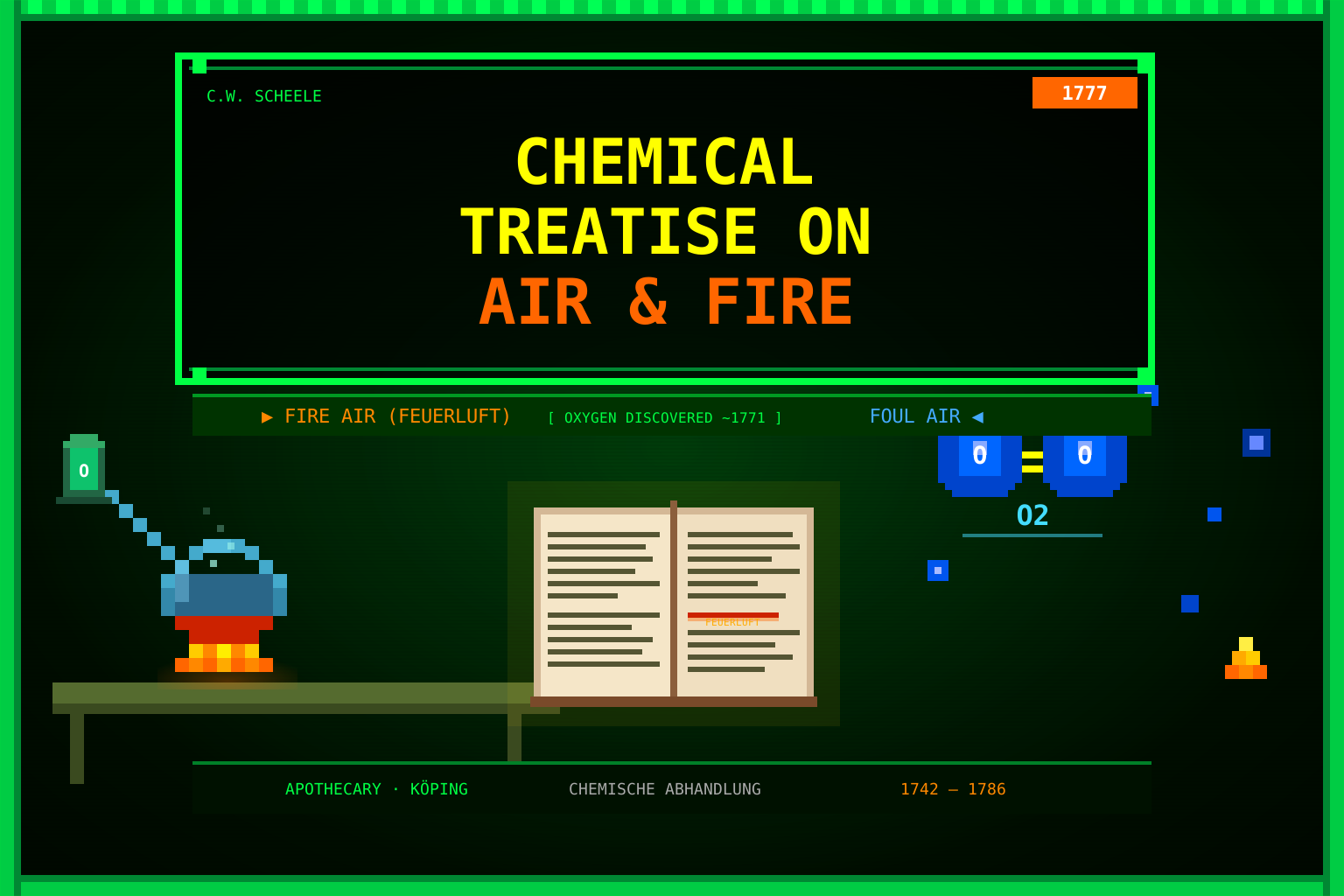
In 1777, the apprentice-trained apothecary Carl Wilhelm Scheele (1742–1786) published Chemische Abhandlung von der Luft und dem Feuer (“Chemical Treatise on Air and Fire”), his only book and the fullest account of a body of experimental gas chemistry he had conducted in provincial Swedish pharmacies years earlier. In it, Scheele described his discovery of “fire air” (Feuerluft) — the gas later named oxygen — which supported combustion and respiration, and “foul air” (verdorbene Luft, largely nitrogen), which did not. Scheele had isolated fire air through numerous methods, including heating mercuric oxide and silver carbonate, by around 1771–1772, roughly two years before Joseph Priestley’s independent preparation of the same gas in August 1774 and several years before Antoine Lavoisier’s reinterpretation of it as a distinct chemical element.
Scheele had drafted the treatise by about 1775, but a combination of a slow-moving Swedish publisher and Scheele’s own perfectionism delayed its appearance until 1777, by which time Priestley had already published his findings and claimed public priority for the gas’s discovery. Working with modest apparatus in a small-town pharmacy — first in Uppsala and then in Köping — Scheele lacked the institutional platform and rapid publication record of contemporaries such as Priestley in England or Lavoisier in Paris, and this delay is generally regarded by historians of science as the principal reason he is remembered as a co-discoverer of oxygen rather than its sole discoverer.
Scheele’s treatise fit into a chemistry still dominated by phlogiston theory, and he interpreted his own results within that framework even as his careful, quantitative descriptions of gas behavior supplied evidence that would help dismantle it. His broader body of work — he is credited with discovering chlorine (1774), manganese, barium, molybdenum and tungsten compounds, and numerous organic acids (tartaric, citric, oxalic, and others) — made him one of the most prolific analytical chemists of the eighteenth century, despite working in relative isolation from the era’s major scientific academies.
Fire Air and Foul Air
Scheele’s central experimental claim was that ordinary atmospheric air is not a single substance but a mixture of at least two distinct components: a life- and combustion-supporting “fire air,” making up roughly a fifth of the atmosphere, and a much larger volume of inert “foul air” that extinguished flames and could not sustain respiration. He produced fire air by heating various oxide and nitrate compounds and demonstrated that a candle burned more vigorously in it than in ordinary air — the same basic phenomenon Priestley and Lavoisier would separately investigate. Scheele went further than simple isolation, proposing a general theory that combustion, respiration, and the calcination of metals were all forms of the same underlying process involving fire air, an insight that anticipated aspects of Lavoisier’s later oxygen theory of combustion.
Priority and the Chemical Revolution
The question of priority between Scheele and Priestley remains one of the classic case studies in the history of science: Scheele’s laboratory notebooks and correspondence with his mentor Torbern Bergman indicate that he had prepared and characterized fire air by 1771 or 1772, well before Priestley’s celebrated August 1, 1774 experiment heating mercuric oxide with a burning lens. Because Scheele’s treatise did not appear in print until 1777, however, Priestley’s published account reached the European scientific community first, and Priestley — not Scheele — is conventionally credited in most historical accounts as oxygen’s discoverer. Both men, working from the dominant phlogiston framework, misinterpreted the significance of what they had found; it was Antoine Lavoisier, drawing on the work of both, who reinterpreted fire air as a distinct chemical element central to combustion and named it “oxygen” in 1779.
Significance
Scheele’s 1777 treatise stands as one of the founding texts of the Chemical Revolution, documenting — independently and ahead of his better-known rivals — the gas that would become central to the collapse of phlogiston theory and the rise of modern chemistry. The episode illustrates how publication timing, institutional access, and geographic isolation shaped scientific credit in the eighteenth century: Scheele’s provincial circumstances cost him recognition that his experimental priority arguably merited, even as his findings fed directly into the theoretical synthesis Lavoisier would complete within the same decade.
Sources
- Carl Wilhelm Scheele — Encyclopædia Britannica
- Carl Wilhelm Scheele — Wikipedia
- Carl Wilhelm Scheele — Royal Society of Chemistry
Related
- Lavoisier’s Oxygen Theory — Lavoisier’s 1777 memoir reinterpreted the gas Scheele had isolated years earlier as a distinct chemical element
- The Royal Society Lightning Conductor Controversy of 1777 — another 1777 dispute over scientific priority and authority, playing out at Britain’s leading scientific institution