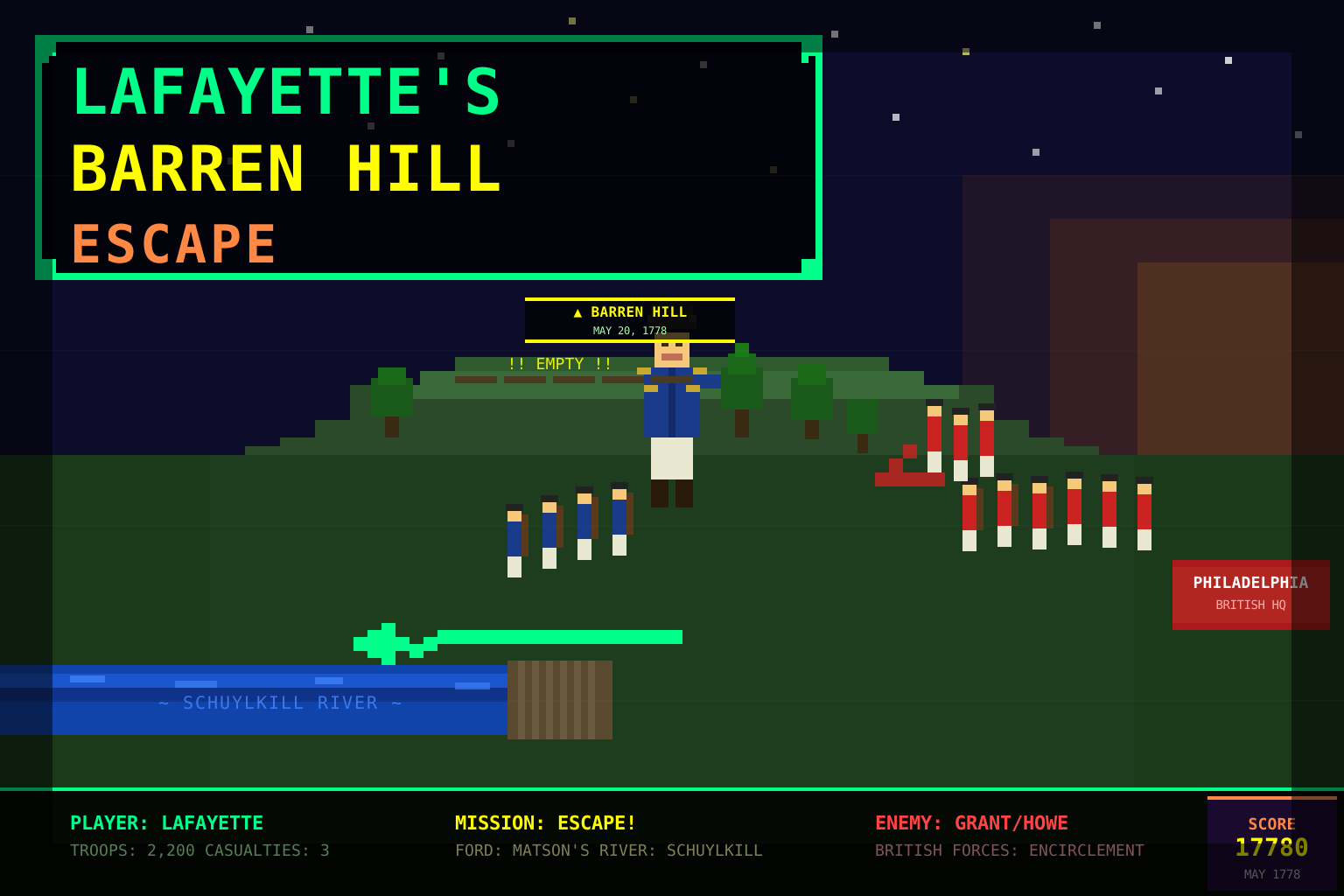
Key figures: Marquis de Lafayette, General William Howe, Major General James Grant, Baron Friedrich von Steuben, General George Washington
Summary
On May 20, 1778, the Marquis de Lafayette and his detachment of approximately 2,100–2,400 Continental troops narrowly escaped encirclement by British forces under Major General James Grant during a reconnaissance-in-force mission near Philadelphia. Positioned at Barren Hill, Pennsylvania (modern-day Lafayette Hill), Lafayette was attempting to observe and harass the British garrison occupying Philadelphia when British commander General William Howe organized a surprise dawn trap intended to capture the young French general and his entire detachment. Learning of the approaching British columns in the early morning hours, Lafayette executed a disciplined fighting withdrawal across the Schuylkill River via Matson’s Ford, escaping with only three to four casualties while leaving the British columns to find empty trenches at Barren Hill. The episode demonstrated the value of the training regimen implemented at Valley Forge under Baron Friedrich von Steuben’s supervision and became a symbol of American tactical competence in the spring of 1778.
Background and Context
Valley Forge Transformation and Lafayette’s Role
The Continental Army had endured a brutal winter at Valley Forge, Pennsylvania, from December 1777 through June 1778. The encampment suffered approximately 2,000 deaths from disease, exposure, and malnutrition. However, the winter camp proved transformative: Baron Friedrich von Steuben, a Prussian staff officer who arrived in February 1778 carrying a letter of introduction from Benjamin Franklin, implemented an intensive training program that reorganized and drilled American regiments in close-order European tactics, coordinated musket fire, and bayonet work. By May 1778, the Continental Army was measurably more disciplined and tactically capable than it had been six months earlier.
Lafayette, a French aristocratic volunteer without command at his arrival in 1777, had become one of George Washington’s most trusted officers by the spring of 1778. He had served with distinction at Brandywine Creek in September 1777 (where he received a musket wound) and had demonstrated consistent loyalty during the Conway Cabal crisis of late 1777–early 1778. Washington regarded him with paternal affection and entrusted him with increasingly independent commands.
The Strategic Situation in May 1778
The Treaty of Alliance between France and the United States, signed on February 6, 1778, had transformed British strategic calculations. The prospect of French naval intervention made Philadelphia—accessible only by sea and thus potentially trapped—untenable as a British base. General Sir Henry Clinton, who had replaced Sir William Howe as commander of British forces in May 1778, was directed to evacuate Philadelphia and move the main British army northward to New York.
At the time of Lafayette’s May 1778 reconnaissance mission, the British army was still in Philadelphia preparing to evacuate, but the decision had been made. Washington sought to harass the British withdrawal and gather intelligence on their movements. Lafayette was tasked with leading a strong reconnaissance force forward to observe, probe, and potentially raid the British outposts.
Chronology of the Engagement: May 19–20, 1778
The following timeline reconstructs the sequence of events based on surviving American and British accounts:
| Time | Event |
|---|---|
| ~May 18 (afternoon) | Lafayette’s detachment departs Valley Forge and marches toward Philadelphia, halting at Barren Hill by evening |
| ~10:30 p.m., May 19 | General James Grant’s main British column departs Philadelphia, beginning its overnight march toward Barren Hill |
| Overnight May 19–20 | British flanking detachments move to cut Ridge Road and White Marsh Road, attempting to close all escape routes behind the American position |
| ~4:00–5:00 a.m., May 20 | American sentries or local informants alert Lafayette that British columns are approaching on multiple axes; Lafayette convenes a rapid council with his senior officers |
| ~5:00–6:00 a.m., May 20 | Lafayette orders a withdrawal; column formation begins in the pre-dawn darkness; Oneida warriors and Morgan’s riflemen form the rearguard |
| Early morning, May 20 | American main body exits Barren Hill via the concealed secondary road toward Matson’s Ford; artillery pieces are moved first |
| Morning, May 20 | American column crosses Matson’s Ford and re-enters the south bank of the Schuylkill with minimal casualties; rearguard disengages |
| Morning, May 20 | British columns converge on Barren Hill to find the position empty; no general engagement occurs |
| Afternoon, May 20 | British forces withdraw to Philadelphia; Lafayette’s detachment returns toward Valley Forge |
The key operational variable was the secondary road. Grant’s planners had apparently not accounted for this route in their blocking scheme, and the gap in the British cordon allowed the American column to slip away before the encirclement could close.
The Barren Hill Trap
British Plan and Troop Deployment
On the evening of May 19, 1778, General William Howe—seeking a dramatic final success before relinquishing his command to Clinton—learned of Lafayette’s position at Barren Hill and resolved to trap the French general. Howe organized a three-pronged envelopment with approximately 5,000 troops under the command of Major General James Grant, supported by 15 pieces of artillery.
The British plan called for:
- Grant’s main column to advance from Philadelphia overnight (departing around 10:30 p.m. on May 19) northwestward toward Barren Hill
- Two flanking detachments to cut off Lafayette’s retreat routes: one moving toward Ridge Road/White Marsh Road to block the eastern escape route, another advancing from the west to drive him toward the Schuylkill River
- Coordination timed to pin the American force between British columns by dawn
Howe was reportedly confident enough of success that he arranged a dinner celebration for the evening of May 20, planning to dine with Grant and formally receive Lafayette as his captive.
Lafayette’s Position and Forces
Lafayette had established his brigade at Barren Hill, a high-ground position midway between Valley Forge and Philadelphia. His force consisted of:
- Approximately 2,100–2,400 Continental infantry (sources vary; the range reflects contemporary documentary differences rather than a resolved consensus figure)
- Five artillery pieces
- Oneida Nation warriors and Daniel Morgan’s riflemen, holding western approaches
- Pennsylvania militia units guarding outlying positions
The Americans had prepared defensive positions with earthworks and artillery fields of fire covering the approaches to the hill.
The American Escape
Early on the morning of May 20, before British columns could encircle the position, Lafayette learned of the approaching trap—exact intelligence sources are not documented in surviving accounts, but American sentries and local guides provided warning. Rather than defend the hill and risk annihilation or capture, Lafayette made the critical decision to withdraw immediately.
A secondary road leading south and west to Matson’s Ford on the Schuylkill River proved crucial. This route ran through low ground that screened the American column from British observation and took advantage of a gap in the British envelopment that Grant’s coordination had failed to close completely. Lafayette organized a disciplined fighting withdrawal, covering the retreat with skirmishers and artillery to delay any British pursuit.
The Continental regiments executed the withdrawal in good order—a stark contrast to American retreats of 1776–1777 that often dissolved into panicked routs. Lafayette’s force crossed Matson’s Ford and rejoined the main Valley Forge encampment with minimal casualties. The British, arriving at Barren Hill to find the position empty, withdrew to Philadelphia without engaging.
Casualties and Historical Significance
Engagement Statistics
American casualties: reported as three to four men killed or wounded (some sources specify three killed/wounded, consistent across American Battlefield Trust and Wikipedia)
British casualties: reported variously as nine to thirty men (sources do not converge on a precise figure; the discrepancy likely reflects incomplete British casualty documentation or confusion between different British regiments reporting their losses)
Oneida Nation casualties: Six burials recorded at Saint Peter’s Church (now Saint Peter’s in the Great Valley), Barren Hill, including the Oneida sachem Thomas Sinavis (also recorded as “Sinnott” in some English-language documents). The Oneida’s participation was part of a broader pattern of Oneida alliance with the Continental cause throughout 1778 — the same nation had supplied women and children to carry corn to Valley Forge during the winter of 1777–78. Their warriors’ sacrifice in the Barren Hill rearguard was one of the costlier engagements the Oneida experienced that year. (See Haudenosaunee Strategic Alliance for the broader Haudenosaunee-Continental relationship.)
Strategic and Tactical Significance
Vindication of Valley Forge training: Barren Hill was the first major engagement fought by Continental troops after Baron von Steuben’s winter training program. The disciplined withdrawal of approximately 2,000–2,400 men under pressure, executed without panic or breakdown, stood in sharp contrast to American tactical performances at Brandywine (September 1777) or Germantown (October 1777). The episode was cited by contemporary observers and historians as early concrete proof that Steuben’s drill regimen had fundamentally improved American tactical capability.
Demonstration of Lafayette’s tactical competence: The escape reinforced Washington’s confidence in Lafayette and demonstrated his capacity to handle complex tactical situations independently. Lafayette had not been defeated; he had escaped a superior force through superior tactical judgment. The episode elevated his standing within the Continental officer corps and with the French command.
Minor blow to British prestige: Howe’s failed trap—intended as a dramatic capstone to his command—instead became a minor embarrassment. The inability to catch a relatively inexperienced young general with 5,000 troops against 2,100–2,400 suggested declining British tactical superiority, a narrative that the Battle of Monmouth on June 28 would amplify.
Parallel to the broader spring campaign: Barren Hill occurred within the strategic context of the British evacuation of Philadelphia, which was precipitated by the Franco-American Alliance signed in February 1778. The failed trap and the subsequent evacuation formed parts of a continuous strategic arc that led directly to the Battle of Monmouth nine weeks later, making Barren Hill a consequential but smaller element in the larger transformation of the war in 1778.
Primary Sources and Historiography
The Barren Hill engagement is documented primarily through:
- Lafayette’s own after-action letter to Washington, written May 20–21, 1778, which describes the position of British columns, the withdrawal route, and casualty figures. The letter survives in the Lafayette Papers and formed the basis for most subsequent American accounts.
- British orderly books for Grant’s column and the Philadelphia garrison, which record departure times and the failure of the envelopment without detailed explanation. British accounts are notably sparse on reasons for the failure.
- Pennsylvania civilian testimony collected in the 19th century by local historians in the Barren Hill (later Lafayette Hill) area, which identifies the secondary road and Matson’s Ford as the critical escape route and names local guides as part of the warning system.
- Oneida oral tradition and church burial records at Saint Peter’s, which are the only documentation of Oneida casualties.
Modern scholarly treatments include the American Battlefield Trust’s site survey (2010s), which confirmed the topography of the withdrawal route, and the multi-volume Marquis de Lafayette biography by Stanley Idzerda (Cornell University Press, 1977–1983), which remains the standard scholarly account of Lafayette’s 1778 service.
Epilogue
Lafayette returned to Valley Forge and participated in the subsequent Battle of Monmouth on June 28, 1778—the longest single-day engagement of the Revolutionary War, during which he commanded the initial American withdrawal and then supervised the orderly repositioning that allowed Washington to mount a successful counterattack. The Barren Hill escape was widely reported in both American and French newspapers as an example of American military improvement and Franco-American cooperation. When Lafayette returned to France in January 1779 to lobby for additional military support, the Barren Hill episode featured prominently in accounts of American competence that he used to argue for increased French naval and land commitments. The engagement is commemorated today at Lafayette Hill, Pennsylvania (the modern name of the Barren Hill community), where a historical marker notes the site of the American defensive position.
See Also
- Marquis de Lafayette (1757–1834) — the young French officer whose tactical skill and leadership enabled the escape
- Baron Friedrich von Steuben (1730–1794) — the Prussian drillmaster whose Valley Forge training made the disciplined withdrawal possible
- Valley Forge Encampment Ends — the winter training program tested directly at Barren Hill in May
- Battle of Monmouth — the next major engagement, occurring nine weeks later, which further validated Steuben’s training
- George Washington (1732–1799) — the commander who trusted Lafayette with the reconnaissance mission
- Britain Declares War on France — the March 1778 declaration that set the strategic context for British evacuation planning
- Haudenosaunee Strategic Alliance — the broader Iroquois Confederacy political context in which Oneida warriors fought at Barren Hill
Sources
- Battle of Barren Hill - Wikipedia — Comprehensive tactical account with casualty figures and troop strengths
- Marquis de Lafayette - American Battlefield Trust — Biographical summary emphasizing Barren Hill within Lafayette’s military career
- Battle of Barren Hill (1778) - Revolutionary War — Strategic context and tactical details of the engagement
- Marquis de Lafayette - Mount Vernon — Washington’s perspective on Lafayette’s 1778 service and the Barren Hill engagement