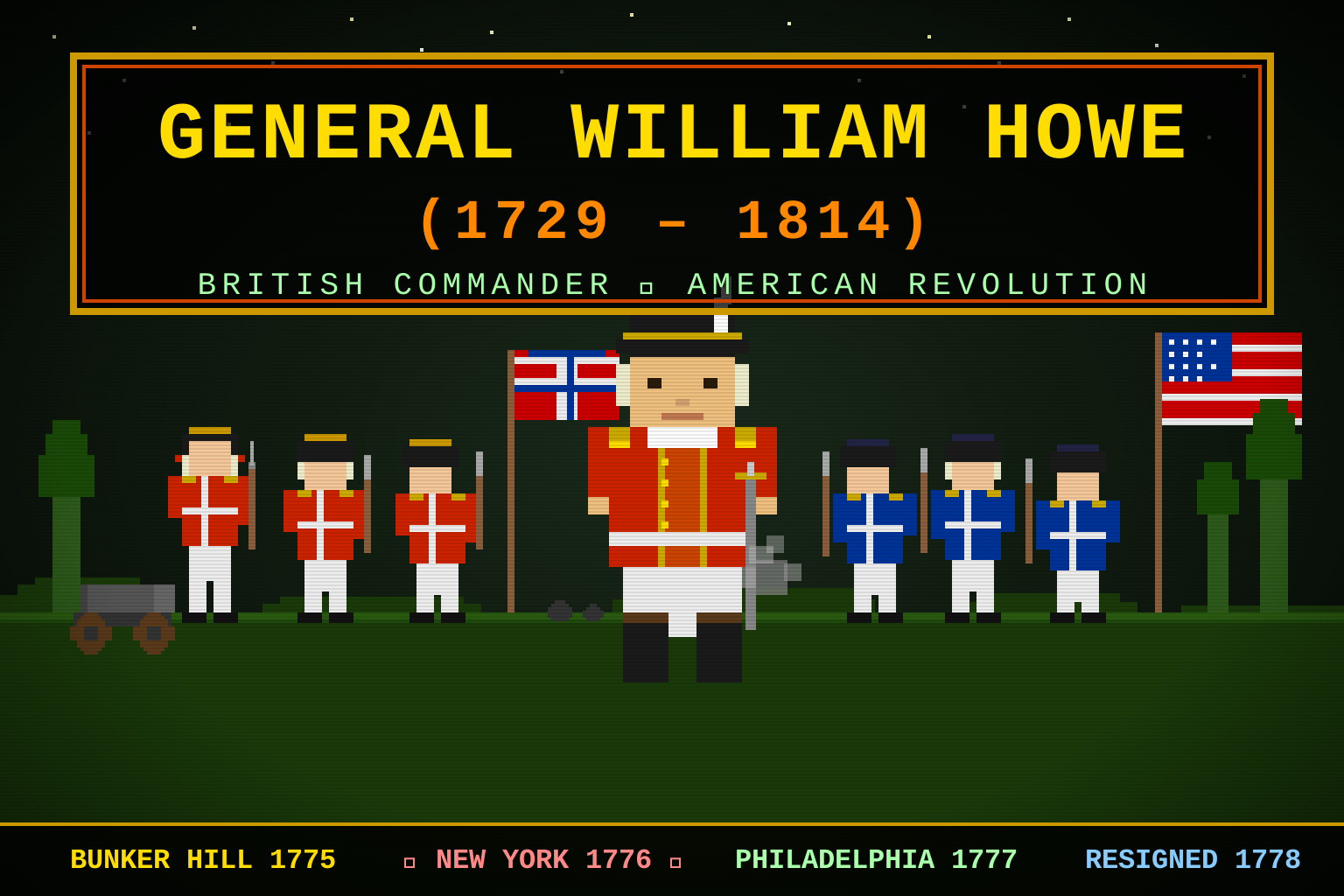
Key figures: William Howe, Henry Clinton, George Washington, Lord Germain
Summary
General Sir William Howe, 5th Viscount Howe (August 10, 1729 – July 12, 1814) commanded British forces in North America from October 1775 through May 26, 1778—a tenure that encompassed the most intensive conventional-warfare phase of the American Revolutionary War. A veteran of the Seven Years’ War who had served with distinction at the Battle of Quebec (1759), Howe brought to America both genuine tactical ability and a set of strategic assumptions—that American loyalty to the Crown was recoverable, and that one decisive defeat of Washington’s army would end the rebellion—that would ultimately prove ill-matched to the nature of the conflict.
Campaign Record, 1775–1777
Howe’s North American command produced a string of tactical successes that failed to achieve strategic resolution:
- June 1775: Commanded British forces at the Battle of Bunker Hill, capturing the American-held heights at significant cost (1,054 British casualties of roughly 2,400 engaged—a rate that sobered his approach to frontal assaults thereafter).
- August–September 1776: Routed Washington’s army in the New York campaign, capturing Long Island, Manhattan, and eventually pushing the Continental Army across New Jersey.
- December 1776: Failed to pursue Washington aggressively after his retreat across the Delaware, an inaction that allowed Washington to regroup and strike at Trenton (December 26) and Princeton (January 3, 1777).
- September 1777: Defeated Washington at Brandywine (September 11) and captured Philadelphia (September 26), achieving his political objective of occupying the American capital.
- October 1777: Repulsed Washington’s counterattack at Germantown (October 4), but his strategic position was undermined that same month by Burgoyne’s surrender at Saratoga.
The Saratoga defeat—which Howe had contributed to by moving south to Philadelphia rather than north to meet Burgoyne—triggered the Franco-American alliance of February 6, 1778, fundamentally changing the war’s strategic environment.
1778: Mischianza and Departure
During the winter of 1777–1778, while Washington’s army endured the hardships of Valley Forge eleven miles away, Howe’s forces occupied Philadelphia in relative comfort. His officers organized the Mischianza (May 18, 1778)—an elaborate farewell fête for departing commander including a mock medieval tournament, a lavish dinner, and fireworks—that became notorious as a symbol of British complacency. Peggy Shippen (later Peggy Arnold) attended; Major John André organized the decorations.
Howe had submitted his resignation to Lord Germain, the Colonial Secretary, in October 1777. He sailed for England on May 26, 1778, turning command over to General Sir Henry Clinton. His departure came as the Continental Army, reformed by Friedrich Wilhelm von Steuben during the Valley Forge winter, was preparing to demonstrate its new discipline. Just three weeks after Howe left, the Battle of Monmouth (June 28, 1778) showed British forces that the Continental Army they now faced was a fundamentally different opponent.
Parliamentary Inquiry and Legacy
Back in England, Howe and his brother Admiral Richard Howe demanded a parliamentary inquiry to defend their conduct. The inquiry (1779) consumed several months of parliamentary debate without producing a verdict but allowed Howe to present his strategic rationale. He argued that his orders had been contradictory and that the ministry had failed to provide adequate resources. The inquiry illuminated the structural tensions between London’s political direction and field commanders’ operational latitude.
Howe was promoted to full General on October 23, 1793. He later served as Governor of Berwick-upon-Tweed (1795–1808) and as Lieutenant-General of the Ordnance, and succeeded his brother as 5th Viscount Howe in 1799. He died at Plymouth on July 12, 1814, at the age of 84.
Significance
Howe’s 1778 departure marked the end of British attempts to win the war through conventional urban occupation and battlefield dominance in the north. Clinton’s succeeding strategy—evacuating Philadelphia (June 18, 1778), consolidating at New York, and executing the “southern strategy” beginning in 1779—represented a tacit acknowledgment that Howe’s approach had not worked. The transition also coincided exactly with France’s entry and the Battle of Monmouth, making May–June 1778 a genuine inflection point in the war.
Military historians debate whether Howe’s restraint—particularly his decision not to destroy Washington’s army at Long Island or after Brandywine—reflected a political calculation that reconciliation remained possible, a belief that British public opinion could not sustain heavy casualties, or simple operational caution learned at Bunker Hill. The debate has not been resolved, but it reveals the distinctive challenge of fighting a war against one’s own colonial subjects within a political system that retained some sympathy for the colonists’ grievances.
See Also
- Benedict Arnold (1741–1801)
- John Hancock (1737–1793)
- Battle of Monmouth
- Valley Forge Encampment
- Treaty of Alliance (France–United States)