Key figures: Lech Kaczyński (President), Donald Tusk (opponent), Jarosław Kaczyński (twin brother, future Prime Minister), Aleksander Kwaśniewski (outgoing President)
Summary
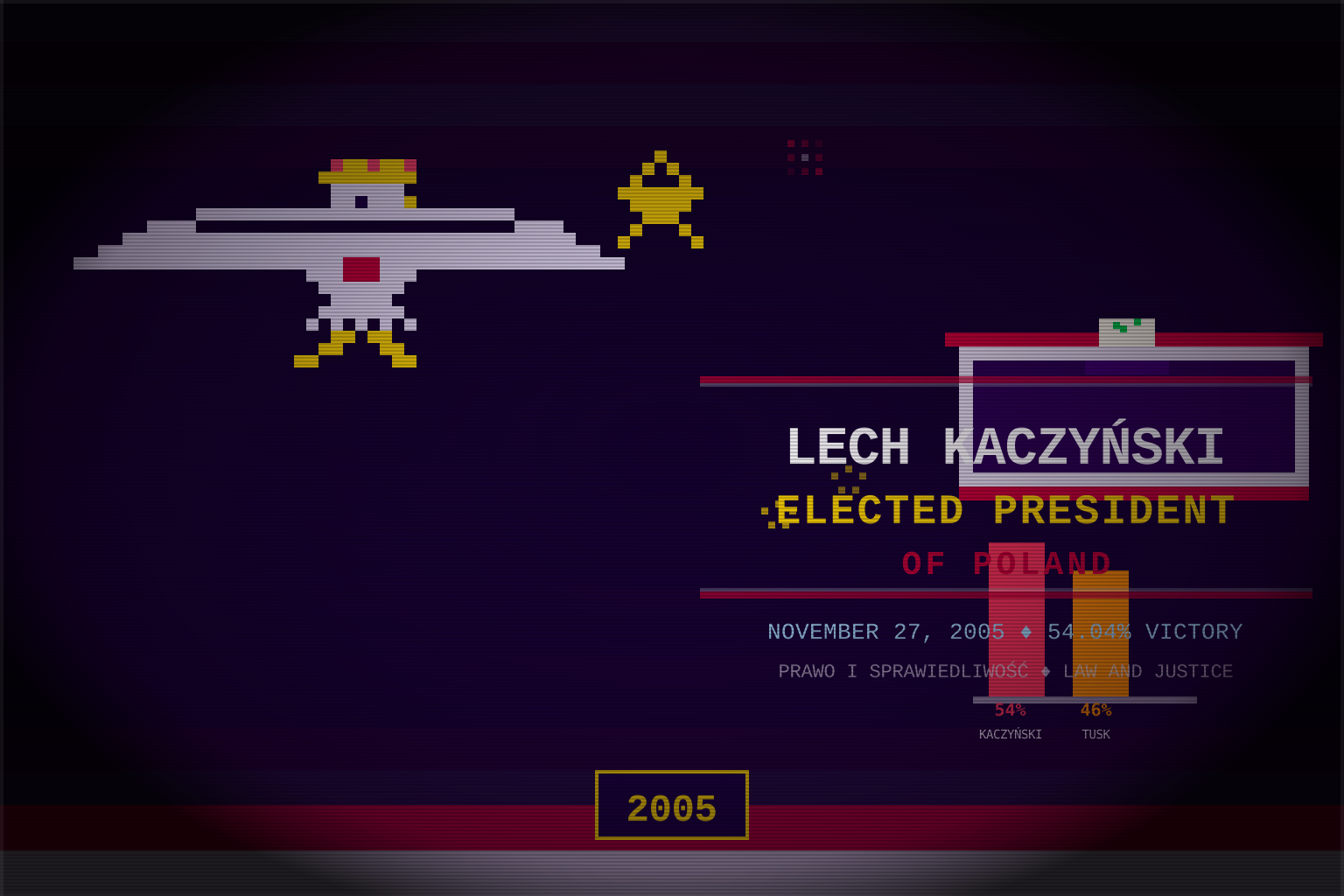
Lech Kaczyński was elected President of Poland in a two-round contest in 2005, with his inauguration formally taking place on December 23, 2005, before the National Assembly. In the first round of voting held on October 23, 2005, Kaczyński, the leader of the conservative Law and Justice (Prawo i Sprawiedliwość, PiS) party, secured 33.1% of valid votes, finishing in second place behind Donald Tusk of the Civic Platform (Platforma Obywatelska, PO) who received 36.3%. In the ensuing runoff held on November 27, 2005, Kaczyński emerged victorious with 54.04% of the vote to Tusk’s 45.96%—a margin of approximately 658,000 votes among 8.25 million ballots cast. Between the two rounds, Kaczyński successfully built a coalition of political support, gaining endorsements from the nationalist broadcaster Radio Maryja, the agrarian Self-Defence of the Republic of Poland (Samoobrona RP), and the Polish People’s Party (Polskie Stronnictwo Ludowe). His victory represented a significant rightward shift in Polish electoral sentiment, departing from the centrist orientation of his predecessor, Aleksander Kwaśniewski.
Background
Post-communist Poland and the 2004 EU accession
Poland joined the European Union on May 1, 2004, as part of the largest single enlargement in EU history, along with nine other states. Accession generated broad public enthusiasm—a June 2003 referendum had produced a 77% vote in favour—but also exposed fault lines between those favouring rapid economic integration and those anxious about cultural sovereignty and the influence of post-communist elites in public institutions.
Aleksander Kwaśniewski of the post-communist Democratic Left Alliance (SLD) had served two consecutive presidential terms since 1995 and was constitutionally barred from seeking a third. His period in office, and especially the Rywin bribery affair of 2002–2004—which implicated senior media and political figures in an alleged scheme to amend broadcast law for private gain—had generated widespread cynicism about the existing establishment, creating an opening for parties promising institutional clean-up.
Lech Kaczyński and the Law and Justice party
Law and Justice was co-founded in 2001 by Lech Kaczyński and his twin brother Jarosław Kaczyński. Lech served as Minister of Justice from 2000 to 2001 and was elected Mayor of Warsaw in October 2002, a position he held until his presidential inauguration. As mayor he cultivated a reputation for anti-corruption enforcement and socially conservative positions, while the party built its national identity around lustration (vetting of communist-era collaborators), judicial reform, and law-and-order messaging.
The 2005 parliamentary election
The presidential contest ran alongside, and was shaped by, Poland’s parliamentary (Sejm) election of September 25, 2005. Law and Justice won a plurality with 26.99% of the vote and 155 seats; Civic Platform came second with 24.14% and 133 seats. The two parties’ failure to form a coalition government (their negotiations collapsed in October) pushed PiS toward governing arrangements with smaller nationalist and agrarian partners, foreshadowing the ideological direction Kaczyński would pursue as president.
The presidential campaign and runoff
Kaczyński’s campaign concentrated on anti-corruption themes, Catholic social values, and a vision of “solidarity Poland” (Polska solidarna) offering state protection for those left behind by market transformation—explicitly contrasted with Tusk’s “liberal Poland” (Polska liberalna) emphasising individual economic initiative and lower flat taxes.
The two-week campaign between rounds was notably negative. A leaked government document suggesting Tusk’s grandfather may have voluntarily enlisted in the Wehrmacht during World War II became a major controversy; Tusk denied the implication and accused opponents of smearing his family. Kaczyński’s campaign also benefited from the explicit backing of Radio Maryja, a nationalist Catholic broadcaster with an estimated audience of several million daily listeners, whose founder Father Tadeusz Rydzyk endorsed PiS candidates across the 2005 election cycle.
Turnout in the runoff was 50.99%—higher than the first round’s 49.74% but still modest. Kaczyński ran strongly in rural and eastern constituencies; Tusk’s support was concentrated in large cities and western Poland.
Inauguration and early presidency
Lech Kaczyński was sworn in as the fourth President of the Republic of Poland on December 23, 2005, before a joint session of the National Assembly (Zgromadzenie Narodowe) in Warsaw. Outgoing President Kwaśniewski handed over the presidential insignia in a ceremony watched by invited dignitaries including representatives of the European Union and NATO partner states.
In his inaugural address Kaczyński stressed national solidarity, historical memory—especially Poland’s suffering in the twentieth century—and the need for a moral renewal of public life. He signalled that Warsaw would pursue an assertive foreign policy within the EU, defending Poland’s demographic weight in Council voting arrangements established by the Treaty of Nice (which gave Poland near-parity with Spain and Germany under a square-root formula that the forthcoming Constitutional Treaty proposed to replace).
In July 2006 Jarosław Kaczyński became Prime Minister, succeeding Kazimierz Marcinkiewicz and creating the unprecedented situation of twin brothers simultaneously holding Poland’s two most powerful executive offices. The configuration lasted until the early parliamentary election of October 2007, which returned Donald Tusk’s Civic Platform to government; Jarosław left the premiership the following month.
Significance
Kaczyński’s election marked a watershed moment in contemporary Polish politics, establishing a presidency defined by conservative social values, historical nationalism, and institutional reform. The 2005 results foreshadowed a sustained realignment of the Polish electorate along cultural and economic-security lines that would play out through subsequent election cycles.
The election coincided with a broader rightward turn in European politics: in Germany, Angela Merkel became Chancellor in November 2005 after CDU/CSU edged out the SPD in a tight September election; both leaders would face the challenge of navigating national interest against EU institutional reform in the years that followed.
Domestically, the Kaczyński presidency (2005–2010) proved divisive: celebrated by those seeking lustration and moral-institutional renewal, criticised by opponents as populist and corrosive to judicial independence and media pluralism. The European Commission later cited PiS governance as raising rule-of-law concerns, initiating Article 7 proceedings in 2017—a conflict whose roots lay in the institutional vision Kaczyński’s 2005 victory first empowered.
Lech Kaczyński’s presidency ended abruptly when he was killed on April 10, 2010, in an air crash near Smolensk, Russia, along with his wife Maria and 94 other Polish officials, as the delegation travelled to a memorial ceremony for the 1940 Katyn massacre. The Smolensk disaster became one of the most traumatic events in post-communist Polish national memory and subsequently a source of intense political controversy about its causes.