Key figures: Evo Morales, Jorge Quiroga, Samuel Doria Medina, Carlos Mesa, Eduardo Rodríguez Veltzé
Summary
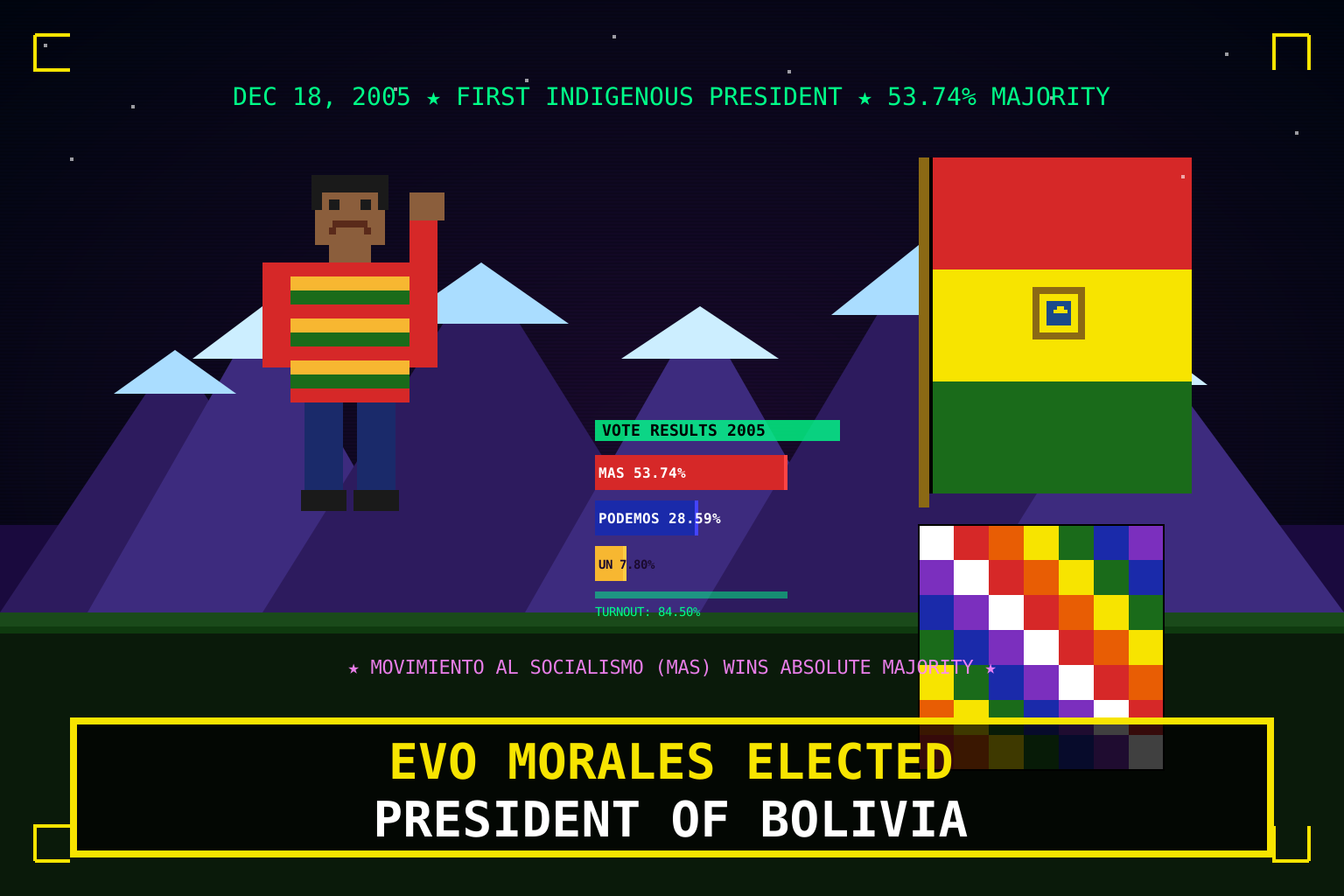
On December 18, 2005, Juan Evo Morales Ayma, leader of the Movement for Socialism (Movimiento al Socialismo, MAS), was elected President of Bolivia with 1,544,374 votes, or 53.74 percent of the valid vote. His victory made him the first Bolivian head of state drawn from the country’s indigenous majority and the first candidate to win an absolute majority in a presidential election since the disputed contest of 1978. Because Morales cleared the 50 percent threshold, no congressional runoff was required — a departure from the practice, common in earlier Bolivian elections, of having the legislature choose among the leading candidates. He was inaugurated on January 22, 2006, for a five-year term.
His nearest rival, former president Jorge Quiroga of the conservative Social Democratic Power (Poder Democrático y Social, Podemos), took 821,745 votes (28.59 percent). The cement magnate Samuel Doria Medina of the National Unity Front finished third with 224,090 votes (7.80 percent). Turnout was high at 84.50 percent of registered voters. In the concurrent legislative elections, MAS won a majority in the Chamber of Deputies, taking 72 of 130 seats, while falling short in the Senate, where it held 12 of 36 seats to Podemos’s 13.
Background
The election was held early. President Carlos Mesa had resigned in June 2005 amid sustained protests over control of Bolivia’s natural gas reserves — the culmination of the unrest known as the “gas war” that had already forced the resignation of President Gonzalo Sánchez de Lozada in October 2003. Supreme Court Chief Justice Eduardo Rodríguez Veltzé assumed the presidency on an interim basis and called elections for December 2005, moving forward a vote that had been scheduled for 2007. The campaign unfolded against a backdrop of deep polarisation between the highland indigenous and popular movements of the west and the wealthier, more conservative eastern lowland departments centred on Santa Cruz.
Evo Morales
Evo Morales was born on October 26, 1959, in Isallawi, in the Orinoca Canton of the Oruro Department, into an Aymara family of subsistence farmers. He moved to the Chapare region and became a coca grower (cocalero), rising through the ranks of the coca-growers’ unions and campaigning against United States–backed coca eradication programmes, which he framed as an assault on indigenous livelihoods and culture. He built a national profile as a union leader before taking over the Movement for Socialism as its standard-bearer in the late 1990s and contesting the 2002 presidential election, in which he finished a close second.
Significance
Morales’s election was widely reported around the world as a watershed for indigenous political representation in Latin America, coming in a country where people of indigenous descent make up a majority of the population yet had historically been excluded from the highest office. His platform combined resource nationalism — above all the promised nationalisation of the hydrocarbons sector, which his government carried out by decree in May 2006 — with pledges to rewrite the constitution and expand the political voice of indigenous communities. A new constitution refounding Bolivia as a “plurinational” state was approved by referendum in 2009.
His victory formed part of the broader “pink tide” of left-leaning governments elected across South America in the 2000s. Morales went on to serve as president from January 2006 until his resignation in November 2019 amid disputes over that year’s election. His 2005 win came the same year that Ellen Johnson Sirleaf became the first woman elected to lead an African nation and Angela Merkel became Germany’s first female Chancellor, part of a year in which several elections broke long-standing barriers of gender and ethnicity.