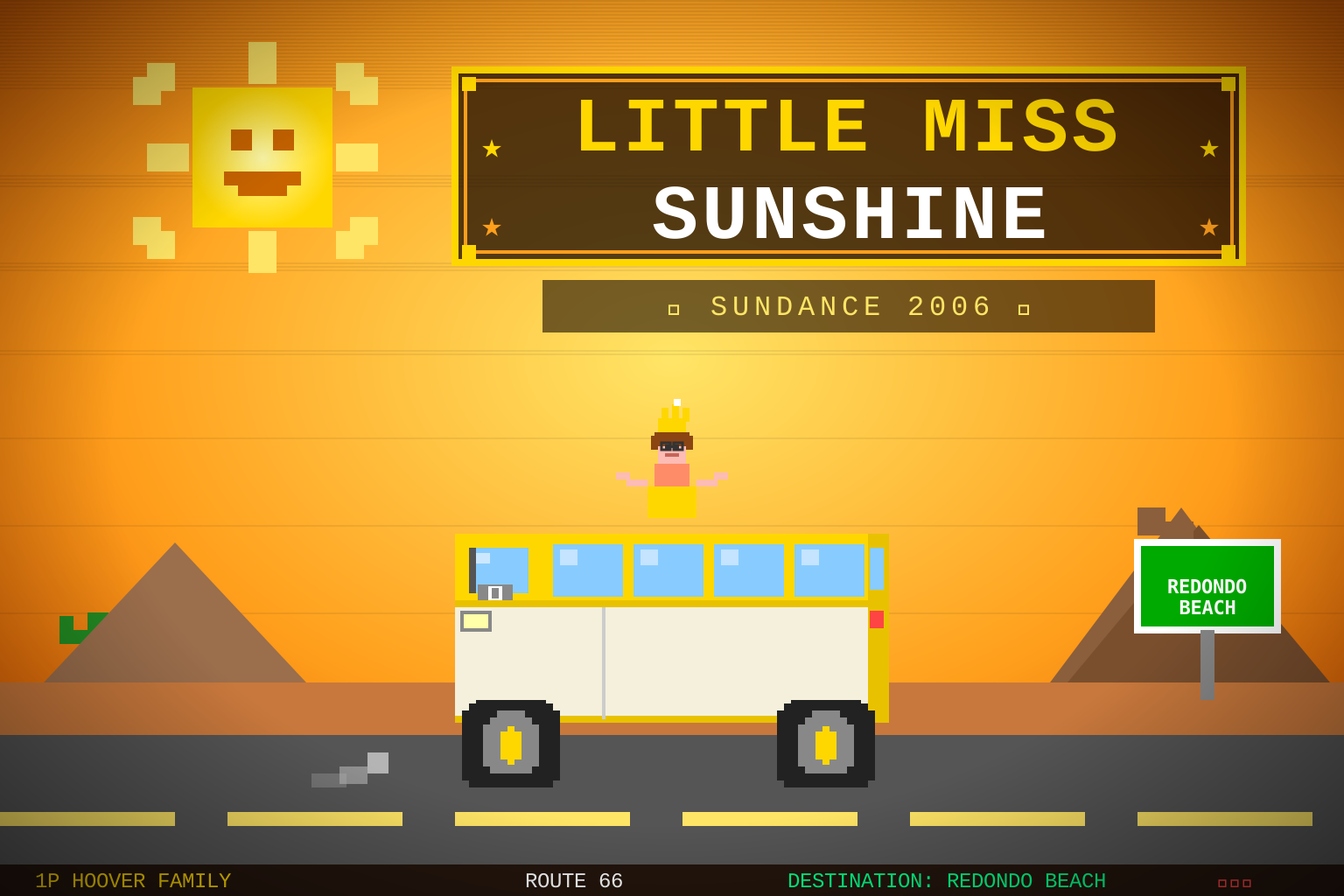
Key figures: Jonathan Dayton (co-director); Valerie Faris (co-director); Greg Kinnear (Richard Hoover); Toni Collette (Sheryl Hoover); Steve Carell (Frank Ginsberg); Paul Dano (Dwayne Hoover); Abigail Breslin (Olive Hoover); Alan Arkin (Grandpa Edwin); Michael Arndt (screenwriter)
Summary
Little Miss Sunshine, written by Michael Arndt and directed by Jonathan Dayton and Valerie Faris in their feature film debut, premiered in the U.S. Dramatic Competition at the 2006 Sundance Film Festival on January 20, 2006, where it drew strong audience response and sparked a record distribution-rights bidding war. It received a wide theatrical release on July 26, 2006, following a limited release on July 14. The film follows the dysfunctional Hoover family—a middle-class household in Albuquerque, New Mexico—as they embark on a road trip in a dilapidated 1969 Volkswagen Microbus to deliver their seven-year-old daughter, Olive (Abigail Breslin), to the “Little Miss Sunshine” children’s beauty pageant in Redondo Beach, California.
The ensemble cast includes Greg Kinnear as Richard, a failed self-help motivational speaker devoted to his “nine-step program” for success; Toni Collette as his exhausted wife Sheryl; Paul Dano as their teenage son Dwayne, who has taken a vow of silence and is obsessed with Nietzsche; Steve Carell as Frank Ginsberg, a suicidal Proust scholar and Sheryl’s brother who has just been released from a psychiatric hospital; and Alan Arkin as Grandpa Edwin, a profane, heroin-using patriarch who coaches Olive for the pageant.
Arndt’s screenplay, written between 1998 and 2002, spent several years in development before Dayton and Faris attached to direct. The script had circulated within Hollywood with admiration but without takers until the directing team agreed to finance the production independently through Big Beach Films with a budget of approximately $8 million.
Production and Sundance
Principal photography took place in 30 days across New Mexico and Arizona, with the finale filmed in Redondo Beach. The production’s most logistically complex element was the recurring use of the VW Microbus, which became so central to the film’s visual identity that the vehicle was treated as a character in its own right—given its own breakdown narrative that required the family to push-start it while running alongside it throughout the second half of the film.
Dayton and Faris, known for music video direction (including work for the Red Hot Chili Peppers and R.E.M.), brought an economy of visual storytelling that kept the film’s pacing brisk despite the ensemble’s emotional complexity. Cinematographer Tim Suhrstedt shot in a naturalistic, handheld-inflected style that reinforced the family drama’s authenticity.
The Sundance reception was exceptional. Fox Searchlight Pictures acquired U.S. distribution rights following the premiere for $10.5 million—at the time, one of the largest acquisition deals in Sundance history, reflecting the distributor’s confidence that the film had mainstream crossover potential.
Box Office and Commercial Performance
Little Miss Sunshine earned $6.3 million in limited release before expanding to wide release on July 26, 2006. Its total North American gross was $59.9 million; worldwide it earned approximately $100.5 million—a 12.5-fold return on its $8 million production budget. The film remained in theatrical circulation through the end of 2006 and into 2007, sustained by awards-season attention and word-of-mouth.
The acquisition and distribution deal with Fox Searchlight became a case study in independent film economics. The studio’s $10.5 million acquisition price was recouped many times over, and the film’s success validated Fox Searchlight’s strategy of acquiring festival films with mainstream emotional appeal rather than narrowly niche prestige content.
Critical Reception
Little Miss Sunshine received near-universal critical acclaim. On Rotten Tomatoes, the film holds an 91% approval rating. Critics praised the ensemble’s chemistry, Arndt’s screenplay’s balance of comedy and genuine emotional weight, and Dayton and Faris’s controlled direction that kept the film from tipping into either sentimentality or cruelty. Roger Ebert gave the film four out of four stars, calling it “one of the year’s best films” and praising its refusal to resolve its characters’ problems neatly: “The screenplay has the wit to know that these people cannot be fixed.”
Steve Carell’s dramatic performance as Frank was widely cited as a revelation, demonstrating range beyond his The 40-Year-Old Virgin (2005) persona. Alan Arkin’s profane, disruptive Grandpa Edwin became one of the year’s most memorable supporting performances.
Awards and Industry Impact
At the 79th Academy Awards (February 2007), Little Miss Sunshine earned four nominations: Best Picture, Best Supporting Actor (Arkin), Best Supporting Actress (Breslin), and Best Original Screenplay (Arndt). Alan Arkin won Best Supporting Actor—at 72, among the oldest winners in that category. Abigail Breslin’s Supporting Actress nomination, at age 10, made her one of the youngest acting nominees in Academy history. Michael Arndt won Best Original Screenplay, launching a career that would include Toy Story 3 (2010) and early drafts of Star Wars: The Force Awakens (2015).
The film’s Best Picture nomination—alongside Babel, Letters from Iwo Jima, The Queen, and eventual winner The Departed—confirmed its standing as a serious cultural achievement despite its modest indie budget.
Significance
Little Miss Sunshine arrived when American independent cinema was under pressure from both the blockbuster dominance exemplified by films such as Superman Returns and Pirates of the Caribbean: Dead Man’s Chest and from prestige dramas such as Brokeback Mountain. Its commercial breakthrough demonstrated that character-driven, emotionally honest comedies could compete with spectacle cinema for mainstream audiences.
The film influenced a wave of dysfunctional-family road-trip and ensemble comedies in the late 2000s and early 2010s, including Juno (2007), The Descendants (2011), and Silver Linings Playbook (2012). Its success also reinforced the Sundance Film Festival’s role as a launchpad for commercially viable independent cinema, encouraging distributors to compete aggressively for acquisition rights at the festival.
The 1969 Volkswagen Microbus became an iconic image of mid-2000s independent film aesthetics, appearing in promotional materials and merchandise long after the film’s release. Abigail Breslin’s performance launched her as a major young actor, with subsequent roles in No Reservations (2007) and Nim’s Island (2008).