Category: History & Politics
Key figures: King Gyanendra Bir Bikram Shah Dev, Girija Prasad Koirala (Nepali Congress leader and incoming prime minister), Pushpa Kamal Dahal “Prachanda” (Maoist leader), Baburam Bhattarai (Maoist ideologue)
Summary
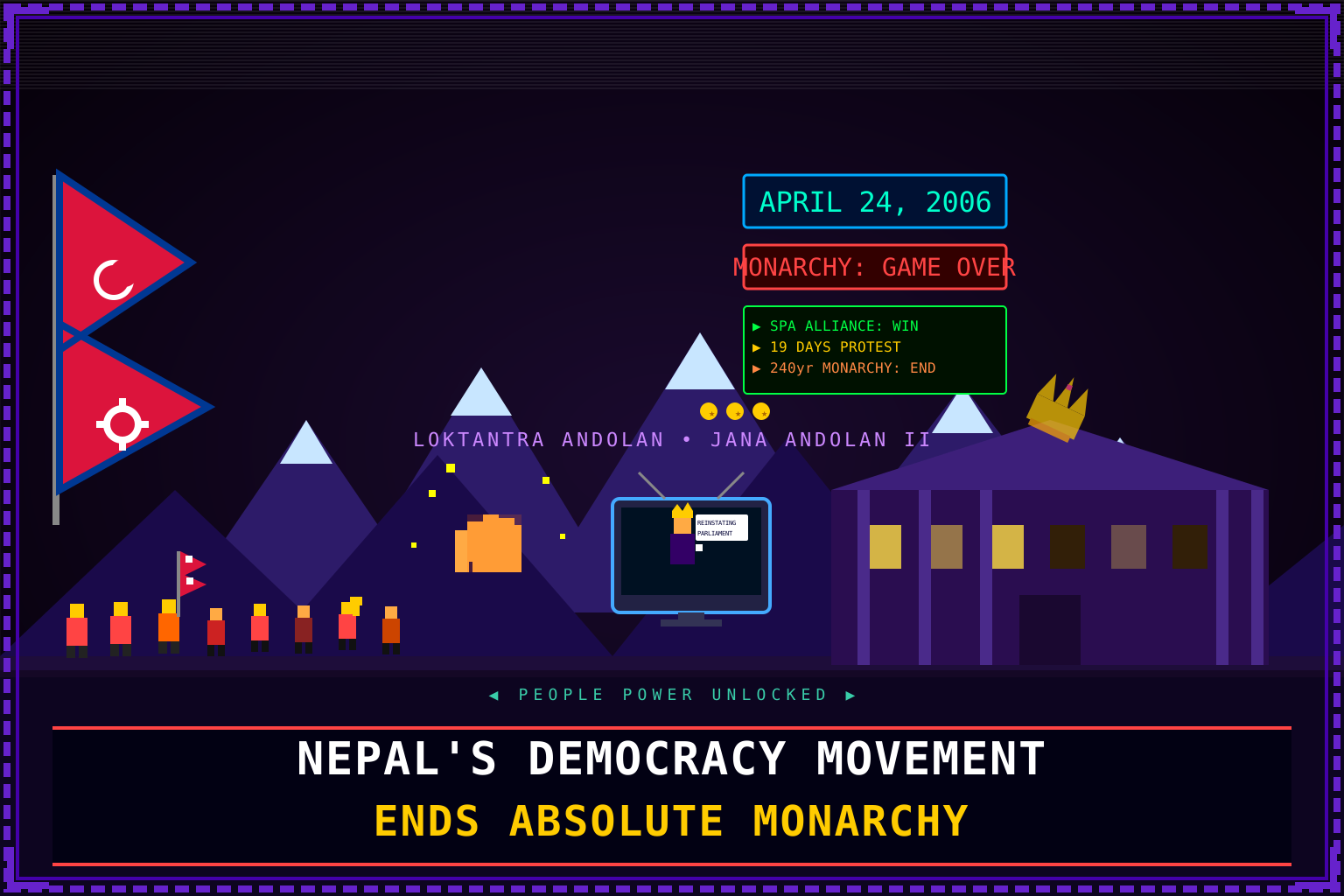
Between April 6 and April 24, 2006, a mass pro-democracy uprising in Nepal—known as the Loktantra Andolan (“Democracy Movement”) or Jana Andolan II (“People’s Movement II”)—forced King Gyanendra to relinquish the direct royal rule he had seized fourteen months earlier. Coordinated by a Seven Party Alliance (SPA) of mainstream opposition parties acting in concert with the Communist Party of Nepal (Maoist), the movement combined a nationwide general strike with sustained street demonstrations that paralysed the capital, Kathmandu, and other cities despite curfews and a security crackdown.
On the night of April 24, 2006, after nineteen days of protest, King Gyanendra appeared on national television and announced the reinstatement of the House of Representatives, the lower house of parliament he had allowed to be dissolved in 2002. The SPA accepted the proclamation and named veteran Nepali Congress leader Girija Prasad Koirala as prime minister. The reinstated parliament convened on April 28 and moved quickly to strip the crown of its powers, setting Nepal on a two-year path that ended with the abolition of the 240-year-old monarchy in 2008.
At least nineteen protesters were killed and thousands injured during the demonstrations, with some tallies placing the death toll as high as twenty-five.
Background
King Gyanendra’s Seizure of Power
Gyanendra ascended the throne in June 2001 following the palace massacre that killed King Birendra and much of the royal family. Nepal was simultaneously mired in a decade-old Maoist insurgency (begun in 1996) that had killed an estimated 13,000 people and destabilised much of the countryside. Citing the elected government’s failure to hold elections or defeat the insurgents, Gyanendra dismissed the government in October 2002 and then, on February 1, 2005, dissolved the cabinet entirely, declared a state of emergency, suspended civil liberties, arrested political leaders and journalists, and assumed direct executive control.
The 2005 royal coup isolated the king internationally—India, the United Kingdom, and the United States suspended military aid—and pushed the previously antagonistic parliamentary parties toward the Maoists. In November 2005, the Seven Party Alliance and the Maoists concluded a 12-point understanding in New Delhi, agreeing to cooperate against absolute monarchy and to bring the Maoists into competitive politics.
The Seven Party Alliance
The SPA united Nepal’s principal parliamentary forces, including the Nepali Congress, the Communist Party of Nepal (Unified Marxist–Leninist), and five smaller parties. Their alignment with the Maoists—who declared a unilateral ceasefire and pledged to support peaceful mass protest—broadened the movement well beyond the urban middle class and neutralised the king’s justification that only royal rule could contain the insurgency.
The Uprising
The alliance called an indefinite general strike beginning April 6, 2006. Demonstrations swelled daily despite a shoot-on-sight curfew in Kathmandu, mass arrests, and clashes in which security forces opened fire on crowds. Professional associations, civil servants, students, and eventually large sections of the middle class joined, and by mid-April hundreds of thousands were marching in the Kathmandu Valley alone.
On April 21, Gyanendra offered to return executive power to a prime minister nominated by the parties while retaining the throne—a concession the SPA rejected as insufficient, demanding the restoration of parliament and elections to a constituent assembly. Protests intensified, and on April 24 the king yielded, announcing on television that he was reinstating the House of Representatives and inviting the alliance to form a government.
Aftermath
The reinstated House of Representatives met on April 28, 2006 and, in a series of sweeping resolutions in May, curtailed the monarchy’s authority:
| Measure | Effect |
|---|---|
| May 18, 2006 declaration | Stripped the king of command of the army, ended his immunity, and brought royal income under taxation |
| Secular state | Declared Nepal a secular state, ending its status as the world’s only Hindu kingdom |
| Comprehensive Peace Accord (Nov 21, 2006) | Formally ended the Maoist insurgency and brought the Maoists into an interim government |
| Constituent Assembly election (April 2008) | Produced an assembly that abolished the monarchy on its first sitting |
The Comprehensive Peace Accord signed on November 21, 2006, between Prime Minister Koirala’s government and the Maoists formally ended the ten-year civil war. Elections to a Constituent Assembly followed in April 2008; at its first meeting on May 28, 2008, the assembly declared Nepal a federal democratic republic, abolishing the monarchy and requiring Gyanendra to vacate the royal palace.
Significance
The 2006 movement was the decisive turning point in Nepal’s transition from a Hindu monarchy to a secular republic. In under three weeks of largely nonviolent mass action it reversed an entrenched royal autocracy, and within two years it ended a monarchy that had ruled since the country’s unification in 1768. By binding the mainstream parties to the Maoists through the 12-point understanding, the uprising also created the political framework that ended one of South Asia’s longest-running insurgencies. The Loktantra Andolan is frequently cited alongside the 1990 Jana Andolan as a landmark example of a broad-based civil-resistance campaign compelling a sitting monarch to surrender absolute power.