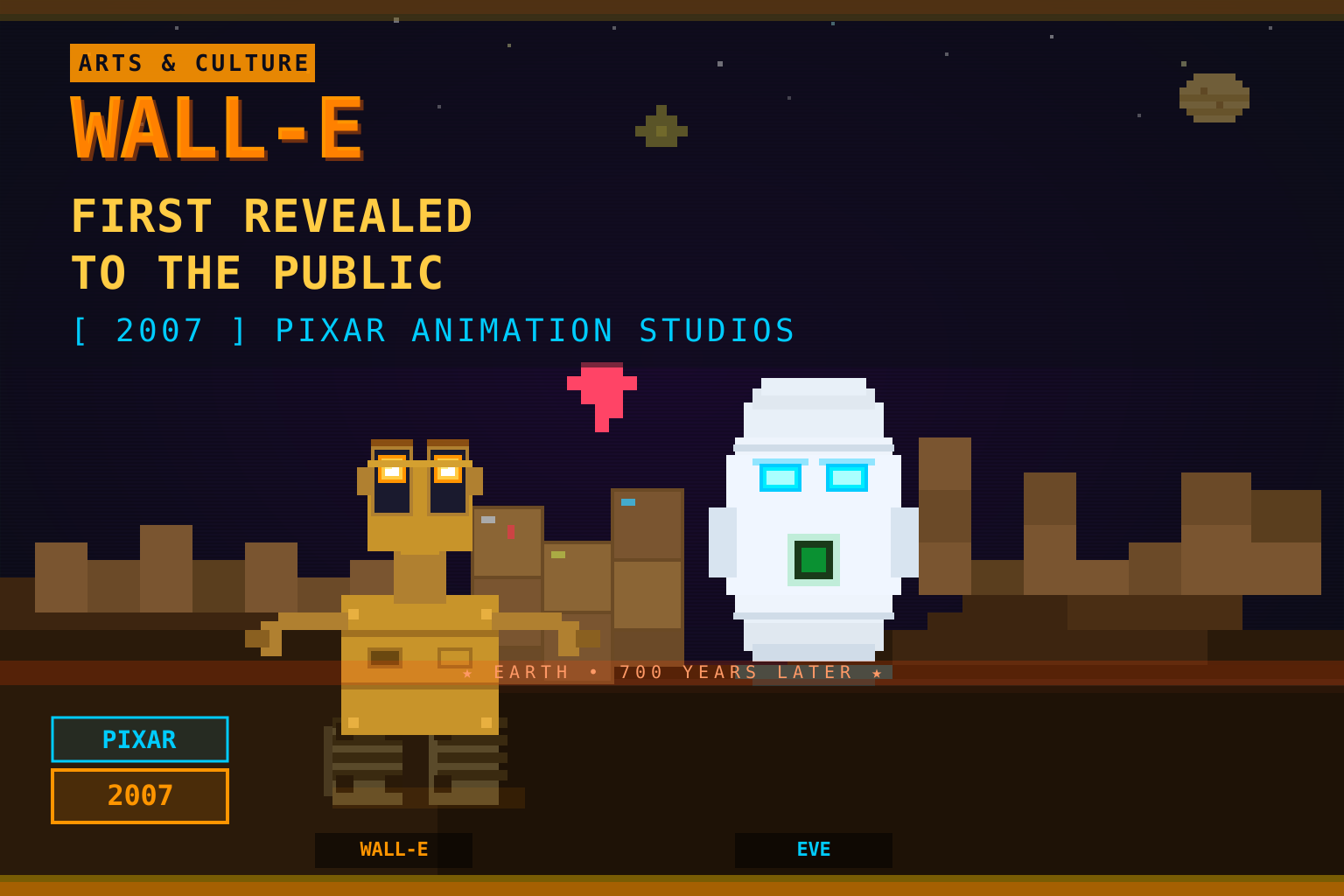
Category: Arts & Culture Key figures: Andrew Stanton (director/co-writer); Jim Reardon (co-writer); Ben Burtt (sound designer/voice of WALL-E); Elissa Knight (voice of EVE); Pete Docter (executive producer); John Lasseter (executive producer)
Summary
In summer 2007, Pixar Animation Studios publicly revealed WALL-E for the first time, with a teaser trailer debuting alongside its film Ratatouille, which opened in U.S. theaters on June 29, 2007. The teaser showed the small waste-collecting robot WALL-E alone on an abandoned Earth, compacting garbage — introducing the film’s post-apocalyptic premise and silent-film aesthetic without dialogue. The film itself was released on June 27, 2008.
WALL-E, directed by Andrew Stanton (Finding Nemo, 2003), tells the story of a waste-allocation load lifter — Earth-class robot — left alone on a garbage-covered Earth for 700 years. The robot’s routine is disrupted when EVE, a sleek extraterrestrial vegetation evaluator probe, arrives from the massive starliner Axiom, which carries the surviving remnants of humanity in a state of technological dependence and physical passivity. WALL-E’s pursuit of EVE drives both robots to the Axiom, where they trigger a chain of events restoring humanity’s connection to the planet it had abandoned.
The film grossed $521.3 million worldwide against a production budget of approximately $180 million, and won the Academy Award for Best Animated Feature at the 81st Academy Awards on February 22, 2009.
Development and Conception
Origins of the Idea
Andrew Stanton conceived the kernel of WALL-E in 1994, during the same lunch meeting at which he and fellow Pixar writers John Lasseter, Pete Docter, and Joe Ranft outlined what would become A Bug’s Life, Monsters, Inc., and Finding Nemo. The central image Stanton carried from that lunch was a small, solitary robot surviving on an abandoned Earth — an image he described as inspired by the question: “What if mankind had to leave Earth and somebody forgot to turn off the last robot?”
Stanton did not begin active development on WALL-E until after Finding Nemo was released in 2003. He worked on the project through 2004 and 2005 with co-writer Jim Reardon, developing the minimal-dialogue structure that would become the film’s most distinctive feature. Stanton cited French filmmaker Jacques Tati (Mon Oncle, Playtime) and silent comedians Buster Keaton and Charlie Chaplin as primary influences — particularly the ability to convey complex emotion and narrative through physical behavior rather than speech.
Sound Design and WALL-E’s Voice
One of the film’s most ambitious technical decisions was the creation of WALL-E’s voice. Rather than cast a conventional voice actor, Stanton worked with veteran sound designer Ben Burtt — the Academy Award-winning creator of the sound effects in the original Star Wars trilogy, including R2-D2’s beeps and Darth Vader’s breathing — to develop WALL-E’s vocal language from scratch. Burtt used recordings of motors, circuits, and audio samples processed through custom filters to build a voice that could convey a wide emotional range (loneliness, curiosity, joy, fear) without using a single recognizable word.
EVE’s voice was performed by Elissa Knight, a Pixar employee, and also processed through digital manipulation to create a higher, more melodic contrast with WALL-E. The principle that humans in the future communicate in fully articulate English while the robots communicate only in expressive sound was a deliberate reversal of conventional science-fiction conventions.
Environmental Themes
The film’s dystopian setting — an Earth buried under centuries of accumulated consumer waste, its surviving human population morbidly obese and passive from a lifetime of screen-mediated corporate entertainment — drew from Stanton’s and Reardon’s observations about consumerism, environmental neglect, and screen addiction in contemporary American life. The fictional corporation Buy n Large (BnL), whose logo appears on every surface of both the ruined Earth and the Axiom, was conceived as a satire of corporate consolidation.
Stanton consistently described the film as a love story first and an environmental message second — he resisted the idea that the environmental and social critique should drive the narrative, arguing that the emotional core of WALL-E’s relationship with EVE was the film’s actual engine, and the themes emerged naturally from the world he had constructed.
The 2007 Teaser and Pre-Release Period
Ratatouille Teaser (June 2007)
The first public glimpse of WALL-E came as a teaser trailer attached to Ratatouille, which opened in U.S. theaters on June 29, 2007. The teaser — approximately 90 seconds — showed WALL-E alone on Earth, compacting garbage into cubes, watching a VHS tape, and looking up at the stars. No narrator explained the premise; no dialogue or title was spoken. Audience and critical response to the teaser focused on the film’s visual sophistication, the expressiveness achieved with the robot’s binocular-lens eyes, and the departure from Pixar’s typically dialogue-heavy promotional materials.
Ratatouille itself — also a Pixar film, directed by Brad Bird — opened to $47.1 million in its first weekend in the United States, ensuring that the WALL-E teaser received very wide initial exposure before any further marketing had been developed.
Pre-Release Development (2007–2008)
During the second half of 2007, Pixar’s animation team worked on the film’s two visually contrasting environments: the ruined Earth (photographed references included real junkyards, rust textures, and sunsets over industrial landscapes) and the Axiom’s sterile white interiors. The production team made a deliberate choice to shoot the Earth sequences with a cinematographic quality — handheld-feeling camera work with shallow depth-of-field and anamorphic lens flare — that was unusual for digital animation, working with director of photography Jeremy Lasky to approximate the warmth and imperfection of film photography.
During this period, the film received its first full theatrical trailer in November 2007, which extended the teaser’s premise and introduced EVE. The two trailers generated sustained online discussion, with media observers noting that Pixar appeared to be making an ambitious silent-film-influenced science-fiction feature — a combination of genres that had no direct precedent in mainstream animated cinema.
Theatrical Release and Reception (2008)
WALL-E opened in North American theaters on June 27, 2008, earning $63.1 million in its opening weekend — the third-highest opening weekend for an animated film at that time. Its worldwide gross of $521.3 million on a production budget of approximately $180 million made it one of the most profitable animated films of the decade.
Critical reception was exceptional: the film holds a 95% approval rating on Rotten Tomatoes and a score of 96/100 on Metacritic, making it one of the highest-rated films ever reviewed on that platform. Critics praised the film’s visual ambition, narrative restraint, emotional depth, and the sophistication of its environmental and social commentary — subjects rarely addressed in children’s animated features with such directness.
Academy Awards Recognition
At the 81st Academy Awards ceremony on February 22, 2009, WALL-E won the Academy Award for Best Animated Feature, defeating Kung Fu Panda (DreamWorks) and Bolt (Walt Disney Animation Studios). It was also nominated for Best Original Screenplay, Best Original Score (Thomas Newman), Best Original Song (“Down to Earth,” Peter Gabriel), Best Sound Editing, and Best Sound Mixing — an unusually broad range of nominations for an animated film, reflecting critical consensus that WALL-E was a work of cinematic ambition beyond its genre.
Significance
WALL-E represented a maturation of animated science fiction, combining entertainment with substantive commentary on ecological collapse, consumerism, corporate dominance, and the consequences of human disconnection from the natural world. Arriving a year after Sicko (June 2007) had placed healthcare policy at the center of cultural debate, and in the same period as Al Gore and the IPCC’s Nobel Peace Prize for climate advocacy (October 2007), WALL-E’s environmental themes resonated with a public already engaged with questions about institutional responsibility for long-term systemic risk.
The film’s minimal-dialogue approach — a structural choice that required Pixar’s animators and sound designers to carry narrative and emotion without the verbal scaffolding that sustained most animated features — has since been cited as one of the most technically ambitious commitments in studio animated film. Pixar’s willingness to make that bet with a $180 million production, and audiences’ willingness to follow it, shaped subsequent animated filmmaking: the success of the film encouraged Disney and Pixar to continue pursuing adult-inflected animated subjects.
WALL-E also demonstrated that children’s entertainment could serve as a vehicle for serious prescient cultural commentary — a function it shares with the live-action films of 2007 such as No Country for Old Men, which similarly refused generic conventions to engage with systemic anxiety and moral ambiguity.
Sources
- WALL-E — Wikipedia
- WALL-E — Box Office Mojo — worldwide gross of $521.3 million.
- 81st Academy Awards — Wikipedia — confirms Best Animated Feature win and five additional nominations.
- WALL-E — Rotten Tomatoes — 95% critics score.
- Ratatouille — Wikipedia — confirms June 29, 2007 US opening and attached WALL-E teaser.
- Ben Burtt — Wikipedia — confirms Burtt’s role as WALL-E’s voice/sound designer and prior work on Star Wars.
- Andrew Stanton — Wikipedia — confirms 1994 development origins and film influences.