Category: Society & Economics Key figures: Bill Belichick (head coach); Tom Brady (quarterback); Randy Moss (wide receiver); Wes Welker (wide receiver); Ellis Hobbs (cornerback); Rodney Harrison (safety)
Summary
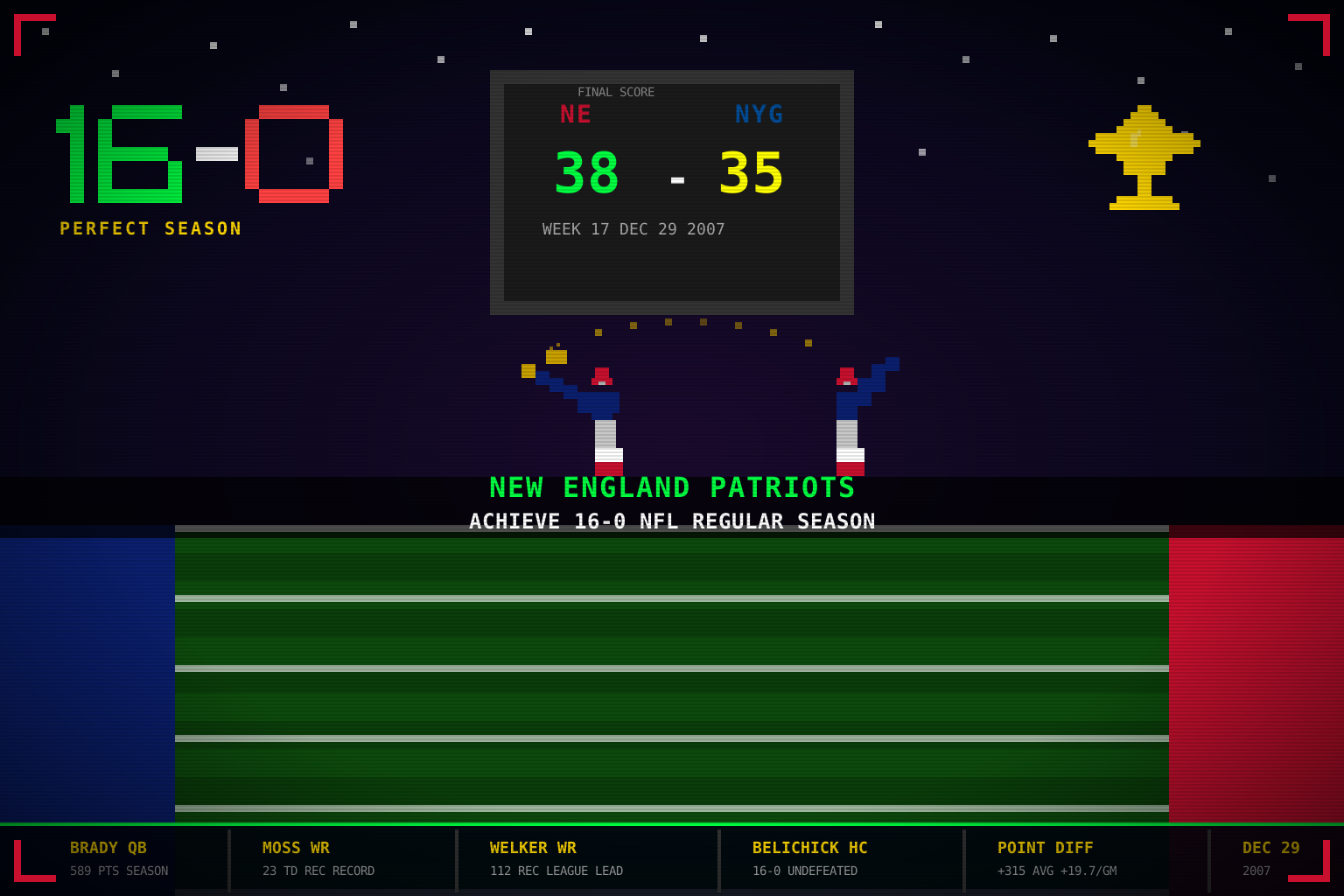
The New England Patriots completed the 2007 NFL regular season with a record of 16 wins and 0 losses on December 29, 2007, when they defeated the New York Giants 38–35 in Week 17 at Giants Stadium. The 16-0 finish made the Patriots the first team to go undefeated across a 16-game regular season (the NFL had expanded from 14 games to 16 games in 1978) and the first team with an undefeated regular season of any length since the 1972 Miami Dolphins, who went 14-0. The achievement also extended a winning streak that had begun in December 2006 and would ultimately reach an NFL-record 21 consecutive regular-season victories before ending in September 2008.
Coached by Bill Belichick and led by quarterback Tom Brady, the 2007 Patriots scored 589 points over their 16-game regular season—an average of 36.8 points per game, near-record offensive efficiency. The offensive weapons included wide receivers Randy Moss (23 touchdown receptions, an NFL single-season record) and Wes Welker (112 receptions, leading the league in that category). On defense, the team featured cornerback Ellis Hobbs, safety Rodney Harrison, and pass-rushing specialist Richard Seymour. The team’s point differential of +315 (averaging +19.7 points per game) was among the highest in NFL history, indicating consistent dominance across the regular season.
2006 Foundation & Consecutive Win Streak
The 2007 undefeated regular season was not achieved in isolation; it extended a Patriots dynasty that had already produced three Super Bowl titles following the 2001, 2003, and 2004 seasons. The regular-season winning streak that the 16-0 campaign carried forward began on December 17, 2006, when the Patriots defeated the Houston Texans 40–7. New England closed the 2006 season by winning its final regular-season games, establishing a foundation of momentum that carried into 2007.
The 2007 season represented the Patriots’ continuation of a sustained period of excellence: they had won Super Bowls following the 2003 and 2004 seasons (Super Bowl XXXVIII and XXXIX), won the AFC East division in 2006 (12–4 record), and had not had a losing season since 2000 (Belichick’s first year in charge, when they went 5–11). The organizational stability—with head coach Belichick, quarterback Brady, and owner Robert Kraft all in place—created conditions for the unprecedented regular-season success of 2007.
Regular Season Performance
The Patriots’ 16-0 record included several dominant performances. Notable wins included:
- Week 1 at New York Jets: Patriots 38, Jets 14 (a statement win to open the season)
- Week 2 vs. San Diego Chargers: Patriots 38, Chargers 14
- Week 6 at Dallas Cowboys: Patriots 48, Cowboys 27 (a high-scoring showcase of the Patriots’ offensive firepower)
- Week 9 vs. Indianapolis Colts: Patriots 24, Colts 20 (a much-anticipated meeting of unbeaten teams against the defending Super Bowl champions)
- Week 17 at New York Giants: Patriots 38, Giants 35 (the clinching game for the undefeated regular season)
The Patriots’ offense, built around the Brady-to-Moss and Brady-to-Welker axis, showcased an efficient, high-tempo attack that generated explosive plays. Randy Moss’s 23 touchdown receptions shattered the previous single-season record of 22, held by Jerry Rice (1987, in a 12-game season; adjusted for games played, both players roughly matched). Moss’s achievement was particularly notable because it occurred in a season emphasizing heavy passing volume: the Patriots threw the ball 578 times in 2007 (averaging 36.1 pass attempts per game), well above league average.
Historic Statistical Records
The 2007 regular season produced multiple individual offensive records that cemented the Patriots’ place in NFL history independent of their win total:
-
Tom Brady — 50 touchdown passes: Brady threw for 50 touchdown passes in 2007, eclipsing the previous NFL single-season record of 49 set by Peyton Manning (Indianapolis Colts) in 2004. Brady’s 50-TD season came with a completion percentage of 68.9% on 578 pass attempts, 4,806 passing yards, and just 8 interceptions — a passer rating of 117.2, the highest single-season rating in NFL history at that point. The 50-TD mark stood as the record until Peyton Manning threw 55 touchdown passes in 2013; Patrick Mahomes matched Brady’s 50 in 2018.
-
Randy Moss — 23 receiving touchdowns: Wide receiver Randy Moss caught 98 passes for 1,493 receiving yards and 23 touchdowns, surpassing the previous single-season receiving touchdown record of 22 held by Jerry Rice (set in 1987, a strike-shortened season in which Rice played 12 of 16 games). Moss had joined the Patriots from the Oakland Raiders in the 2007 off-season — his first two seasons in Oakland had been disappointing by his earlier career standards — and his reunion with an elite quarterback in Brady represented one of the most dramatic single-season player performances in NFL history.
-
Wes Welker — 112 receptions: Slot receiver Wes Welker led the league with 112 receptions (1,175 yards), establishing himself as Brady’s most reliable short-to-intermediate-range target in the Patriots’ passing tree. Welker’s role — running precise routes out of the slot, converting third downs at a high rate — became a template for the “slot receiver as offense hub” design that influenced NFL offensive schemes throughout the following decade.
-
Team scoring: The Patriots’ 589 points remained the NFL single-season scoring record until the Denver Broncos eclipsed it with 606 points in 2013.
Controversy & “Spygate” Context
The 2007 Patriots’ regular season unfolded under the shadow of “Spygate”—a controversy that erupted during the season opener itself. On September 9, 2007, in the Week 1 game against the New York Jets, the NFL caught Patriots video assistant Matt Estrella filming Jets defensive coaches’ signals from an unauthorized location, a violation of league rules on recording opponents’ signals. On September 13, 2007, Commissioner Roger Goodell fined head coach Bill Belichick $500,000, fined the team $250,000, and stripped New England of its first-round pick in the 2008 draft. Though the Patriots insisted the filming was for in-game reference only, the scandal created a narrative backdrop to the 2007 season: observers debated whether the Patriots’ success was attributable to coaching excellence and player talent or to an organizational culture that valued rules-bending.
The undefeated regular season was, to some observers, a vindication of the Patriots’ organizational strength despite Spygate; to others, it was a reminder that the team’s methods were ethically questionable. This duality would persist in retrospective assessments of the Patriots’ dynasty and of Bill Belichick’s legacy.
Playoff Expectations
The 16-0 regular season generated enormous expectations for the Patriots’ playoff run. Historically, NFL regular season records do not guarantee Super Bowl success—the undefeated regular season of the 2007 season had only been matched once before in the modern era, by the 1972 Miami Dolphins (14-0 regular season, followed by playoff victories in the 14-game era). The Patriots entered the 2008 AFC playoff tournament (held in January 2008, for the 2007 season) as Super Bowl favorites, with oddsmakers giving them 2–1 odds to win it all.
However, the Patriots’ Super Bowl XLII run (played February 3, 2008, at University of Phoenix Stadium in Glendale, Arizona) resulted in an unexpected 17–14 loss to the New York Giants, ending their bid for a perfect 19-0 season. The decisive play was quarterback Eli Manning’s 32-yard completion to receiver David Tyree — who pinned the ball against his helmet with one hand while being tackled — with 1:15 remaining, a play immediately recognized as one of the most extraordinary catches in Super Bowl history. The Giants scored the winning touchdown 35 seconds later. The defeat was Brady’s first postseason loss and Belichick’s first Super Bowl loss as head coach, complicating the narrative of the 16-0 regular season: it remained an unmatched regular-season achievement, but without a championship to accompany it, the 2007 Patriots entered the unusual position of being remembered simultaneously as one of the greatest regular-season teams and one of the most consequential Super Bowl upsets in NFL history.
Significance
The Patriots’ 16-0 regular season represented the culmination of the NFL’s evolution toward an increasingly high-paced, pass-oriented offensive game. The 2007 season itself featured record offensive production league-wide: the average points per game in 2007 was 21.3, near an all-time high at the time, reflecting rule changes that had begun in 2004 (emphasizing illegal contact and pass-interference penalties to protect receivers). The Patriots, coached by Belichick and led by Brady, fully exploited these rule changes, establishing an offensive standard that would influence NFL strategy through the subsequent decade.
The 16-0 season also solidified the Patriots as the dominant franchise of the early-to-mid 2000s. By 2007, they had won three Super Bowls in four years (2001, 2003, 2004 seasons) and were on pace to compete for championships consistently—a trajectory that would continue through Brady’s 20-season tenure with the team. The 2007 season, despite the playoff disappointment, established the Patriots as an offensive juggernaut and set expectations for sustained excellence that defined the franchise’s identity.
The 16-0 record also occurred at a pivot point in media coverage of sports: the 2007 season was widely documented on early sports blogs, YouTube clips of Patriots games and highlight reels circulated virally, and the milestone was tracked obsessively on sports websites like ESPN.com and dedicated Patriots fan sites. The record became a media sensation in a way that earlier records, achieved before internet-era saturation coverage, had not—accelerating the cultural narrative around the Patriots and contributing to the organization’s public prominence going forward.
The 2007 season unfolded within a broader sports landscape marked by records and controversy. Barry Bonds’ career home-run record (set August 7, 2007) had similarly attracted national attention while raising questions about legitimacy and rule-interpretation, establishing a thematic parallel between two of the year’s most prominent sports stories: historic achievement shadowed by ethical dispute. Meanwhile, the subprime mortgage crisis erupting in late 2007 would soon redirect national attention toward economic catastrophe — but through the autumn of 2007, the Patriots’ winning streak provided an unambiguous sports spectacle that briefly commanded the same media intensity as financial and political turmoil.
The Patriots’ 16-0 season also intersected with the accelerating transformation of sports media. The 2007 NFL season was the first in which NFL Network broadcast exclusive games during the regular season, and the league’s experiment with late-season streaming via the internet (several Week 16 games were simulcast) previewed the trajectory of sports broadcasting that would intensify over the following decade. The Patriots’ historic run provided ideal content for this expanding media ecosystem, generating multi-platform coverage that helped establish the NFL’s dominance of the American sports-media market.
Sources
- 2007 NFL season — Wikipedia
- New England Patriots — Wikipedia
- Tom Brady — Wikipedia — career statistics including 2007 season records
- Randy Moss — Wikipedia — single-season receiving touchdown record details
- Wes Welker — Wikipedia — 2007 reception statistics
- Bill Belichick — Wikipedia
- Spygate — Wikipedia — context for the 2007 controversy
- Super Bowl XLII — Wikipedia — game details including the Helmet Catch play
- David Tyree — Wikipedia — background on the Helmet Catch and its context in the game