Key figures: Alberto Gonzales (Attorney General), George W. Bush (President), Patrick Leahy (Senate Judiciary Committee Chairman), Arlen Specter (Republican Senator), Joseph Biden (Democratic Senator), Kyle Sampson (DOJ White House Liaison), John Ashcroft (former AG), James Comey (former Deputy AG), Michael Mukasey (successor AG)
Timeline of Key Events
| Date | Event |
|---|---|
| February 3, 2005 | Gonzales confirmed as Attorney General by the Senate (60–36 vote), replacing John Ashcroft |
| August 1, 2002 | Bybee-Yoo torture memo signed; Gonzales’s White House Counsel office had authorized its production |
| March 10, 2004 | Gonzales and White House Chief of Staff Andy Card visit hospitalized AG Ashcroft at Walter Reed to seek reauthorization of NSA surveillance; Ashcroft refuses after deputy AG Comey warns him not to sign |
| December 7, 2006 | Justice Department dismisses eight U.S. attorneys, many mid-term dismissals unusual by historical standards |
| January 17, 2007 | Gonzales testifies before Senate Judiciary Committee; senators question his role in the firings |
| March 12, 2007 | Kyle Sampson resigns as DOJ chief of staff; his subsequent testimony contradicts Gonzales’s account |
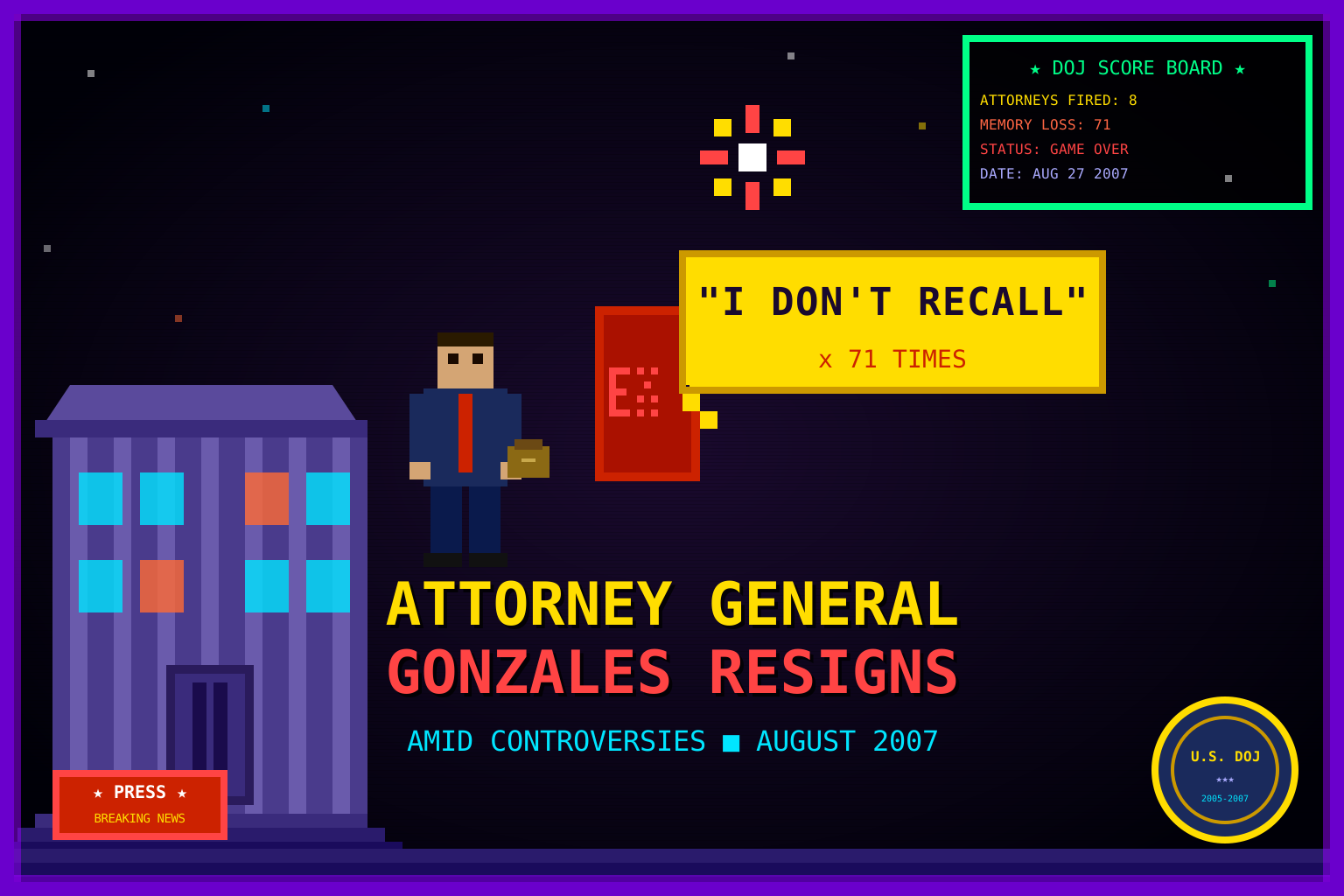
| April 19, 2007 | Gonzales testifies again before Senate Judiciary Committee; uses the phrase “I don’t recall” or variants approximately 71 times |
| May–July 2007 | Bipartisan Senate resolutions calling for Gonzales’s resignation gain momentum |
| August 27, 2007 | Gonzales announces resignation, effective September 17, 2007 |
| November 8, 2007 | Senate confirms Michael Mukasey as Gonzales’s successor by 53–40 vote |
Summary
On August 27, 2007, Attorney General Alberto Gonzales announced his resignation from the U.S. Department of Justice, effective September 17, 2007. Gonzales stated he was leaving “in the best interests of the department,” but his departure was widely understood as a forced resignation resulting from sustained congressional and public pressure over three major controversies: the politically motivated firing of eight U.S. attorneys, authorization of torture as part of the war on terror, and warrantless domestic surveillance programs. His resignation marked the end of an unprecedented tenure marked by challenges to the Justice Department’s traditional independence from presidential politics.
Gonzales had served as Attorney General since February 2005, having previously been White House Counsel during Bush’s first term. His tenure was defined by legal decisions that expanded executive power during the war on terror, but it also became marked by credibility problems after his congressional testimony about controversial policies appeared contradictory and incomplete.
Background: Gonzales’s Role in Bush Administration Legal Policy
Alberto Gonzales had been deeply involved in shaping the Bush administration’s legal approach to the war on terror from its earliest days. As White House Counsel (2001-2005), he played a central role in authorizing enhanced interrogation techniques, including waterboarding. The August 1, 2002, Yoo-Bybee memo—which provided legal justification for techniques long considered torture—carried Gonzales’s bureaucratic imprimatur if not his formal authorship.
When he became Attorney General, Gonzales brought this legacy with him, effectively placing the nation’s chief law enforcement officer at the center of defending policies most international law experts and human rights organizations regarded as torture. This positioning set the stage for his later troubles: the Attorney General normally defends the Justice Department’s institutional interests and the rule of law; instead, Gonzales found himself defending executive power claims that tested those boundaries.
Controversy 1: The U.S. Attorney Firings (December 2006)
The most immediate catalyst for Gonzales’s resignation involved the controversial dismissal of eight U.S. attorneys in December 2006. Under the Bush administration, U.S. attorneys are political appointees who serve at the President’s pleasure—they can be fired without cause. However, the pattern of these firings suggested they were motivated by political disloyalty rather than performance concerns.
Among the fired prosecutors were those who:
- Had declined to prosecute voter-fraud cases (perceived as weak on voter suppression)
- Were investigating Republican officials
- Had not pursued aggressive death penalty prosecutions
When Congress questioned Gonzales about the firings, his testimony was evasive. He stated he “couldn’t recall” details approximately 71 times during his Senate testimony—a figure that became emblematic of his credibility problems. Internal documents later revealed that the dismissals had been planned as part of a comprehensive political purge.
Even Senator Arlen Specter, a conservative Republican, was exasperated. Specter stated: “Your credibility has been breached to the point of being actionable.” This rebuke from a senior Republican ally signaled that Gonzales had lost the confidence even of his party’s leadership. Democratic Senator Joseph Biden called for Gonzales’s resignation, and the House Judiciary Committee launched formal investigations.
Kyle Sampson, the Justice Department official who coordinated the attorney dismissals, resigned in March 2007 and subsequently acknowledged the political motivations behind the firings. Sampson’s testimony directly contradicted Gonzales’s earlier accounts, effectively proving the Attorney General had misled Congress.
Controversy 2: Torture Authorization and Enhanced Interrogation
Beyond the attorney firings, Gonzales faced sustained criticism over his role in authorizing torture. As White House Counsel, he had championed a legal interpretation that the President, as Commander-in-Chief, could override federal and international prohibitions on torture in the name of national security. The August 2002 Bybee memo, which provided the legal framework for waterboarding and other “enhanced interrogation techniques,” was justified through Gonzales’s bureaucratic channels.
By 2007, the consensus among military leadership, the intelligence community, and international lawyers had shifted decisively against these techniques. Multiple retired military officers testified that waterboarding and similar practices were ineffective for intelligence gathering and damaged America’s moral credibility worldwide. The International Committee of the Red Cross concluded that the techniques amounted to torture under international law.
As Attorney General, Gonzales continued to defend the legality of these practices, effectively making the Justice Department complicit in what critics characterized as crimes under international law. This defense of torture became intertwined with his broader credibility crisis—many viewed it as evidence that he prioritized executive power over the rule of law.
Controversy 3: Warrantless NSA Surveillance
A third major controversy involved Gonzales’s role in the National Security Agency’s domestic eavesdropping program. After the program became public in December 2005, Gonzales claimed in congressional testimony that he had appropriately authorized the program and that it operated within legal bounds. However, subsequent disclosures revealed that the NSA had engaged in extensive warrantless surveillance that went beyond even what Gonzales had acknowledged.
In March 2006, an unusual confrontation occurred at Walter Reed Army Medical Center when hospitalized Attorney General John Ashcroft—Gonzales’s predecessor—refused to reauthorize the surveillance program because his deputy, James Comey, had concluded it was illegal. Gonzales and other administration officials had attempted to pressure the hospitalized Ashcroft to override his deputy’s judgment. Ashcroft refused, and the program was subsequently modified.
This episode illustrated a deeper problem: the Justice Department’s role as a check on executive power had been compromised. Gonzales, as the sitting Attorney General, was a participant in the administration’s surveillance expansions rather than a neutral arbiter of legal authority. This conflict of interest undermined his ability to credibly defend either the programs or his role in them.
Congressional Pressure and Bipartisan Criticism
By mid-2007, calls for Gonzales’s resignation had become bipartisan and intense. Democratic leaders had long opposed his policies on torture and surveillance. But Republican criticism was more damaging to his standing with the White House. Conservative legal scholars questioned his constitutional interpretations. Senator Specter pressed him on credibility. Even Vice President Dick Cheney’s allies, who had supported aggressive executive power claims, began to distance themselves from Gonzales as his political viability deteriorated.
The House Judiciary Committee — empowered by the Democratic majority that had taken control of Congress in January 2007 — had opened investigations into potential perjury charges. The Senate was considering contempt-of-Congress citations for Justice Department officials refusing to testify. The political environment had become untenable.
The Walter Reed Hospital Confrontation (March 10, 2004)
One of the most dramatic episodes of Gonzales’s career—revealed only through James Comey’s May 2007 Senate testimony—occurred three years before his resignation. On March 10, 2004, Deputy Attorney General James Comey had determined that the NSA’s warrantless surveillance program was illegal and refused to reauthorize it. Comey was Acting Attorney General because John Ashcroft was hospitalized with pancreatitis at Walter Reed Army Medical Center.
That evening, Gonzales (then White House Counsel) and White House Chief of Staff Andrew Card drove to Walter Reed and entered Ashcroft’s hospital room to pressure the gravely ill Attorney General to override Comey’s determination and sign reauthorization. Ashcroft, propped up in his hospital bed, refused—telling Gonzales and Card that Comey was right and that the decision was Comey’s to make. FBI Director Robert Mueller, alerted by Comey, sent agents to protect Ashcroft from further pressure.
The episode illustrated the lengths to which the Bush White House went to preserve the NSA program, even attempting to circumvent a deputy attorney general’s legal judgment by pressuring a hospitalized superior. Comey and other senior Justice Department officials had threatened to resign if the program continued without modification. The crisis was resolved only when the White House agreed to reform the program.
When this story became public during Comey’s 2007 Senate testimony—originally focused on the U.S. attorney firings—it dramatically expanded the scope of congressional concern about Gonzales, adding evidence that he had placed administration loyalty over institutional legal integrity even before becoming Attorney General.
Resignation and Succession
After consultation with President Bush, Gonzales announced his resignation on August 27, 2007, effective September 17. Bush accepted it reluctantly, emphasizing that Gonzales had served the nation honorably. In the context of the controversies, the forced resignation was widely understood as an acknowledgment that Gonzales’s continued tenure would damage the administration’s ability to govern.
Gonzales was temporarily succeeded by Acting Attorney General Peter Keisler, who served from September 17 until Mukasey’s confirmation. Michael Mukasey—a retired federal judge from the Southern District of New York, known for presiding over terrorism cases—was confirmed by the Senate on November 8, 2007, by a 53–40 vote. His confirmation was complicated when he refused during hearings to state unequivocally that waterboarding constituted torture, a position that drew protests from human rights advocates but reflected the political constraints the Bush administration imposed on its nominees.
Mukasey, despite this controversy, restored considerable institutional credibility to the Justice Department. He appointed career prosecutors to lead internal investigations and adopted a lower public profile than Gonzales, whose press availability had often become a liability as the controversies escalated.
Significance
Alberto Gonzales’s resignation in August 2007 marked the failure of the Bush administration’s attempt to permanently reshape the Justice Department as an instrument of executive power unconstrained by traditional norms of independence. His downfall demonstrated that even a sympathetic Congress and an administration that valued loyalty had limits on how far it could subordinate institutional law enforcement to political objectives.
The episode also illuminated how the war on terror had strained American legal institutions. Gonzales had attempted to provide legal justifications for interrogation practices, surveillance programs, and prosecutorial decisions that previous administrations would have considered beyond the pale. His inability to maintain credibility while doing so suggested a deeper tension: the legal system itself could not accommodate the expansions he was asked to defend.
For the Justice Department’s future, Gonzales’s resignation underscored the importance of maintaining the institution’s independence from partisan politics. Subsequent administrations, whether Republican or Democratic, would grapple with the precedents set during his tenure—precedents that had stretched the constitutional authority of the executive branch in ways courts had not definitively resolved.
The Gonzales episode also became a touchstone for debates about presidential accountability and rule of law, arriving weeks after President Bush’s commutation of Scooter Libby’s prison sentence had raised parallel questions about executive-branch accountability. His fall showed that credibility crises can force resignation even for officials with presidential protection, but it also raised questions about why accountability stopped at resignation rather than proceeding to prosecution, as international law advocates argued it should.
Legacy: The “71 Times” Standard
Gonzales’s April 2007 Senate testimony became a landmark in congressional oversight hearings—not for its substance, but for its evasiveness. His repeated use of “I don’t recall” (documented at approximately 71 instances across the hearing) became a colloquial shorthand for stonewalling under oath. Critics distinguished this from criminal perjury—Gonzales was technically accurate if he truly did not remember—but the sheer volume of memory lapses about matters central to his department’s operations struck many observers as implausible. The Senate Judiciary Committee referred allegations of perjury and false testimony to the Department’s Office of Professional Responsibility for investigation. Those investigations ultimately concluded without criminal referrals, illustrating the political and legal difficulty of prosecuting senior executive branch officials for congressional testimony.