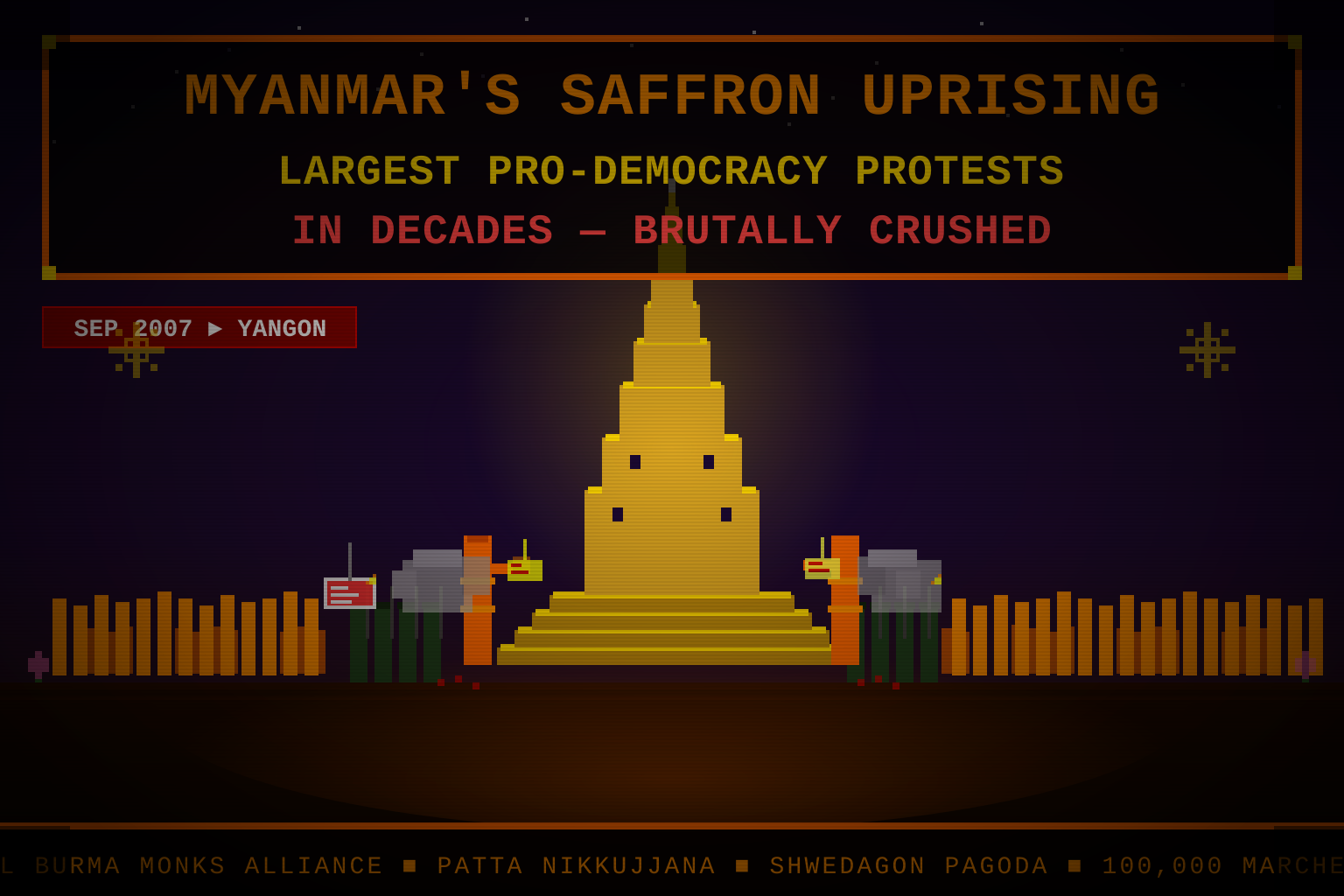
Key figures: Than Shwe (Senior General, State Peace and Development Council), Aung San Suu Kyi (opposition leader, under house arrest since 2003), U Gambira (leading monk and protest organizer), Ibrahim Gambari (UN Special Envoy), Thich Quang Do (international Buddhist solidarity figure), Assistance Association for Political Prisoners (AAPP, documenting casualties and detentions)
Timeline of Key Events
| Date | Event |
|---|---|
| August 15, 2007 | Government announces fuel price increases: petrol up ~66%, diesel up ~100%, compressed natural gas up ~500% |
| August 19, 2007 | Small-scale pro-democracy protests begin in Rangoon; security forces arrest approximately 100 activists within days |
| September 5, 2007 | Security forces and pro-junta thugs attack demonstrators in Pakokku, beating three monks |
| September 6, 2007 | Pakokku monks march to demand apology; junta forces beat and detain monks, triggering nationwide monastic outrage |
| September 9, 2007 | All Burma Monks Alliance formed; monks formally announce “thuddha boycott” (patta nikkujjana) against junta |
| September 17–22 | Monk-led marches spread to Yangon, Mandalay, and dozens of other cities |
| September 24, 2007 | Peak demonstrations in Yangon: an estimated 50,000–100,000 marchers; similar scenes in Mandalay |
| September 26, 2007 | Military surrounds Shwedagon Pagoda, attacks assembled crowds; curfews imposed in Yangon and Mandalay |
| September 27, 2007 | Security forces fire on protesters; Japanese photographer Kenji Nagai killed; crackdown intensifies |
| October 2007 | UN Special Envoy Ibrahim Gambari visits Myanmar, meets Than Shwe and briefly with Aung San Suu Kyi |
| May 2008 | Junta-authored 2008 constitution adopted via heavily contested referendum; enshrines continued military dominance |
Summary
Between August and October 2007, Myanmar (Burma) experienced its largest pro-democracy demonstrations in approximately two decades, a movement subsequently known as the Saffron Uprising due to the predominant role of Buddhist monks, who traditionally wear saffron robes. The uprising began as economic protests against the military junta’s sudden increase of fuel prices by up to 500 percent in August but escalated into a broad challenge to military rule when Buddhist monks joined the movement in early September. At its peak in late September, the demonstrations drew nearly 100,000 marchers to the streets of Yangon (Rangoon), the nation’s largest city. The military junta’s violent crackdown on September 26-27, 2007, killed dozens of demonstrators and resulted in over 3,000 arrests, effectively suppressing the uprising but at significant cost to the regime’s international standing.
The uprising represented the most serious internal challenge to Myanmar’s military rule since the 1988 pro-democracy uprising, which the junta had also crushed with force, killing an estimated 3,000 people. The 2007 movement illustrated both the deep dissatisfaction with military rule and the limits of popular resistance against a regime willing to employ systematic violence.
Background: Fuel Crisis and Economic Distress
The immediate trigger for the Saffron Uprising was the Myanmar government’s announcement in August 2007 of a drastic increase in fuel prices. The junta roughly doubled the prices of petrol and diesel—petrol by about two-thirds and diesel by around 100 percent—and raised the price of compressed natural gas, which fueled much of the country’s public bus fleet, by roughly 500 percent. The decision was characteristic of the regime’s arbitrary economic management: the junta had isolated Myanmar from global markets through decades of military rule and mismanagement, making the country dependent on fuel imports while lacking the foreign exchange reserves to absorb price shocks.
The fuel price increase had cascading effects on transportation, food prices, and the cost of electricity. Ordinary Burmese faced immediate and severe reductions in living standards. For a country where average per capita income was among the lowest in Southeast Asia, the shock was devastating.
Preliminary pro-democracy and pro-reform activism had intensified in 2007. Aung San Suu Kyi, the opposition leader and Nobel Peace Prize laureate, had been held under house arrest since 2003. Various opposition groups and pro-democracy networks had been plotting how to challenge the regime. The fuel price announcement provided the catalyst many had been waiting for.
Initial Phase: Secular Protests (August-Early September)
In August and early September, pro-democracy activists and students launched protests, joined by some elements of the urban middle class affected by rising costs. These demonstrations were significant but not unprecedented. The junta had developed sophisticated mechanisms for controlling such protests, including surveillance networks, informants within activist circles, and rapid deployment of security forces.
The regime’s typical response was consistent with its historical pattern: disperse demonstrations, arrest visible leaders, and use imprisonment or torture to deter further activism. Many expected the fuel-price protests to follow this predictable trajectory—suppressed quickly and thoroughly.
The Thuddha Boycott: Theological Dimensions of Protest
The monks’ most powerful symbolic act was the patta nikkujjana kamma—literally the “overturning of the alms bowl”—a formal Vinaya (monastic code) procedure by which monks refuse to accept alms from laypeople deemed to have behaved immorally. Announced by the All Burma Monks Alliance on September 9, 2007, the boycott declared that monks would refuse to accept offerings from members of the military junta, their families, and those associated with them.
This act carried profound theological weight in Theravada Buddhist culture. Monks and laypeople exist in a symbiotic relationship: laypeople support monks materially; monks provide merit and spiritual guidance in return. For a monk to refuse alms from an individual is to declare them spiritually unworthy of making merit—a severe condemnation in a culture where accumulating merit is central to understanding one’s fate in this and future lives. The junta found itself in the position of being spiritually rejected by the very religious establishment it needed for legitimacy.
The boycott was unprecedented in scope: the All Burma Monks Alliance represented monks across the country’s approximately 400,000 strong monastic community (one of the largest per-capita in the world). That this body had formally turned against the regime was a sign of the uprising’s unique moral authority.
The Monastic Turn: Buddhist Monks Join the Uprising (September 5-6)
The dynamic changed dramatically when Buddhist monks entered the movement in early September 2007. Buddhism is central to Burmese identity and culture. Monks occupy a position of immense spiritual authority; their actions carry moral weight that political activists’ words often cannot. The junta, despite its authoritarianism, must maintain at least a veneer of respect for Buddhist institutions to preserve legitimacy within Burmese society.
The catalyst for monastic participation was an incident in the central Burmese town of Pakokku on September 5. Government troops and junta-aligned thugs attacked pro-democracy demonstrators, and in the process, they severely beat and injured three Buddhist monks who were present. The treatment of monks—among the most revered figures in Burmese culture—shocked the Buddhist monastic community.
On September 6, in response to the Pakokku incident, Buddhist monks in that city organized a protest march to seek an apology from the junta. When SPDC (State Peace and Development Council) officers broke up this march by firing warning shots and brutally beating monks, taking some into custody, the monastic community’s outrage intensified. The junta had crossed a cultural and religious line that even many regime loyalists found difficult to justify.
Escalation: The Nationwide Movement (September 18-24)
Over the subsequent weeks, Buddhist monks across Myanmar began organizing a nationwide campaign, calling not only for an apology and the release of detained monks but also for broader political reform and an end to military rule. Monasteries became coordinating centers for protest activity. Senior abbots issued public statements critical of the regime.
By mid-September, monk-led marches were occurring in multiple cities simultaneously. The movement grew qualitatively different from previous pro-democracy protests: it had spiritual legitimacy, nationwide coordination, and the participation of respected religious leaders whose moral authority was difficult for the junta to counter without appearing to attack Buddhism itself.
By September 24, demonstrations in Yangon had grown to unprecedented scale—estimates ranged from 50,000 to 100,000 marchers. Photographs showed lines of saffron-robed monks walking slowly and silently through city streets, often with their alms bowls turned upside down—a powerful symbolic gesture indicating that they were withdrawing their spiritual blessings from the military leaders and refusing to accept donations from them. This ancient monastic practice of refusing alms was revived as a protest tactic and widely recognized internationally as a sign of spiritual rebuke.
Similar large demonstrations occurred in Mandalay, Myanmar’s second-largest city, and smaller towns throughout the country. For the first time in nearly two decades, it appeared the regime faced a genuine threat to its monopoly on power.
The Crackdown: September 26-27, 2007
The junta’s response to the uprising was swift and brutal. On September 26, 2007, military and security forces surrounded major protest sites, particularly the Shwedagon Pagoda—Myanmar’s holiest Buddhist shrine—where large gatherings of monks and protesters had assembled. Soldiers entered the pagoda grounds and attacked the assembled crowd with batons, beating monks and protesters indiscriminately.
The following day, September 27, the crackdown intensified dramatically. Military units fired automatic weapons into crowds of protesters, including demonstrators who were maintaining peaceful marches. Multiple sources reported that soldiers shot directly into crowds rather than firing warning shots. Casualties mounted quickly.
Official government casualty figures stated that approximately 10 deaths occurred during the crackdown, a figure that international observers and human rights organizations regarded as drastically understated. The Assistance Association for Political Prisoners and other human rights groups estimated that between 30 and 50 people were killed, with some estimates reaching higher figures when deaths in detention were included.
Over 3,000 people were arrested in the immediate aftermath of the crackdown. The junta conducted systematic operations to detain monks, student activists, intellectuals, and known opposition figures. Security forces raided monasteries, forcibly disrobing monks to separate them from the protection that monastic status might afford. Hundreds of monks were imprisoned.
The Death of Kenji Nagai
Among the documented deaths in the crackdown was Japanese photojournalist Kenji Nagai of APF News, who was shot on September 27, 2007, during street clashes in Yangon. Video footage captured by bystanders showed Nagai lying wounded on the pavement as a soldier approached and apparently shot him at close range. The footage—broadcast worldwide—became one of the iconic images of the uprising’s suppression and attracted particular outrage in Japan, which led calls for a United Nations investigation.
The Myanmar government initially claimed Nagai had been killed accidentally in crossfire. Japanese diplomatic protests were intense, and the Japanese government summoned Myanmar’s ambassador. A Japanese parliamentary delegation visited Naypyidaw to demand answers. While the junta eventually released his camera and personal effects, no full accounting or prosecution of his killing occurred. The Nagai case illustrated the regime’s impunity and the limits of international pressure.
International Reaction and Aftermath
The Saffron Uprising generated significant international attention. Video footage of soldiers beating Buddhist monks shocked observers worldwide. The junta’s willingness to attack religious figures sparked outrage from human rights organizations, Buddhist organizations globally, and democratic governments. The United Nations Security Council discussed Myanmar, though no formal action was taken due to diplomatic considerations; China—Myanmar’s most important strategic patron—blocked binding resolutions, echoing the great-power deadlock that constrained international action on the contemporaneous Darfur conflict.
The United States and European Union imposed additional sanctions on the Myanmar regime. President George W. Bush announced expanded targeted sanctions against junta leaders in September 2007, freezing assets of specific officials. The EU similarly tightened existing restrictions.
In October 2007, UN Special Envoy Ibrahim Gambari—a Nigerian diplomat who had previously handled UN diplomacy in Iraq—visited Myanmar. He met with Senior General Than Shwe and, significantly, was briefly allowed to meet with Aung San Suu Kyi, the first such meeting she had been permitted with an outsider in years. Gambari’s visit produced no concrete reforms; the junta gave no commitments and viewed the meeting as sufficient demonstration of cooperation with the international community to avoid further censure.
Over the weeks and months following the crackdown, the junta conducted systematic operations to suppress organizing capacity. Additional arrests continued through late 2007 and into 2008. Many detained activists and monks disappeared into the prison system, where torture and mistreatment were routine. Key protest organizer U Gambira was arrested in November 2007 and sentenced to 68 years in prison (later reduced and released in 2012 during the political transition). Some were sentenced to long prison terms; others were eventually released after months or years of detention.
Significance
The Saffron Uprising represented the most serious internal challenge to Myanmar’s military rule since 1988 and would remain so until the political opening of 2011-2012. The movement demonstrated that opposition to the junta extended broadly across Burmese society and that even the regime’s sophisticated mechanisms of control could be temporarily overwhelmed by a unified popular uprising.
The monastic community’s central role illustrated both the symbolic power of religious institutions and the junta’s ultimate willingness to violate cultural and religious norms to preserve political control. The regime’s attack on monks—an action that violated deeply held values of Burmese Buddhist culture—damaged its legitimacy even among some who had previously accommodated military rule.
For Myanmar’s international relations, the uprising underscored the regime’s isolation. While China and Russia provided strategic cover, Western countries viewed the regime with increasingly intense hostility. The footage of violence against monks became iconic imagery of authoritarian brutality.
The Saffron Uprising also influenced the subsequent trajectory of Myanmar’s political transition. The 2008 constitution that followed, while maintaining military dominance, was partly a response to the uprising and international pressure it generated. The subsequent political opening in 2011, which led to the election of Aung San Suu Kyi and a nominally democratic system (though with continued military influence), was partly accelerated by the demonstration of popular demand for change that the Saffron Uprising had represented.
For the broader region, the Saffron Uprising illustrated how economic grievances and political dissatisfaction could mobilize Southeast Asian publics, while also demonstrating the capacity of authoritarian regimes to suppress such movements through coordinated violence. It became a reference point for subsequent debates about authoritarianism, Buddhism and activism, and the possibilities and limits of popular resistance in the absence of external support. The uprising was one of several 2007 flashpoints between authoritarian power and democratic aspiration — coinciding with Mahmoud Ahmadinejad’s contested Columbia University appearance that same September and foreshadowing the assassination of Benazir Bhutto in December, in which a returning pro-democracy leader was killed amid a fraught electoral transition.
The 2008 Constitution: A Managed Response
One structural legacy of the uprising was the accelerated completion and adoption of Myanmar’s 2008 constitution, which the junta had been drafting since 1993. Ratified via a heavily manipulated referendum on May 10, 2008—held just days after Cyclone Nargis devastated the Irrawaddy Delta, killing over 138,000 people—the constitution was designed to perpetuate military dominance while providing a civilian veneer.
Key provisions guaranteed the military (Tatmadaw) 25 percent of parliamentary seats, a proportion specifically calculated to give the military veto power over constitutional amendments, which require more than 75 percent approval. It also barred Aung San Suu Kyi from the presidency because she had been married to a foreign national. International observers widely condemned the referendum as fraudulent; reported approval was 92.4 percent, with turnout of 98.1 percent—figures regarded as implausible given the country’s devastated state and the uprising’s recent memory.
The 2008 constitution thus formalized what the violent suppression had accomplished by force: the preservation of military authority with minimal democratic accountability. It remained the formal framework for Myanmar’s partial political liberalization in 2011–2016 and its return to full military rule via the February 2021 coup.
Sources
- 2007 Myanmar political crisis (Saffron Uprising) — Wikipedia
- Saffron Revolution: September 2007 Protests in Myanmar — Facts and Details
- Burmese monks campaign for democracy — Swarthmore Global Nonviolent Action Database
- The Resistance of the Monks: Buddhism and Activism in Burma — Human Rights Watch