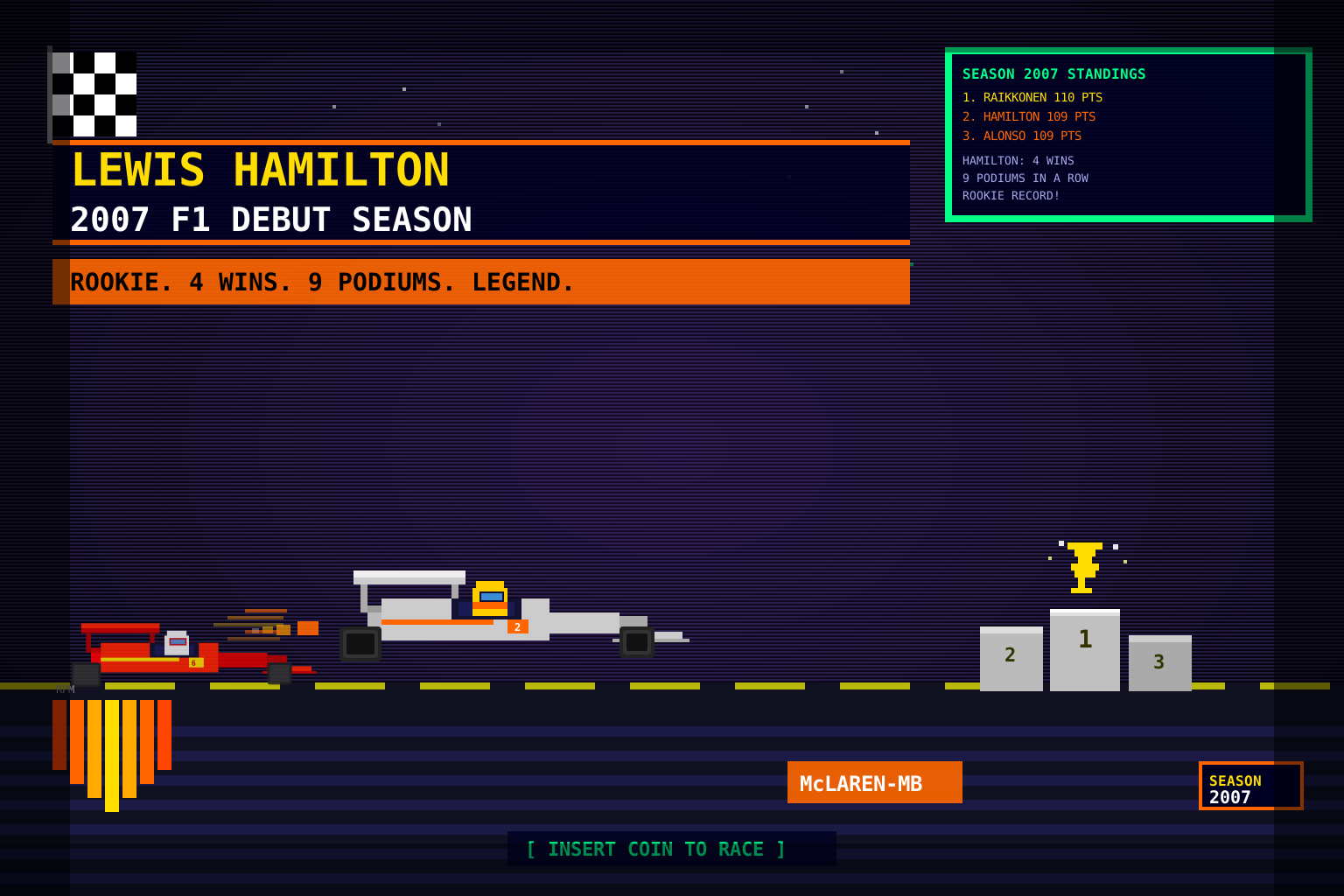
Key figures: Lewis Hamilton (McLaren-Mercedes), Fernando Alonso (McLaren-Mercedes teammate), Ron Dennis (McLaren team principal), Kimi Räikkönen (Ferrari, 2007 world champion)
Summary
Lewis Hamilton’s 2007 Formula 1 debut ranks among the most remarkable rookie seasons in motorsport history. Driving for McLaren-Mercedes at age 22, Hamilton contended for the championship across the 17-race season, winning four Grands Prix and finishing on the podium in each of his first nine races — a record for a debut driver. The season finale in Brazil on October 21, 2007 decided the title: Kimi Räikkönen’s Ferrari took the championship with 110 points, one ahead of both Hamilton and Alonso, who tied on 109 — Alonso claiming second place on the tie-break. Hamilton’s debut established him as a generational talent and launched a career that would come to define modern Formula 1.
The 2007 Season Race by Race
The 2007 calendar comprised 17 Grands Prix across five continents. Hamilton opened with extraordinary consistency, finishing on the podium in each of his first nine races. His first outing — the Australian Grand Prix in Melbourne on March 18 — ended in third behind Räikkönen and Alonso, immediately signalling his competitiveness. He followed with second places in Malaysia (April 8), Bahrain (April 15), Spain (May 13), and Monaco (May 27).
Hamilton’s maiden F1 win came at the Canadian Grand Prix in Montreal on June 10, 2007, where he led from pole and won by more than four seconds. He won again a week later at the United States Grand Prix in Indianapolis (June 17). He then took third at both the French Grand Prix (July 1) and his home British Grand Prix at Silverstone (July 8) before adding further victories at the Hungarian Grand Prix (August 5) and the Japanese Grand Prix (September 30) — four wins in all for the season.
The championship tightened over the closing rounds. Hamilton finished ninth in a rain-hit European Grand Prix at the Nürburgring (July 22) after an accident in qualifying, and a spin into the gravel at the pit-lane entry forced his retirement from the Chinese Grand Prix (October 7), an error that narrowed his points lead going into the finale.
The McLaren–Ferrari Espionage Crisis
The 2007 season was overshadowed by a major scandal. In mid-2007 it emerged that McLaren had obtained roughly 780 pages of confidential Ferrari technical documentation, passed from a Ferrari engineer to a McLaren designer. On September 13, 2007, the FIA found McLaren guilty of possessing the material, fined the team a record $100 million, and excluded it from the constructors’ championship; individual driver points — including Hamilton’s and Alonso’s — were preserved.
The affair deepened the Hamilton–Alonso rift, which had already strained the team, and contributed to Alonso’s departure from McLaren after the season.
Key Facts
- Debut and age: Hamilton joined McLaren for 2007 at age 22, having progressed through McLaren’s young-driver programme.
- First win: June 10, 2007, the Canadian Grand Prix at Montreal, led from pole.
- Podium record: Hamilton finished on the podium in each of his first nine Grands Prix — a record for a debut driver — and reached the podium in 12 of the season’s 17 races (4 wins and 8 further podiums).
- Alonso rivalry: Alonso, the reigning double world champion (2005, 2006), was positioned as McLaren’s lead driver, but Hamilton’s pace produced a season-long battle for supremacy and resources that fractured the team.
- Championship result: Räikkönen 110 points (6 wins), Hamilton 109 points (4 wins), Alonso 109 points (4 wins) — one of the closest three-way finishes in F1 history, decided at the final race.
- McLaren espionage fine: On September 13, 2007 the FIA fined McLaren $100 million and stripped its constructors’ points; driver points were retained, preserving both title bids.
- Historic significance: Hamilton was the first Black driver to compete in Formula 1, adding cultural resonance to his record-setting season.
The Brazilian Grand Prix Finale (October 21, 2007)
The season finale at the Autódromo José Carlos Pace in São Paulo produced one of the most dramatic championship conclusions in F1 history. Hamilton entered the race leading the standings with 107 points, ahead of Alonso (103) and Räikkönen (100), and needed only a fifth-place finish to secure the title. Early in the race a gearbox problem left him briefly stuck and dropped him toward the back of the field; he recovered to finish seventh. Räikkönen won the race — and the championship by a single point: Räikkönen 110, Hamilton 109, Alonso 109.
Significance
Lewis Hamilton’s 2007 season was a watershed for Formula 1. His debut combined speed, consistency, and a genuine title challenge against a seasoned teammate on the world stage, and his seven subsequent Drivers’ Championships (2008, 2014, 2015, 2017, 2018, 2019, 2020) would redefine modern F1 achievement and longevity. Beyond the sport, his arrival as the first Black driver in Formula 1 carried broader significance for diversity and representation in elite motorsport.
The team dynamics between Hamilton and Alonso also proved formative: their tension foreshadowed later high-profile intra-team rivalries within championship-winning teams, notably Hamilton and Nico Rosberg at Mercedes (2014–2016).
Hamilton’s run coincided with a broader year of landmark sports stories in 2007. David Beckham’s move to LA Galaxy, Barry Bonds’ all-time home-run record, and the scandal-hit 2007 Tour de France each reflected, in different ways, how individual athletes were reshaping global sport.