Summary
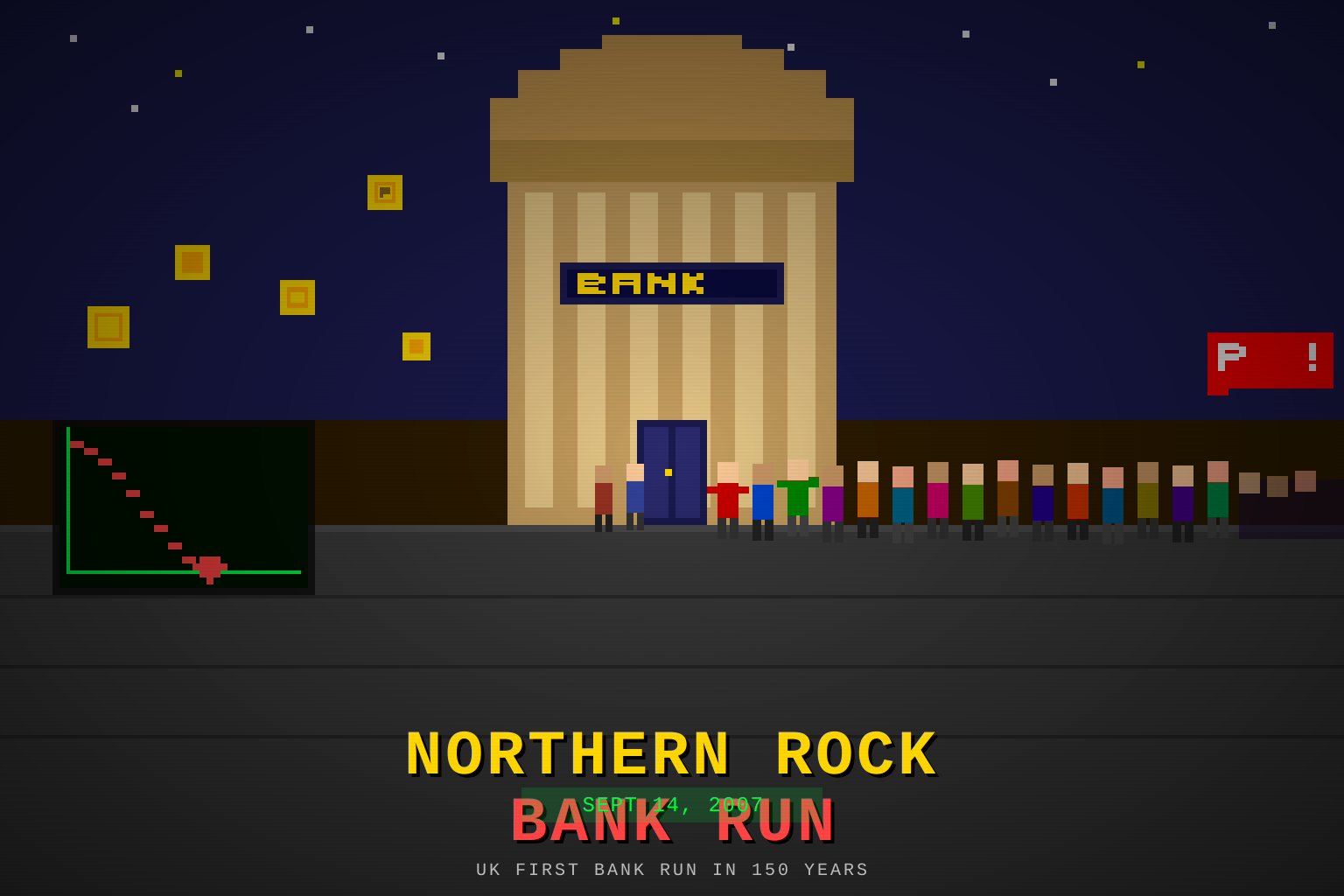
On September 14, 2007, Northern Rock—the UK’s fifth-largest mortgage lender—disclosed that it had sought emergency liquidity assistance from the Bank of England after losing access to short-term wholesale funding as global credit markets seized up. The bank had funded long-term mortgages by borrowing short-term on wholesale money markets, a business model that became fatally exposed when interbank lending froze in August 2007. Within 24 hours of the announcement, depositors panicked, fearing their savings were at risk. Long queues formed outside Northern Rock branches across England, and the bank’s website crashed under the weight of simultaneous online withdrawal attempts. By September 17, an estimated £1 billion had been withdrawn from the bank. The episode was the UK’s first retail bank run in over 150 years—the last comparable episode was Overend, Gurney and Company’s collapse in 1866—and it demonstrated that U.S. housing-market contagion was reshaping the global financial landscape far beyond American borders.
Northern Rock’s Business Model
Northern Rock, headquartered in Newcastle upon Tyne, had grown rapidly through the early 2000s by adopting an aggressive mortgage-lending strategy financed largely through the wholesale money markets rather than traditional retail deposits. By 2007 only 22% of its funding came from retail deposits; the remaining 78% was sourced from short-term wholesale borrowing—securitizing mortgages into bonds and borrowing on interbank markets, then rolling over those loans continuously. This “originate and distribute” model allowed Northern Rock to offer highly competitive mortgage rates (including its famous “Together” mortgage allowing 125% of a property’s value) and expand its market share to roughly 8% of new UK mortgages by 2007. The bank had grown assets from £15.8 billion in 2000 to £113.5 billion by the end of 2006, a seven-fold increase in six years. The strategy worked as long as global credit markets remained liquid—but it meant that any disruption to wholesale funding would immediately threaten the bank’s ability to fund existing mortgages and renew maturing loans.
The Credit Freeze and the Run
The crisis that felled Northern Rock began not in the UK but in the United States, where rising defaults on subprime mortgages throughout 2007 caused investors worldwide to question the value of mortgage-backed securities (see: Subprime Mortgage Crisis). In August 2007, BNP Paribas froze three investment funds exposed to U.S. subprime assets, triggering a global interbank freeze. LIBOR—the London Interbank Offered Rate, the benchmark for wholesale borrowing costs—spiked sharply above official central-bank rates, and lenders stopped rolling over short-term loans to institutions with perceived exposure. Northern Rock, almost entirely dependent on this market, could no longer fund itself. On September 13, 2007, Northern Rock’s CEO Adam Applegarth called the Financial Services Authority (FSA) and the Bank of England to request emergency support. The Bank of England agreed, but under UK law the assistance had to be disclosed publicly. The BBC’s Robert Peston broke the story on the evening of September 13; by the morning of September 14, queues had formed.
Chancellor of the Exchequer Alistair Darling issued a full government guarantee of all Northern Rock deposits on September 17, 2007, halting the immediate run. By that point the Bank of England had provided approximately £25 billion in emergency liquidity support—equivalent to roughly one-fifth of the UK’s annual housing transactions. The British government’s guarantee was broadly criticized as an improvised response that set a precedent for full taxpayer backstops of private banks; Darling later wrote in his memoirs that the decision was made over a weekend with inadequate legal frameworks in place. Treasury Secretary Hank Paulson and Fed Chair Ben Bernanke (see: Hank Paulson and Ben Bernanke at the Fed) observed the episode closely as they assessed the exposure of U.S. financial institutions to the same wholesale-funding vulnerabilities.
Nationalization and Aftermath
Two bids from private buyers—Virgin Group (led by Richard Branson) and a management buyout consortium—failed to secure financing after due diligence revealed the scale of Northern Rock’s liability position. On February 22, 2008, the British government nationalized Northern Rock, becoming its sole shareholder under the Banking (Special Provisions) Act 2008, which Parliament passed in a single day. The nationalization cost the UK government an estimated £37 billion in guarantees and direct capital support. Northern Rock was split in 2010 into Northern Rock plc (the “good bank,” sold to Virgin Money in 2012 for £747 million) and Northern Rock (Asset Management) plc (the “bad bank,” wound down over more than a decade). The total net cost to UK taxpayers, after eventual asset recoveries, was estimated at approximately £400 million—far less than the initial exposure but unprecedented in British banking history.
Significance
The Northern Rock bank run marked a critical moment in the developing 2007–2008 financial crisis, demonstrating that the credit seizure was not confined to U.S. institutions. The run exposed severe structural gaps in the UK’s regulatory and deposit-protection frameworks. The FSA had failed to identify that Northern Rock’s wholesale-funding dependency made it acutely vulnerable to market disruption; the deposit-insurance regime—the Financial Services Compensation Scheme (FSCS)—covered only 100% of the first £2,000 and 90% of the next £33,000, leaving many depositors with meaningful uninsured exposure. The episode directly led to the Banking Act 2009, which created a Special Resolution Regime with expanded powers for bank nationalization, restructuring, and orderly wind-down, as well as an enhanced FSCS cap (raised to £50,000, and later £85,000). The tripartite authority (Bank of England, FSA, HM Treasury) that had governed UK financial regulation was subsequently judged to have failed at communication and crisis response; it was replaced in 2013 by the Prudential Regulation Authority (under the Bank of England) and the Financial Conduct Authority.
Beyond UK reforms, the Northern Rock episode supplied critical evidence for the global reform agenda that culminated in Basel III (adopted by the Basel Committee on Banking Supervision in 2010–2011): new liquidity coverage ratios and net stable funding ratios were designed precisely to prevent any bank from being as dependent on short-term wholesale funding as Northern Rock had been. The episode unfolded in the same months as the U.S. stock market was reaching its all-time peak in October 2007 (see: Stock Market Peak, October 2007) and as oil prices were rising toward $100 per barrel (see: Oil Price Spike 2007), together signaling the precariousness of the global financial architecture underpinning that apparent prosperity.