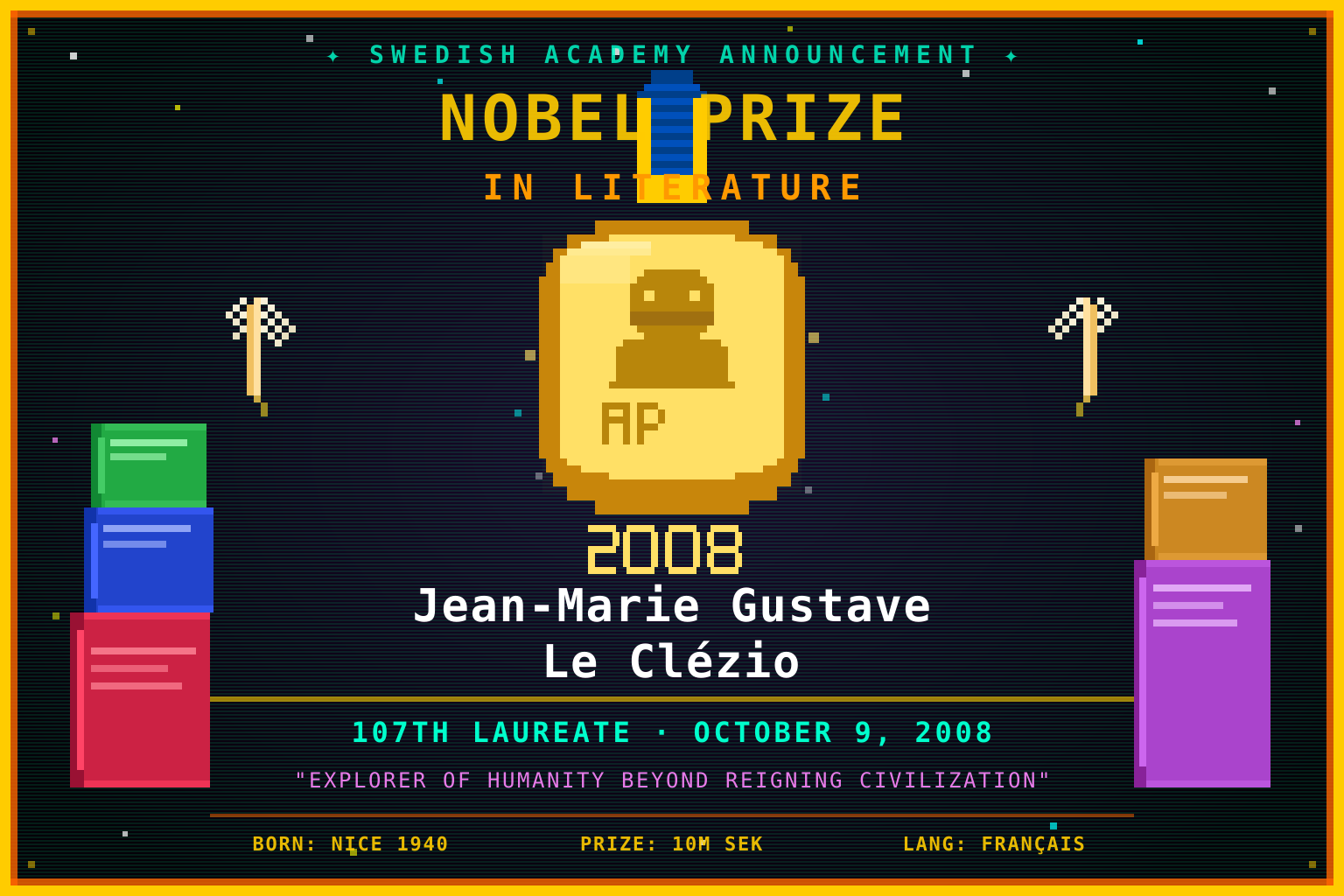
Key figures: Jean-Marie Gustave Le Clézio (author); Horace Engdahl (Permanent Secretary, Swedish Academy); Swedish Academy (Nobel Committee)
Summary
On October 9, 2008, the Swedish Academy in Stockholm announced that French-Mauritian author Jean-Marie Gustave Le Clézio had won the 2008 Nobel Prize in Literature, awarded for new departures, poetic adventure and sensual ecstasy — described by the Academy as an “explorer of a humanity beyond and below the reigning civilization.” Le Clézio, 68 at the time of the award, became the 107th recipient of the Nobel Prize in Literature since its inaugural award in 1901 and the 14th author writing primarily in the French language to receive the honor. He was the first French-language laureate since Claude Simon in 1985.
The prize carried a monetary award of 10 million Swedish kronor (approximately $1.4 million USD), consistent with the Nobel Foundation’s award level in 2008.
Le Clézio’s Life and Career
Born Jean-Marie Gustave Le Clézio on April 13, 1940, in Nice, France, to a French mother and a Breton-origin Mauritian father, Le Clézio spent formative years in Mauritius and Nigeria before settling in France for his education. He studied at the University of Nice and later at the University of Aix-en-Provence, receiving a degree in 1963. His doctoral thesis was published as a book on the history of Mexican civilization.
Le Clézio’s literary debut came in 1963 with Le Procès-verbal (The Interrogation), which won the Prix Renaudot — one of France’s most prestigious literary awards. He was 23 years old at the time. The novel’s experimental form, influenced by the French New Novel movement (Nouveau Roman), established him as a significant avant-garde voice.
His bibliography expanded to more than 40 published works over five decades:
- 1963: Le Procès-verbal (The Interrogation) — Prix Renaudot winner; debut novel
- 1967: Terra Amata — existential novel featuring a protagonist’s stream-of-consciousness reflections on existence
- 1975: Les Géants (The Giants) — dystopian narrative critiquing consumer culture and mass media
- 1978: Mondo et autres histoires (Mondo and Other Stories) — short story collection; became required reading in French secondary schools
- 1980: Désert (Desert) — breakthrough novel weaving two narrative strands: a 1910 Saharan resistance movement and a contemporary Moroccan immigrant’s life in Marseille
- 1985: Le Chercheur d’or (The Prospector) — set in Mauritius; blends adventure and memory
- 1991: Onitsha — novel drawing on his childhood in Nigeria following his Mauritian father’s work there
- 2000: Révolutions — multi-generational family saga tracing Mauritian, African, and European threads
- 2004: L’Africain (The African) — memoir-essay about his father and his own roots in Nigeria
His writing shifts between the lyrical and analytical, moving between fictional worlds populated by outsiders, nomads, and dispossessed peoples. A recurring theme is cultural dislocation — characters who occupy the margins of Western civilization, drawn from his observations in Africa, the Pacific islands, Central America (he lived in Mexico among the Embera people), and Mauritius.
The Nobel Announcement
The Swedish Academy’s Permanent Secretary Horace Engdahl described Le Clézio as a humanist who had constructed a literary universe in the service of human dignity. The announcement highlighted Le Clézio’s linguistic experimentation — his ability to combine European and non-European narrative traditions and to use language itself as a sensory medium rather than merely a conveyor of narrative.
The award was not without controversy: Horace Engdahl had earlier in 2008 sparked debate by publicly stating that American literature was “too insular” and “too ignorant of what is happening in the rest of the world” — remarks widely interpreted as signaling a preference for non-American authors. While Le Clézio is French-Mauritian, the remarks highlighted ongoing tensions about the Nobel Prize’s geographical and cultural distribution.
Le Clézio delivered his Nobel Lecture on December 7, 2008, in Stockholm, titled “In the Forest of Paradoxes.” He used the lecture to reflect on the paradox of literature in a world of increasing inequality — arguing that writing is simultaneously a privileged act and an act of resistance, and that the best literature speaks for those whom society marginalizes.
Literary Style and Influences
Le Clézio’s prose is distinguished by several recurring features:
- Polyphonic narrative: simultaneous threads from different historical periods and geographies
- Sensory density: extended attention to light, sound, smell, and physical sensation
- Disrupted chronology: non-linear time structures that mirror memory and displacement
- Multilingual allusions: French prose inflected with Arabic, Spanish, and African linguistic patterns
He was influenced by Samuel Beckett (studied in Aix-en-Provence), the French New Novelists Alain Robbe-Grillet and Michel Butor, and the Mexican Codex traditions he discovered during fieldwork in Mexico in the 1970s. His interest in non-Western oral traditions led him to collaborate with his wife Jemia, herself Mauritanian, on translations of Berber oral literature.
Critical Reception and Legacy
In France, Le Clézio had long been considered one of the major literary figures of the postwar generation. He was named “the greatest living francophone writer” by Le Magazine Littéraire in 1994. His work is included in French secondary school curricula, particularly Mondo et autres histoires.
In the English-speaking world, his books had limited circulation before the Nobel Prize. The announcement prompted Penguin Books and other major English-language publishers to commission new translations of works not previously available in English, significantly expanding his international readership.
Significance
Le Clézio’s 2008 Nobel Prize represented several intersecting themes in the history of the prize:
-
Postcolonial recognition: The award validated a body of work deeply concerned with the experiences of peoples displaced by European colonialism — both historically (in Désert, Onitsha) and in the contemporary present (immigration narratives).
-
Linguistic diversity: Le Clézio’s Nobel was part of a broader pattern in which the Swedish Academy consistently recognized writers working outside the dominant English-language publishing market — a deliberate curatorial choice about literature’s global reach.
-
Genre experimentation: The citation’s language (“new departures”) acknowledged a career built on refusing conventional novel structures, contributing to a broader international validation of experimental literary fiction.
-
French literature’s continuity: The recognition placed Le Clézio in the lineage of French Nobel laureates including Albert Camus (1957), Jean-Paul Sartre (1964, declined), Samuel Beckett (1969), and Claude Simon (1985).
The prize elevated Le Clézio’s profile globally and encouraged translation projects in dozens of languages. His Nobel lecture’s themes — marginalization, the power of storytelling, and literature’s political responsibility — resonated with concurrent cultural conversations about migration and postcolonial identities unfolding across Europe in 2008, the same autumn that Danny Boyle’s Slumdog Millionaire brought an outsider’s view of postcolonial India to a global film audience.